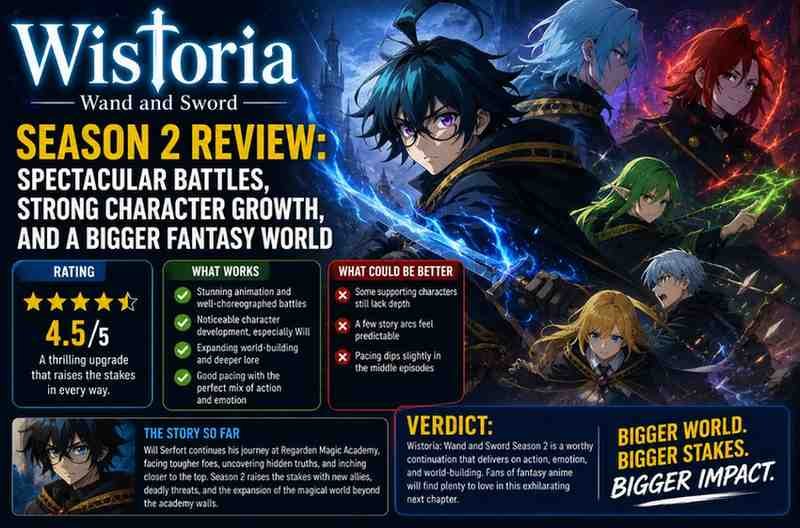
Wistoria: Wand and Sword Season 2 Review
Fantasy Anime has never been short on stories about unlikely heroes overcoming impossible odds. From magic academies and ancient prophecies to elite organizations protecting humanity, many modern series revisit familiar formulas. Wistoria: Wand and Sword Season 2 embraces those conventions rather than avoiding them—but succeeds because of its confident execution, memorable action sequences, and steadily expanding world.
Premiering during the Spring 2026 anime season, the second installment continues Will Serfort’s remarkable journey inside a kingdom where magical ability determines social status. Unable to cast spells, Will relies entirely on extraordinary swordsmanship in a society built around magic. While the premise remains recognizable to longtime anime fans, Season 2 broadens the narrative beyond simple underdog victories by exploring institutional power, political rivalries, and the cost of maintaining rigid hierarchies.
Although originality is not the series’ strongest attribute, its commitment to emotional storytelling, high-energy combat, and character relationships makes it one of the most entertaining fantasy anime currently streaming.
What Is Wistoria: Wand and Sword About?
Set inside a magical kingdom where power is measured by one’s ability to wield spells, Wistoria: Wand and Sword follows Will Serfort, a student at Rigarden Magical Academy who possesses virtually no magical talent.
Instead of accepting failure, Will trains relentlessly with a sword, becoming an exceptional close-range fighter in a world where almost everyone depends on magic. His dream is not merely personal achievement but reaching the legendary Tower and standing beside Elfaria, one of the kingdom’s greatest mages.
This unique contrast between magic and physical combat continues to define the series. Rather than presenting Will as another overpowered protagonist gifted with hidden abilities from the beginning, the story emphasizes perseverance, discipline, and determination.
Season 2 Picks Up Without Wasting Time
The new season begins immediately after the dramatic conclusion of the previous arc. Following the disastrous dungeon expedition, Will graduates from Rigarden Academy but still lacks one final requirement before earning access to the prestigious Tower.
Meanwhile, the annual Terminalia festival provides an unexpected opportunity for enemies to strike. During the celebration, the elite Magia Vander expend enormous magical energy maintaining the protective barrier surrounding the kingdom. Their temporary vulnerability becomes the perfect opening for Goetia, a dangerous terrorist organization, to unleash monsters capable of neutralizing conventional magic.
This shift dramatically changes the battlefield.
Instead of relying solely on magical superiority, characters must adapt to enemies specifically designed to eliminate their greatest strength. As a result, Will’s swordsmanship suddenly becomes more valuable than ever, allowing the series to naturally justify his growing importance.
Storytelling That Prioritizes Momentum Over Surprise
One reason Wistoria remains engaging is its pacing.
The series rarely spends excessive time on unnecessary detours. Every major confrontation pushes Will closer to his long-term objective while gradually revealing more about the political structure governing the magical world.
Although experienced anime viewers may predict many story developments, the narrative compensates through consistent forward momentum. Rather than relying on shocking twists, the show focuses on building anticipation for larger conflicts waiting beyond each milestone.
This approach creates an enjoyable viewing experience where emotional investment matters more than narrative unpredictability.
The Tower Becomes the Season’s Biggest Game Changer
Perhaps the most meaningful development arrives when Will finally enters the Tower.
Instead of representing the end of his struggles, admission reveals an entirely new social hierarchy. Elite institutions promise opportunity, yet they often introduce even greater competition, political maneuvering, and pressure.
The Tower symbolizes much more than achievement.
It becomes a commentary on how success frequently replaces one challenge with another. Gaining acceptance into an exclusive organization rarely eliminates inequality—it simply changes its form.
This thematic shift gives Season 2 greater narrative depth compared to its predecessor.
Character Development Finally Takes Center Stage
Season 2 succeeds because it invests more heavily in supporting characters rather than focusing exclusively on Will.
Will Serfort
Will remains an inspiring protagonist because his greatest strength is persistence rather than overwhelming magical ability. Every victory still demands physical sacrifice, strategic thinking, and relentless training.
Unlike many modern shonen heroes who rapidly unlock increasingly powerful abilities, Will continues earning progress through discipline, making his accomplishments feel genuinely satisfying.
Julius Becomes One of the Season’s Biggest Surprises
Initially introduced as an arrogant rival, Julius experiences one of the strongest character arcs this season.
Instead of remaining trapped inside predictable rivalry clichés, he gradually evolves into a supportive training partner who recognizes Will’s determination.
Their relationship demonstrates that healthy competition can strengthen both individuals rather than existing solely to generate conflict.
Elfaria Receives Greater Emotional Weight
Elfaria’s role expands beyond being Will’s distant motivation.
Her growing involvement within the political landscape highlights the limitations even powerful leaders face inside rigid institutional systems.
Despite possessing tremendous magical influence, she cannot easily dismantle centuries of tradition—a realistic obstacle that adds complexity to her character.
Action Animation Continues to Impress
One of the series’ greatest strengths remains its action choreography.
Season 2 delivers several visually stunning battles featuring:
- Fluid sword combat
- Large-scale magical explosions
- Dynamic camera movement
- Creative spell combinations
- Excellent impact animation
The Albis Wis awakening serves as one of the season’s visual highlights, combining fast-paced movement with dramatic lighting and cinematic effects.
Likewise, Elfaria’s confrontation against Zeo showcases spectacular magical combat that demonstrates how powerful Prime Magic can become when fully unleashed.
These sequences represent some of the strongest animation in recent fantasy anime.
Production Quality Isn’t Perfect—but It Knows Where to Spend Its Budget
Like many seasonal anime productions, Wistoria occasionally displays noticeable differences in animation quality.
Major battles receive exceptional attention, while quieter dialogue scenes sometimes rely on simpler compositions and reduced character movement.
Rather than viewing this solely as a weakness, it reflects a common production strategy across the anime industry.
Studios frequently allocate resources toward climactic episodes where impressive visuals create lasting audience impact.
The result is a production that consistently delivers when viewers expect spectacle most.
| Category | Season 2 Performance |
|---|---|
| Story Progression | Strong improvement with larger world-building |
| Character Development | Better supporting cast growth |
| Animation Quality | Excellent during action scenes with occasional inconsistency |
| World Building | Expanded political and institutional depth |
| Action Sequences | Outstanding choreography and visual effects |
| Emotional Impact | Consistently engaging character relationships |
The Series Still Relies on Familiar Shonen Formulas
Even with its improvements, Wistoria cannot completely escape traditional fantasy storytelling.
Many recurring patterns remain:
- The underestimated protagonist repeatedly proving everyone wrong.
- Elite institutions constantly raising new obstacles.
- Powerful rivals gradually becoming allies.
- Friendship serving as emotional motivation.
- Progress requiring increasingly dangerous battles.
These elements are hardly revolutionary.
However, the series succeeds because it executes them sincerely rather than attempting to parody or subvert them.
How Wistoria Compares with Other Fantasy Anime
Rather than competing through originality alone, Wistoria distinguishes itself through execution.
| Anime | Main Strength | How Wistoria Differs |
|---|---|---|
| Frieren | Emotional storytelling and reflection | More action-oriented with faster pacing |
| Jujutsu Kaisen | Modern supernatural battles | Classic fantasy setting with sword combat |
| Black Clover | Magic academy underdog story | Greater emphasis on swordsmanship over magic |
| Mashle | Comedy and parody | More serious emotional narrative |
This comparison illustrates that Wistoria occupies its own comfortable niche by combining familiar fantasy structures with polished action and earnest storytelling.
Why the Series Continues to Attract Fans
The biggest reason behind the anime’s popularity is surprisingly simple.
It understands exactly what audience it wants to entertain.
Rather than chasing every industry trend, Wistoria focuses on delivering satisfying action, emotionally rewarding victories, memorable friendships, and continual character progression.
For viewers who enjoy traditional fantasy adventures, that consistency becomes a strength rather than a weakness.
What Season 2 Suggests About the Future
The conclusion positions the story for significantly darker developments.
Will’s arrival inside the Tower introduces more dangerous political conflicts, rival factions, and increasingly complex power struggles that extend beyond academy life.
The narrative now has opportunities to explore:
- The internal politics of the Magia Vander.
- The true ambitions of Goetia.
- The origins of anti-magic enemies.
- The future relationship between magic and swordsmanship.
- Will’s evolving role within the kingdom.
These developments provide a stronger foundation than another season centered solely around classroom competitions.
Our Verdict: Familiar Yet Surprisingly Addictive Fantasy Entertainment
Wistoria: Wand and Sword Season 2 may not redefine fantasy anime, but it demonstrates that excellent execution often matters more than groundbreaking ideas.
Its engaging protagonist, expanding world-building, thrilling battles, and emotionally satisfying character relationships elevate what could have been another conventional magic academy story.
Although repetitive storytelling patterns occasionally limit its originality, the series consistently delivers exciting action and meaningful character moments that keep audiences invested.
More importantly, Season 2 successfully transitions the story from a simple underdog narrative into a broader fantasy epic involving institutional politics, ideological conflict, and increasingly dangerous threats.
With a third season already anticipated by fans, Will Serfort’s journey appears ready to enter its most ambitious chapter yet. If future installments continue building upon the stronger themes introduced here while refining the storytelling formula, Wistoria: Wand and Sword could evolve from an entertaining fantasy series into one of the genre’s most compelling long-running adventures.
For breaking news and live news updates, like us on Facebook or follow us on Twitter and Instagram. Read more on Latest Entertainment on thefoxdaily.com.


COMMENTS 0