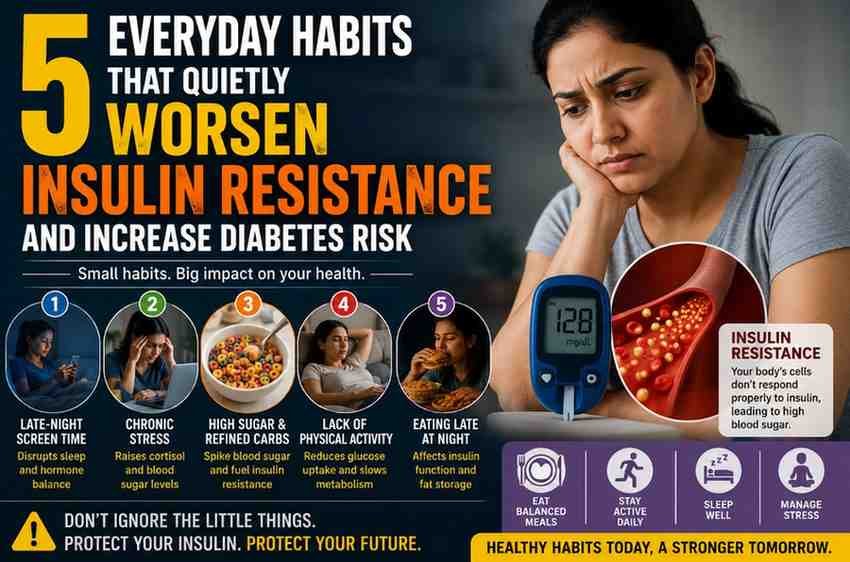
Somewhere between your morning coffee and yourlate-night phone scroll, your body is running a metabolic experiment on you and most people never get the results. Insulinresistance doesn’t announce itself with a dramatic symptom. Itbuilds quietly, often for five to ten years, before a routine blood testfinally spells it out: elevated fasting glucose, a rising HbA1c, or a diagnosisof prediabetes that seems to appear overnight but actually took a decade towrite itself.
Who does this affect? Almost everyone with amodern, convenience-driven lifestyle not just people who are overweight. Whatis actually happening? Your cells are gradually losing their ability to respondto insulin, the hormone responsible for shuttling glucose out of yourbloodstream and into your muscles, liver, and fat tissue for storage or use.When and where does this start? Long before any diagnosis often in your 20sand 30s, driven by habits so ordinary they barely register as choices. Why doesit matter? Because unmanaged Insulin resistance is the metabolic engine behindabdominal obesity, type 2 diabetes, fatty liver disease, and a meaningfullyhigher risk of heart disease. How do you stop it? By recognizing which everydayhabits are quietly working against you and that’s exactly what this articlebreaks down.
What Insulin Resistance Actually Is (And Why It’sSneaky)
Insulin resistance happens when cells in yourmuscles, liver, and fat tissue stop responding efficiently to insulin’s signal.Your pancreas compensates by producing more and more insulin to force glucoseinto cells and keep blood sugar in a normal range. For years, this compensationworks which is precisely the problem. Your lab results can look completelynormal while your pancreas is quietly working overtime, a state researcherscall compensated hyperinsulinemia.
Eventually, the pancreas can’t keep pace. That’swhen fasting glucose creeps up, triglycerides rise, and doctors start using theword “prediabetes.” According to global health research, insulinresistance combined with elevated insulin levels now affects a substantialshare of the general population worldwide, a trend researchers attributelargely to changes in diet and daily lifestyle patterns accumulated overgenerations not a sudden event, but a slow drift.
That slow drift is what makes it dangerous. It’snot one bad meal or one skipped workout. It’s the accumulation of small,repeated behaviors the five below are among the mostunderestimated.
1. Sitting for Hours Without Moving
Prolonged sitting is arguably the single mostunderrated driver of insulin resistance in modern life, and it has nothing todo with weight gain directly. Muscle is the largest glucose-disposal site inyour body when you sit for extended stretches, your muscles simply stopasking for fuel. Glucose transporters that normally activate during movementstay dormant, and blood sugar lingers in circulation longer than itshould.
Research on adolescents and adults alike has foundthat sedentary behavior can independently reduce insulin sensitivity, separatefrom its effect on body weight. In other words, you don’t have to gain a singlepound for a desk-bound lifestyle to already be nudging your metabolism in thewrong direction.
The overlooked angle: mostadvice focuses on “exercise more,” but the research increasinglypoints to sitting duration itself independent of whether you work out later as the variable that matters. A person who sits for ten hours and then runs forthirty minutes is metabolically different from someone who simply stands,walks, or shifts position every 30–45 minutes throughout the day.Micro-movement breaks may do more for insulin sensitivity than a single dailyworkout tacked onto an otherwise motionless day.
2. Irregular Eating and Sleep Timing
Eating dinner at 6 p.m. one night and 10 p.m. thenext. Sleeping five hours on weekdays and “catching up” on weekends.These inconsistencies feel harmless, but your metabolism runs on circadianrhythm — a biological clock that governs when insulin sensitivity is naturallyat its peak (generally earlier in the day) and when it naturally declines(later at night).
Scientific reviews on insulin resistance mechanismsspecifically flag irregular eating patterns and poor sleep as contributors toboth obesity and insulin resistance, independent of diet quality alone. Eatinga large meal at 11 p.m. isn’t processed the same way as eating that identicalmeal at 1 p.m., because your insulin sensitivity has already declined for theday.
Unique insight competitorsmiss: most articles treat “poor sleep” and”late-night eating” as two separate bullet points. They’re actuallythe same mechanism wearing two different masks — circadian misalignment. Fixingyour meal timing without fixing your sleep timing (or vice versa) delivers onlyhalf the benefit, which is why so many people who “eat healthy” stillsee stubborn blood sugar numbers.
3. Relying on Refined Carbohydrates as a DailyDefault
This one is intuitive to most people, but thenuance is usually missing. It’s not carbohydrates themselves that drive insulinresistance it’s the repeated glucose spikes from refined, low-fibercarbohydrates (white bread, sugary cereals, pastries, sweetened drinks)consumed without protein, fat, or fiber to slow absorption. Each spike demandsa large, fast insulin response. Do that several times a day, every day, foryears, and you’re training your cells to tune out the signal — much likeignoring a smoke alarm that goes off constantly eventually makes you stopreacting to it.
Large cohort studies on lifestyle habits andinsulin resistance consistently find that low adherence to whole-food dietarypatterns, such as the Mediterranean diet, is one of the strongest associationswith higher insulin resistance risk scores even in people of normalweight.
4. Chronic, Low-Grade Stress You’ve Learned toIgnore
Not the dramatic, obvious stress the backgroundhum of notifications, deadlines, and constant low-level tension that manypeople have simply normalized. Cortisol, your primary stress hormone, directlyopposes insulin’s job. It signals your liver to release stored glucose into thebloodstream, precisely when insulin is trying to clear glucose out. Chronicstress keeps this tug-of-war running on a loop, and over time, it pushes cellstoward reduced insulin sensitivity as a byproduct of constantly elevated bloodsugar and inflammation.
The real-world impact peopleunderestimate: stress-driven insulin resistance often getsmisdiagnosed as a “diet problem.” Someone eats reasonably well,exercises occasionally, yet their fasting glucose keeps rising because themissing variable is a nervous system stuck in a low-grade fight-or-flightstate, not their fork.
5. Excess Alcohol Even the “Just a Coupleof Drinks” Kind
Alcohol is frequently left off insulin resistancelists entirely, which is a significant blind spot. Large-scale research onhundreds of thousands of working adults found that alcohol consumption shows adose-dependent relationship with insulin resistance risk — meaning the more youdrink, the higher the measurable risk, with excessive intake significantlyworsening outcomes. The liver, which is central to glucose regulation, has toprioritize metabolizing alcohol over regulating blood sugar, disrupting itsnormal insulin-signaling function in the process.
This matters because “moderate drinking”is often framed as neutral or even heart-protective in older nutritionnarratives. Newer, larger datasets complicate that picture considerably,particularly for anyone already carrying other insulin resistance risk factorslike a sedentary job or a family history of type 2 diabetes.
How These Five Habits Interact: A QuickComparison
| Habit | PrimaryMechanism | Fastest Way to Counter It |
|---|---|---|
| Prolongedsitting | Reduced muscle glucoseuptake | Stand or walk 2–3 minutes every 30–45minutes |
| Irregular sleep/mealtiming | Circadian rhythmdisruption | Fixed sleep and meal windows, even onweekends |
| Refinedcarbohydrates | Repeated glucose/insulinspikes | Pair carbs with protein, fat, orfiber |
| Chronic low-gradestress | Elevated cortisol opposinginsulin | Short daily breathing or movementbreaks |
| Regular alcoholintake | Liver prioritizes alcohol over glucosecontrol | Alcohol-free days built into theweek |
Why This Matters More Than Most PeopleRealize
Insulin resistance isn’t just a precursor todiabetes — it’s a shared root cause behind a cluster of conditions that oftenget treated as unrelated: stubborn abdominal fat that won’t respond to dieting,non-alcoholic fatty liver disease, polycystic ovary syndrome symptoms, andelevated cardiovascular risk markers. Emerging cardiovascular research has evenlinked insulin resistance and its associated elevated insulin levels to thedevelopment and progression of a specific type of heart failure, independent oftraditional risk factors like cholesterol.
This is the piece most consumer health articlesmiss: insulin resistance isn’t a side issue to manage after your”real” health problem. In a growing number of cases, it is the realproblem, wearing different masks depending on which organ system shows symptomsfirst.
A Prediction Worth Paying Attention To
As continuous glucose monitors (CGMs) becomemainstream consumer devices rather than medical-only tools, expect a shift inhow insulin resistance gets caught. Right now, most people only discover itthrough a fasting blood test often years after cellular resistance began.Real-time glucose data from wearables is likely to expose these five habits farmore personally and immediately than any article can: people will start seeing,in real time, exactly how an afternoon spent sitting or a late dinner spikes theirglucose curve. That visibility will likely do more to change behavior in thenext five years than decades of general dietary advice have managed so far.
Conclusion: Small Habits, CompoundingConsequences
None of these five habits sitting too long,irregular sleep and meal timing, relying on refined carbs, unmanaged stress, orregular alcohol — are dramatic on their own. That’s exactly the point. Insulinresistance isn’t caused by one bad decision; it’s assembled, piece by piece,from ordinary choices repeated thousands of times over years. The encouragingflip side is that insulin sensitivity is also highly responsive to change.Improvements in movement, sleep consistency, food quality, stress regulation,and alcohol intake can measurably shift insulin sensitivity markers withinweeks, long before weight changes are even visible on a scale.
The goal isn’t perfection it’s awareness. Onceyou can see which of these five habits apply to your day, you already have morecontrol over your metabolic future than most people ever realize theyhad.
This article is for general educationalpurposes and is not a substitute for personalized medical advice. Anyoneconcerned about insulin resistance, prediabetes, or related symptoms shouldconsult a qualified healthcare provider for testing andguidance.
For breaking news and live news updates, like us on Facebook or follow us on Twitter and Instagram. Read more on Latest Health on thefoxdaily.com.


COMMENTS 0