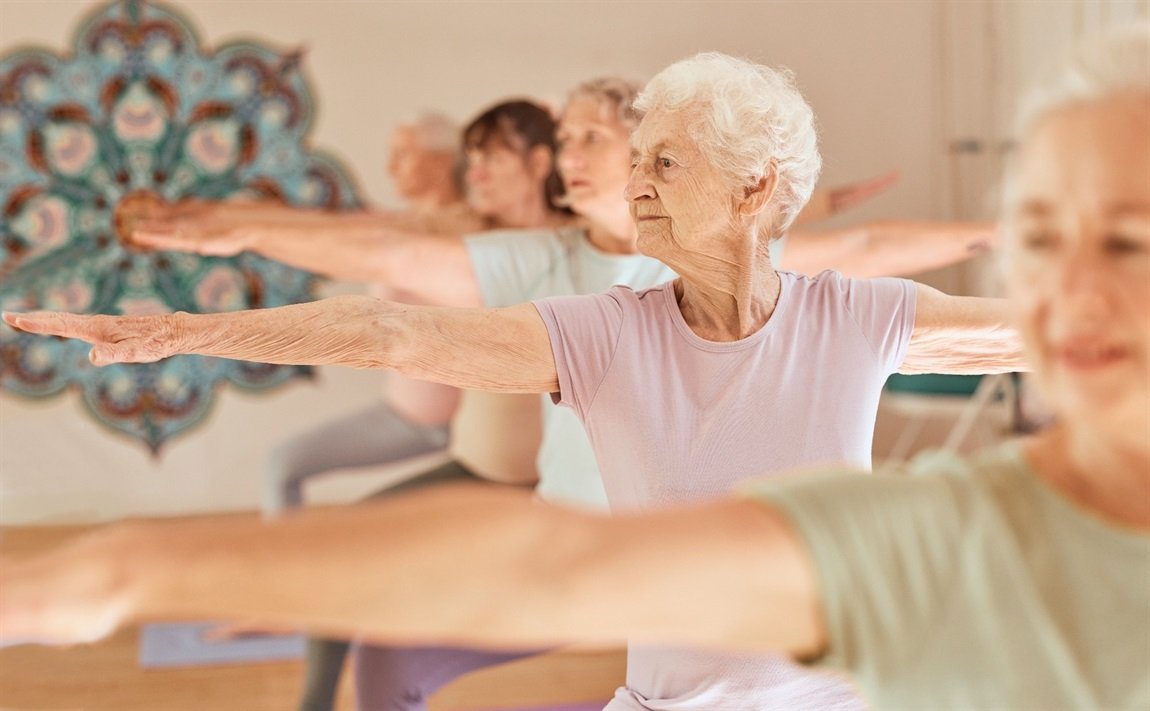
A pilot randomized controlled trial has found that both traditional Hatha yoga and a faster, cue-based form of yoga may improve cognitive and physical performance in older adults, while the newer approach showed additional benefits in selected areas. The study, published in Scientific Reports, compared traditional Hatha yoga with a novel intervention called YogaCue among adults aged 60 to 90.
The researchers were interested in more than flexibility or balance. They wanted to understand whether combining physical movement with memory, attention, visual processing and rapid responses could provide a stronger challenge for the ageing brain and body.
The results suggest that yoga may have potential as a broader healthy-ageing activity, particularly when physical movement is combined with tasks that require participants to remember sequences, respond to changing signals and coordinate different types of information.
Why Cognitive Fitness Matters as People Age
Ageing is naturally accompanied by changes in memory, attention, processing speed and other aspects of cognitive function. While these changes vary considerably from one person to another, maintaining cognitive and physical abilities can help older adults remain independent and continue performing everyday activities.
Physical activity is already considered an important part of Healthy Ageing. Regular movement can support cardiovascular fitness, muscle function, balance and mobility. Activities that also require concentration and coordination may provide an additional mental challenge.
This is where YogaCue becomes particularly interesting.
Instead of asking participants simply to hold a pose, the programme required them to remember movement sequences and react to different cues. In effect, participants had to think while moving.
What Is YogaCue?
YogaCue is a high-speed, cued yoga programme designed to combine physical movement with cognitive stimulation. Participants were exposed to multiple types of cues during the sessions, including visual, verbal and auditory signals.
The programme evolved as the researchers developed the intervention. Initially, action observation was combined with verbal instructions and numbered flow sequences. The numerical identifiers were later replaced with colour-based cues.
Visual signals were then introduced through coloured paddles, while verbal instructions remained part of the programme. An auditory cue, delivered through a gong, instructed participants to switch between paired movement sequences.
The order of the sequences was randomized, meaning participants could not simply rely on performing the same routine in the same predictable order.
This element is important because it introduced a cognitive component into the physical activity.
How Traditional Hatha Yoga Was Different
The Hatha yoga group followed a more conventional approach. Participants performed gentle seated and standing yoga poses slowly and consistently throughout the study.
As sessions progressed, the researchers increased the complexity of the poses and introduced greater variability.
The difference between the two programmes was therefore not simply about one group doing yoga faster than the other.
YogaCue was deliberately designed to make participants process information while moving. Hatha yoga, meanwhile, provided a slower and more consistent movement experience while gradually increasing pose complexity.
| Feature | YogaCue | Hatha Yoga |
|---|---|---|
| Movement style | Faster, progressively quicker sequences | Gentle, slower movements |
| Cognitive challenge | High, with randomized sequences and multiple cues | Lower emphasis on rapid cue processing |
| Visual cues | Coloured paddles and colour-based signals | Not a central part of the intervention |
| Verbal cues | Used throughout the programme | Traditional instruction |
| Auditory cues | Gong used to signal sequence changes | No comparable switching system |
| Progression | Shorter pose duration and shorter intervals between movements | More complex and varied poses |
What Did the Researchers Find?
The pilot trial reported improvements in cognitive and physical performance in both groups. This is significant because it suggests that older adults may benefit from structured yoga regardless of whether the programme emphasizes traditional practice or faster, cognitively demanding sequences.
However, the YogaCue group demonstrated additional gains in some measures.
These included aspects of memory, aerobic fitness and physical performance. The findings suggest that adding cognitive demands to movement may create a different training stimulus from conventional yoga alone.
It is important, however, to describe these findings accurately. This was a pilot randomized controlled trial, not definitive proof that high-speed yoga is superior to traditional yoga for all older adults.
The results are better viewed as early evidence that deserves further investigation in larger and longer studies.
Why Combining Brain and Body Training Could Matter
One of the most interesting aspects of the research is the idea of dual-task training.
In everyday life, people rarely use their physical and cognitive abilities separately. Walking while talking, crossing a road while watching traffic, carrying groceries while remembering a shopping list, or changing direction after hearing an instruction all require the brain and body to work together.
Older adults may face greater challenges when physical movement and cognitive processing have to happen simultaneously.
YogaCue appears to target this interaction directly.
A participant might have to remember a sequence, watch a colour cue, listen for an auditory signal and execute a physical movement within a relatively short period. This creates a more complex task than simply holding a yoga position.
The concept could therefore have implications beyond yoga.
Could Faster Yoga Be Better for the Ageing Brain?
The study does not prove that speed itself is the key ingredient.
A more plausible interpretation is that speed, unpredictability and cognitive engagement worked together to increase the overall challenge.
When movements happen faster and the order changes, participants have less opportunity to rely on automatic repetition. They must pay attention, retrieve information and respond to external signals.
That creates a form of mental practice while the body is moving.
This could help explain why YogaCue produced additional improvements in selected cognitive and physical measures compared with traditional Hatha yoga.
Still, more research is necessary to determine which component matters most. Future studies could compare slow yoga with cognitive cues, fast yoga without cues, and full YogaCue training to identify the individual effects.
The Study’s Most Important Insight May Not Be About Yoga
The broader lesson is that exercise for older adults does not necessarily need to separate physical fitness from cognitive fitness.
Traditional exercise programmes often measure success using strength, endurance, flexibility or balance. Brain-training programmes, meanwhile, typically focus on memory, attention or problem-solving.
But real-world independence depends on all of these abilities working together.
A person does not need excellent memory in one room and excellent balance in another. They need both while navigating everyday life.
That makes combined cognitive-physical training an especially interesting area for healthy-ageing research.
YogaCue and Healthy Ageing: What Could Be the Real-World Impact?
If future research confirms the findings, cue-based movement programmes could potentially become another option for older adults looking to maintain both physical and cognitive abilities.
The format could also be adapted for community centres, senior activity programmes and supervised exercise settings.
However, accessibility will be crucial.
A faster programme may not be appropriate for every older adult. People with mobility limitations, balance problems or other health concerns may require modifications and professional guidance before attempting rapid movements.
The goal should not be to make older people move as quickly as possible.
The goal should be to create an appropriate level of challenge while maintaining safety.
Why the Pilot Study Needs to Be Interpreted Carefully
There are several reasons not to overstate the findings.
- It was a pilot study: Early trials are useful for identifying promising effects but require confirmation.
- The study population was older adults: Results should not automatically be generalized to every age group.
- Different yoga styles involve different demands: It is difficult to determine whether the benefits came from speed, cueing, cognitive complexity or the combination.
- Long-term effects remain uncertain: Improvements measured during an intervention do not automatically establish lasting benefits.
- Yoga is not a replacement for medical care: Older adults with health or mobility concerns should choose exercise appropriate to their individual circumstances.
These limitations do not make the findings unimportant. Instead, they show why larger controlled trials are needed.
What Future Research Should Examine
The next generation of studies could answer several questions that remain open.
- Would YogaCue produce similar results in a much larger group?
- Do the cognitive benefits remain after the programme ends?
- Which type of cue contributes most to the results?
- Is faster movement necessary, or would slower cue-based yoga provide similar benefits?
- Could the programme improve everyday activities such as walking, turning or navigating obstacles?
- Would similar training benefit older adults with mild cognitive difficulties?
- What level of speed and complexity is safest for people with different physical abilities?
These questions could help researchers move from an interesting pilot intervention toward a practical exercise programme that can be evaluated on a much larger scale.
Should Older Adults Try Faster, Cue-Based Yoga?
The study provides an interesting reason to think differently about yoga, but it does not mean every older adult should immediately switch from traditional Hatha yoga to a faster routine.
For some people, gentle Hatha yoga may be an excellent way to maintain mobility, flexibility and body awareness. Others may enjoy more dynamic programmes that challenge coordination and attention.
The best approach depends on individual ability, experience, balance, mobility and health status.
What the research does suggest is that mental engagement can be deliberately built into physical activity. That idea can be useful whether the activity is yoga, walking, dancing, tai chi or another form of movement.
Conclusion: The Future of Exercise May Train the Brain and Body Together
The YogaCue study offers an intriguing new perspective on exercise and ageing. Both YogaCue and traditional Hatha yoga were associated with improvements in cognitive and physical performance, while the faster, cue-based approach showed additional gains in selected areas such as memory, aerobic fitness and physical performance.
The findings should not be treated as proof that high-speed yoga is universally better. Instead, they point toward a promising principle: exercise may become more valuable when physical movement and cognitive processing are trained together.
For an ageing population, that could be particularly important. Independence depends not only on having strong muscles or good memory, but on being able to think, react, balance and move at the same time.
The most interesting prediction from this research is therefore not that traditional yoga will disappear. It is that future healthy-ageing programmes may increasingly combine movement with memory, attention, reaction and decision-making.
In other words, the next generation of exercise may ask a little more than “Can you do the movement?” It may also ask, “Can you think while you do it?”
For breaking news and live news updates, like us on Facebook or follow us on Twitter and Instagram. Read more on Latest Health on thefoxdaily.com.






COMMENTS 0