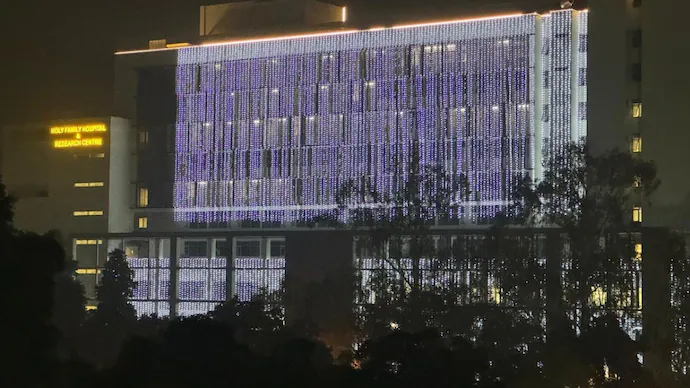
Holy Family Hospital in Delhi has expanded its healthcare infrastructure with the addition of 150 beds and a new super speciality block designed to accommodate patients requiring advanced medical and surgical treatment. The expansion, inaugurated by Vice President C P Radhakrishnan on November 27, 2026, marks an important development for the charitable healthcare institution and its efforts to strengthen specialised treatment services in the national capital.
Located in Okhla, the hospital has introduced several specialised departments under the new facility, covering oncology, organ transplantation, neurological treatment and complex surgical procedures. The expansion is expected to increase the institution’s ability to manage patients with serious medical conditions who require coordinated care from multiple medical specialities.
Beyond the additional infrastructure, the inauguration also highlighted a broader challenge facing India’s healthcare system: making advanced treatment more accessible and affordable. Addressing the gathering, the Vice President emphasised the importance of cooperation between cancer institutions and suggested creating a common platform where healthcare providers could exchange expertise and discuss challenges in improving cancer care.
The development also carries historical significance for the hospital. Its original foundation stone was laid in 1953 by Dr Sarvepalli Radhakrishnan, who was then Vice President of India. More than seven decades later, another Vice President bearing the same surname inaugurated a major expansion of the institution.
Holy Family Hospital’s New Super Speciality Block: What Has Changed?
The most significant development at Holy Family Hospital is the addition of 150 beds through its newly inaugurated super speciality block. The additional capacity will take the hospital beyond its existing 345 beds, strengthening its ability to accommodate patients requiring specialised and critical medical attention.
Hospital expansions are not measured only by the number of beds added. The range of medical services available within a facility also determines how effectively it can manage complicated cases. Patients with cancer, neurological disorders or conditions requiring organ transplantation may need consultations, diagnostic investigations, surgery and prolonged medical supervision.
By bringing several advanced specialities into the new block, Holy Family Hospital is expanding the range of treatments it can provide within its institutional infrastructure.
The new facility will include:
- Medical oncology: Specialised medical treatment for different types of cancer.
- Surgical oncology: Surgical procedures focused on diagnosing and treating cancer.
- Radiation oncology: Cancer Treatment using radiation-based techniques.
- Haematology-oncology: Care for cancers and disorders affecting blood and blood-forming tissues.
- Bone marrow transplantation: Specialised transplantation services for eligible patients with certain blood-related diseases and cancers.
- Nuclear medicine: Medical applications of radioactive substances for diagnostic and therapeutic purposes.
- Cardiothoracic and vascular surgery: Surgical treatment involving the heart, chest and blood vessels.
- Neurosurgery: Surgical treatment of conditions affecting the brain, spinal cord and nervous system.
- Organ transplantation: Specialised medical and surgical services for patients requiring organ replacement.
The combination of these departments gives the expansion significance beyond general hospital capacity. It creates additional infrastructure for conditions that often require specialised equipment, experienced medical teams and coordinated treatment planning.
Why the Expansion of Cancer Care Matters for Delhi Patients
Cancer treatment is one of the most demanding areas of modern healthcare. Depending on the type and stage of the disease, patients may require surgery, chemotherapy, radiation therapy, specialised medicines or a combination of different approaches.
These treatments are not always delivered as isolated procedures. A patient may need diagnostic evaluation, consultation with an oncologist, surgical intervention, radiation treatment and continued monitoring. Access to different specialities within the same hospital can make the treatment process easier to coordinate.
Holy Family Hospital’s expanded oncology facilities are intended to strengthen this range of services. The inclusion of medical oncology, surgical oncology and radiation oncology brings together three important components of comprehensive cancer treatment.
Understanding the Different Oncology Services
Medical oncology focuses on treating cancer through medicines, including chemotherapy and other specialised drug-based approaches. Treatment decisions depend on the cancer type, disease stage, the patient’s overall condition and the intended therapeutic outcome.
Surgical oncology involves operations to remove cancerous growths or address complications associated with tumours. Surgery may form an important part of treatment for several solid cancers, although its suitability depends on individual clinical circumstances.
Radiation oncology uses carefully planned radiation treatment to target cancer cells. It may be used independently or alongside surgery and medical treatment, depending on the diagnosis.
The availability of these specialities within an expanded hospital facility can support multidisciplinary cancer care. This approach allows specialists from different fields to contribute to treatment decisions rather than approaching a complicated diagnosis through a single medical perspective.
However, the inauguration announcement does not establish the number of patients the new oncology departments will treat, the equipment available in each department or the range of cancer-specific procedures currently operational. Patients should therefore confirm service availability, eligibility requirements and treatment arrangements directly with the hospital.
Bone Marrow Transplantation and Haematology-Oncology: A Major Addition
One of the notable services included in the new super speciality block is bone marrow transplantation, alongside haematology-oncology.
Bone marrow is responsible for producing blood cells, including red blood cells, white blood cells and platelets. Certain diseases affect this blood-forming system and can require highly specialised treatment. These include some blood cancers and serious disorders involving the bone marrow.
Bone marrow transplantation, also commonly discussed as haematopoietic stem cell transplantation, involves replacing damaged or diseased blood-forming cells with healthy stem cells. Depending on the patient’s condition, the transplanted cells may come from the patient or a suitable donor.
The procedure is medically complex. It requires careful patient selection, preparation before transplantation, infection prevention, specialist monitoring and follow-up care. Patients may also require extended supervision because complications can occur during different stages of recovery.
The addition of this service indicates an expansion towards more specialised treatment rather than conventional inpatient care alone.
For patients with conditions requiring transplantation, access to a facility offering related haematology and oncology services may help bring important stages of treatment into a more coordinated clinical setting. Nevertheless, the availability of a listed department does not automatically establish that every type of transplant is offered. The specific procedures, donor requirements and treatment protocols need to be confirmed with the hospital.
Organ Transplantation and Advanced Surgical Facilities Expand Treatment Options
The new block will also house organ transplantation services, cardiothoracic and vascular surgery, and neurosurgery. These specialities address some of the most complicated medical conditions and frequently involve lengthy treatment planning and recovery.
Organ transplantation is required when a patient’s organ becomes severely damaged or stops functioning adequately. Depending on the condition, transplantation may involve organs such as the kidney, liver or heart.
Such procedures require more than an operating theatre. Patients need detailed pre-transplant assessment, donor evaluation where applicable, surgical expertise, post-operative monitoring and long-term medical supervision.
Transplant recipients also require continued follow-up because the immune system can recognise a transplanted organ as foreign. Depending on the transplant, patients may need immunosuppressive medicines to reduce the risk of organ rejection.
The addition of organ transplantation to Holy Family Hospital’s specialised services therefore represents an expansion into a particularly demanding area of clinical care. However, the hospital’s announcement does not specify which organs will be covered or provide details about transplant capacity.
Neurosurgery and Cardiothoracic Care
Neurosurgery deals with conditions involving the brain, spinal cord and nervous system. Depending on the diagnosis, treatment may involve procedures for brain tumours, certain spinal disorders, injuries or other neurological conditions requiring surgical intervention.
These procedures often require advanced diagnostic facilities, specialist anaesthesia, intensive monitoring and coordinated post-operative rehabilitation.
Cardiothoracic and vascular surgery covers another important area of specialised treatment. Cardiothoracic surgery involves surgical conditions affecting the heart and chest, while vascular surgery addresses diseases and abnormalities involving blood vessels.
Bringing these services into the expanded hospital infrastructure increases the range of complex conditions the institution aims to address. It also strengthens the hospital’s presence in specialities where treatment frequently requires collaboration between surgeons, physicians, anaesthetists and critical-care teams.
Vice President Calls for Greater Collaboration in Cancer Treatment
At the inauguration ceremony, Vice President C P Radhakrishnan highlighted the need for stronger cooperation among institutions involved in cancer treatment.
He called for greater collaboration to improve access to quality healthcare and make cancer treatment more affordable. He also suggested that institutions, including Holy Family Hospital, establish a common platform to share medical expertise, discuss practical challenges and work towards expanding the availability of cancer care.
The suggestion addresses an important issue in specialised healthcare. Medical knowledge and treatment capabilities are often distributed across different hospitals, research institutions and specialist centres. Greater professional cooperation can create opportunities to exchange experience and discuss approaches to improving patient care.
For cancer treatment in particular, collaboration can be relevant because patients may require several forms of medical intervention. Sharing knowledge between institutions can support discussions on clinical practices, treatment pathways and challenges faced by healthcare providers.
However, the proposed common platform was presented as a suggestion during the ceremony. The announcement does not establish that a formal network has already been created or that participating institutions have signed an agreement.
The Vice President also acknowledged Holy Family Hospital’s contribution to healthcare and assured the institution’s management of his continued support.
Holy Family Hospital’s 1953 Foundation: A Historical Connection With Two Vice Presidents
The inauguration of the new super speciality block carries a historical connection that stretches back to the hospital’s establishment in 1953.
During the ceremony, Archbishop Anil J T Couto, president of the New Delhi Holy Family Hospital Society, recalled that the foundation stone of the original hospital building was laid by Dr Sarvepalli Radhakrishnan, who was serving as Vice President of India at the time.
On November 27, 2026, another Vice President, C P Radhakrishnan, inaugurated the institution’s new facility.
The connection gives the expansion a symbolic significance. The same institution that began its journey with the involvement of one Vice President has now marked another important phase of development through the inauguration of a new medical block by a successor holding the same constitutional office.
For a hospital established more than seven decades ago, the expansion also reflects the changing requirements of healthcare. Medical institutions founded primarily to provide general treatment increasingly need specialised infrastructure to respond to complex diseases, advanced surgical procedures and changing patient expectations.
Holy Family Hospital’s Charitable Healthcare Mission
Holy Family Hospital was established in 1953 by the Medical Mission Sisters. It is a charitable, non-profit institution managed by the Delhi Catholic Archdiocese.
Its institutional identity is closely connected with the provision of healthcare across socio-economic backgrounds. The latest expansion adds specialised infrastructure to this existing charitable framework.
The distinction between a charitable hospital and a conventional commercial healthcare facility is particularly relevant when discussing access to advanced medical treatment. Highly specialised procedures can involve expensive equipment, trained professionals, medicines and extended hospital stays.
For charitable institutions, expanding these capabilities also raises the question of how to balance advanced medical infrastructure with affordability and access for patients from different financial backgrounds.
The hospital has stated that its objective is to provide healthcare across socio-economic groups. The addition of cancer treatment, transplantation and neurological facilities broadens the range of specialised services associated with that mission.
However, the announcement does not provide details about treatment charges, subsidised services, financial assistance programmes or eligibility criteria. Patients should check these arrangements directly rather than assume that every newly introduced treatment will be available at the same cost.
Pope Leo XIV’s Message Highlights the Hospital’s Healing Mission
The inauguration ceremony also included a message from Pope Leo XIV, which was read by Very Rev Andrea Francia, Chargé d’Affaires a.i. of the Apostolic Nunciature in India.
In the message, the Pope congratulated the hospital’s leadership and described the new facility as reflecting the Church’s continuing commitment to the healing mission of Jesus Christ.
The message connected the institution’s healthcare activities with its religious and charitable foundations. For Holy Family Hospital, the expansion is therefore not only an infrastructure development but also an extension of its longstanding institutional mission.
During his address, Vice President Radhakrishnan also spoke about religious freedom and mutual respect, describing the freedom to practise one’s faith as an enduring strength of India.
These remarks added a broader social and cultural dimension to the inauguration, bringing together healthcare, charitable service and the importance of mutual respect among communities.
What the Expansion Could Mean for Delhi’s Healthcare Infrastructure
The addition of 150 beds and multiple specialised departments could strengthen Holy Family Hospital’s role in Delhi’s healthcare network. The significance of the expansion lies in the combination of additional inpatient capacity and services covering several complex medical specialities.
For patients, the availability of specialised departments within one institution may offer practical advantages. People dealing with serious conditions often need consultations across multiple medical disciplines. A hospital with a broader range of specialities can potentially make coordination between these teams more convenient.
The expansion could also increase the hospital’s ability to accommodate patients who need admission for surgery, advanced treatment or continued medical supervision.
However, additional beds alone do not guarantee shorter waiting times or immediate improvements in access. The actual impact will depend on several operational factors, including the availability of doctors, nursing staff, diagnostic equipment, operating facilities and critical-care support.
Similarly, introducing advanced treatment departments requires more than announcing their presence. Their effectiveness depends on whether the relevant services become fully operational and can accommodate patients safely and consistently.
These considerations will determine how significantly the new block changes the hospital’s contribution to specialised healthcare in Delhi.
What Patients Should Know About the New Facilities
Patients considering Holy Family Hospital for specialised treatment should distinguish between the services announced as part of the new block and the procedures currently available for admission.
Before planning treatment, patients and their families should confirm:
- Whether the required speciality or procedure is currently operational.
- Which doctors and specialist teams are available for consultation.
- Whether diagnostic investigations and treatment can be coordinated within the hospital.
- What admission requirements and referral procedures apply.
- Whether the hospital offers financial assistance or subsidised treatment for eligible patients.
- What the estimated treatment costs, insurance arrangements and follow-up requirements involve.
These details are especially important for transplantation and complex cancer treatment, where clinical eligibility, specialist assessment and long-term monitoring are essential parts of care.
What Comes Next for Holy Family Hospital?
The inauguration of the super speciality block marks a significant infrastructure milestone for Holy Family Hospital, but the long-term value of the expansion will depend on how effectively the new facilities are integrated into patient care.
The next important phase will involve the operation and utilisation of the additional beds, the availability of specialist teams and the development of treatment services across the newly announced departments.
The Vice President’s suggestion for greater collaboration among cancer institutions also offers a possible direction for future institutional engagement. If developed into a formal initiative, such cooperation could create opportunities for sharing expertise and addressing common challenges in cancer treatment. For now, it remains a proposal rather than an announced operational programme.
Holy Family Hospital’s expansion combines a larger inpatient capacity with a wider range of specialised medical services. Its historical connection with the Radhakrishnan family, charitable foundation and focus on advanced treatment give the development significance beyond the inauguration ceremony.
Ultimately, the success of the new super speciality block will be measured not simply by the 150 additional beds or the number of departments it houses, but by its ability to translate that infrastructure into accessible, coordinated and effective healthcare for patients across different socio-economic backgrounds.
For breaking news and live news updates, like us on Facebook or follow us on Twitter and Instagram. Read more on Latest Health on thefoxdaily.com.




COMMENTS 0