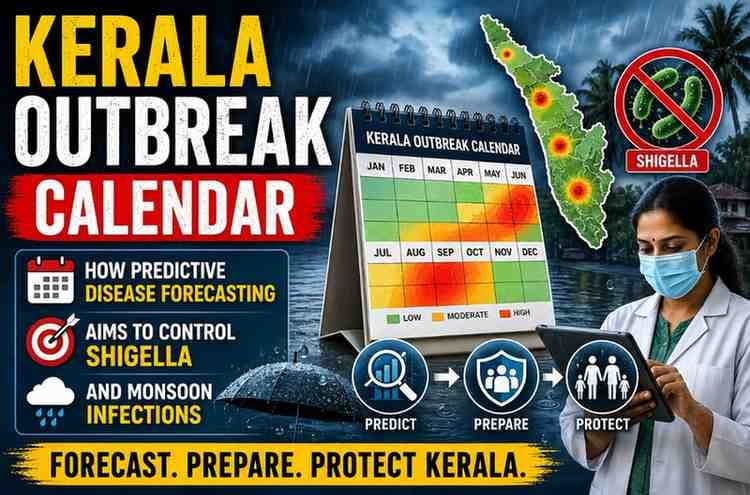
Kerala is working on a new public health forecasting tool called an “outbreak calendar” designed to map and predict disease patterns across the year. The initiative comes in response to recurring seasonal infections, including the current Shigella outbreak, which health authorities say has been aggravated by inadequate monsoon-time cleaning and sanitation.
Health Minister K. Muraleedharan has attributed the present situation partly to poor maintenance of hygiene systems during the monsoon, a period when waterborne diseases typically spike due to flooding, contamination of water sources, and increased bacterial transmission.
The proposed system aims to shift Kerala’s healthcare approach from reactive outbreak control to proactive disease prediction potentially making it one of the more structured epidemiological planning tools in India.
What Is an ‘Outbreak Calendar’?
An outbreak calendar is essentially a predictive health planning framework that maps disease trends based on:
- Historical outbreak data.
- Seasonal climate patterns such as monsoons and heatwaves.
- Geographic disease clustering.
- Population density and sanitation indicators.
- Hospital reporting trends.
The goal is to anticipate when and where specific infections are likely to rise, allowing health departments to deploy resources in advance rather than reacting after cases surge.
In Kerala’s context, this would likely include mapping waterborne diseases like Shigella, leptospirosis, dengue, and viral fevers that show strong seasonal correlations.
Why Kerala Needs Predictive Disease Planning
Kerala has one of India’s most developed public health systems, but it also faces recurring seasonal outbreaks, especially during the monsoon months.
Common challenges include:
- Heavy rainfall leading to water contamination.
- Flood-prone regions increasing bacterial spread.
- Urban waste management strain during rains.
- Rapid population movement between districts.
Shigella infections, for example, are typically spread through contaminated food and water, making monsoon hygiene a critical factor in controlling outbreaks.
Monsoon Cleaning and Disease Spread
The Health Minister’s remarks highlight a recurring issue in public health management: sanitation gaps during seasonal transitions.
During the monsoon, overflowing drains, stagnant water, and disrupted waste disposal systems can create ideal conditions for bacterial growth.
Even small lapses in cleaning public spaces, water storage systems, and sewage infrastructure can contribute to rapid disease transmission.
This is especially significant in densely populated areas and regions with high rainfall intensity like Kerala.
Comparison: Reactive vs Predictive Disease Control
| Reactive Approach | Predictive ‘Outbreak Calendar’ Approach |
|---|---|
| Respond after cases rise | Prepare before expected outbreaks |
| Emergency resource deployment | Planned allocation of healthcare resources |
| Higher strain on hospitals | Reduced system overload |
| Limited early warning | Data-driven forecasting |
| Short-term containment focus | Long-term prevention strategy |
How Data Could Power Kerala’s Outbreak Calendar
The success of such a system depends on integrating multiple data sources into a unified health intelligence model.
Potential inputs include:
- Real-time hospital admissions.
- Water quality monitoring reports.
- Weather and rainfall forecasts.
- Vector surveillance data (mosquito and bacteria tracking).
- Historical outbreak databases.
By combining these datasets, health officials can identify early warning signals before outbreaks escalate.
Shigella Outbreak: Why It Matters
Shigella is a highly contagious bacterial infection that causes severe gastrointestinal illness. It spreads through contaminated food, water, and direct contact.
Symptoms typically include:
- Severe diarrhea (sometimes with blood).
- Abdominal cramps.
- Fever.
- Dehydration in severe cases.
Children and elderly individuals are especially vulnerable, making early detection and containment critical.
An Insight Competitors Often Miss: Climate Change Is Reshaping Disease Timelines
Public health experts increasingly note that climate variability is disrupting traditional disease patterns.
Unpredictable rainfall, rising temperatures, and extreme weather events are extending or shifting outbreak seasons.
This means historical patterns alone are no longer sufficient—modern forecasting systems must adapt to climate-linked uncertainty.
Kerala’s outbreak calendar concept aligns with this evolving need for climate-sensitive public health planning.
Potential Benefits of the Outbreak Calendar System
If implemented effectively, the system could offer several advantages:
- Faster response to emerging infections.
- Better hospital preparedness during peak seasons.
- Targeted sanitation drives in high-risk zones.
- Efficient use of public health funding.
- Reduced mortality from preventable outbreaks.
It could also strengthen coordination between local governments, health departments, and disaster management agencies.
Challenges in Implementation
Despite its promise, the outbreak calendar system may face several practical challenges:
- Data collection inconsistencies across districts.
- Limited integration of digital health records.
- Infrastructure gaps in rural monitoring systems.
- Need for trained epidemiological analysts.
- Real-time coordination between departments.
Without strong execution, predictive models risk becoming underutilized planning tools rather than active decision-making systems.
Prediction: India May Move Toward Seasonal Disease Forecasting Models
Kerala’s initiative could serve as a model for other Indian states facing similar seasonal health challenges.
In the future, we may see:
- National disease forecasting dashboards.
- AI-based outbreak prediction systems.
- Integration of climate and health databases.
- Automated alerts for district health authorities.
This would mark a shift from reactive epidemic control to predictive public health management.
Conclusion
Kerala’s plan to develop an outbreak calendar represents a forward-looking approach to managing seasonal diseases like Shigella. By combining historical data, climate patterns, and real-time monitoring, the state aims to anticipate health risks before they escalate into full-scale outbreaks.
However, the success of such a system will depend on execution, coordination, and sustained investment in public health infrastructure.
If effective, this approach could transform how India prepares for monsoon-linked diseases—turning prediction into prevention and reactive care into proactive protection.
For breaking news and live news updates, like us on Facebook or follow us on Twitter and Instagram. Read more on Latest Health on thefoxdaily.com.

COMMENTS 0