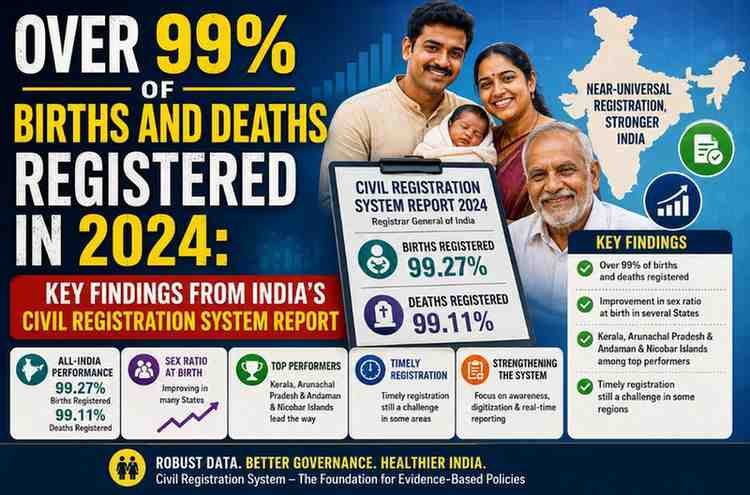
India has quietly crossed a demographic milestone that deserves more than a one-day headline. According to the newly released Civil Registration System (CRS) report for 2024, compiled by the Office of the Registrar General of India (RGI) under the Ministry of Home Affairs, more than 99% of births and deaths occurring in the country in 2024 were officially registered. That’s the “what.” The “who” is every state and Union Territory, tracked through the legal machinery set up under the Registration of Births and Deaths (RBD) Act, 1969. The “when” is calendar year 2024, with the report itself surfacing in mid-2026 — registration data typically takes a year or more to compile, verify, and publish. The “where” is a country of 1.4 billion people, and the “why” this matters goes far beyond a statistic: birth and death registration is the invisible infrastructure behind school admissions, passports, Aadhaar enrolment, inheritance claims, insurance payouts, and critically the sex ratio data that tells us how India treats its daughters before they’re even born.
This piece unpacks the report’s headline number, places it in historical context most news coverage skips, and digs into the one figure that actually matters more than the registration percentage itself: the sex ratio at birth (SRB), and why Kerala, Arunachal Pradesh, and the Andaman & Nicobar Islands are being singled out as top performers while large, populous states continue to lag.
Background: Why Birth and Death Registration Is a Bigger Deal Than It Sounds
It’s easy to read “99% registration” as a bureaucratic footnote. It isn’t. Every registered birth generates a certificate that is now, under the amended law, a single sufficient document for school admission, passport issuance, and Aadhaar registration. Every registered death closes a legal identity, unlocking inheritance, insurance, and pension processes for families. Unregistered events, by contrast, push people into a parallel, undocumented existence invisible to welfare schemes, unable to prove age or identity when it matters most.
India’s registration coverage has actually been on a long, unglamorous climb. Back in 2011, only 82.4% of births and 66.4% of deaths were being registered nationally meaning nearly one in three deaths went unrecorded. By 2023, birth registration had risen to 98.4%, with death registration also climbing steadily, though somewhat more slowly, since deaths in rural and remote areas are harder to capture in real time than institutional births. The leap to over 99% for both births and deaths in 2024 isn’t a sudden jump it’s the payoff of a decade-plus of administrative tightening.
What Changed: The Legal and Digital Push Behind the Numbers
Two structural shifts explain why 2024’s numbers look so much better than a decade ago.
First, the Registration of Births and Deaths (Amendment) Act, 2023, which came into force on October 1, 2023, made digital registration mandatory nationwide through a centralised CRS portal. Chief Registrars and Registrars across states are now legally required to feed data into the RGI’s central database in near real time, closing the old problem of paper registers sitting unreconciled for months. The amendment also elevated the birth certificate to a single, standalone proof of date and place of birth for a wide range of official purposes — a practical incentive for families to register births promptly rather than treat it as optional paperwork.
Second, the RGI issued direct circulars to hospitals, both government and private, mandating that births and deaths be reported within the legal 21-day window. This closed a specific loophole: private hospitals, unlike government ones, are not registrars themselves and were historically inconsistent about forwarding event data to local registrars. Tightening this reporting chain at the point of occurrence the hospital bed, effectively has done more for registration completeness than any awareness campaign could.
The real story in the 2024 data isn’t that registration crossed 99% it’s that India got there through enforcement and digitisation, not just voluntary compliance. That distinction matters for how durable this achievement is.
The Sex Ratio at Birth: Where the Real Inequality Still Lives
Registration completeness tells you how much data India is capturing. The sex ratio at birth tells you what that data reveals — and this is where the report’s subheading, “progress remains uneven,” carries real weight.
The Sex Ratio at Birth (SRB) measures the number of female births per 1,000 male births. A ratio at or above 1,000 signals no discernible bias against girls at birth; anything meaningfully below the natural biological baseline of roughly 950–952 is read as evidence of sex-selective practices, still illegal in India under the PC-PNDT Act but persistent in pockets of the country.
Based on the most recent Civil Registration System figures available, Arunachal Pradesh continues to record the country’s healthiest sex ratio at birth, reporting well over 1,000 females per 1,000 males a position it has held consistently for several years. It’s followed closely by the Andaman & Nicobar Islands, which also registers more female than male births, and by Kerala, whose ratio has hovered in the high 960s. These three geographies two island/hill regions and one state with historically strong female literacy and healthcare access form a template that policy researchers keep returning to: where women have stronger educational and economic standing, sex-selective bias tends to shrink.
| Indicator | 2011 | 2023 | 2024 (Report) |
|---|---|---|---|
| Birth registration rate | 82.4% | 98.4% | Over 99% |
| Death registration rate | 66.4% | ~95–97% (rising) | Over 99% |
| Top SRB performers | Data limited | Arunachal Pradesh, A&N Islands, Nagaland, Kerala | Kerala, Arunachal Pradesh, A&N Islands (top performers) |
| Legal framework | RBD Act, 1969 (original) | RBD Amendment Act, 2023 in force | Digital CRS portal fully operational |
What the report frames as “improving in some places” is a polite way of describing a real divergence. States in the Gangetic plain and parts of western India historically Jharkhand, Bihar, Telangana, Maharashtra, and Gujarat among them have repeatedly posted sex ratios at birth below the national figure, some dipping under 910. This isn’t a data glitch; it reflects deep-rooted son preference that no amount of registration efficiency alone can fix. Better registration makes the problem more visible, not smaller — which is arguably the more useful outcome for policymakers, even if it’s less flattering as a headline.
The Angle Most Coverage Misses: CRS vs. SRS, and Why the Numbers Don’t Always Match
Here’s something almost no mainstream report on this data explains clearly, and it matters if you’re trying to make sense of conflicting sex-ratio numbers you might see quoted elsewhere: India actually runs two separate vital-statistics systems, and they don’t always agree.
- The Civil Registration System (CRS) the source of this “99% registered” report counts every birth and death actually reported to a registrar. It’s an administrative census, not a sample.
- The Sample Registration System (SRS) a separate, survey-based demographic exercise also run by the RGI estimates vital rates from a large, statistically representative sample of about 8,800 sampling units, independent of what gets formally registered.
The two can diverge meaningfully. The most recent SRS statistical report, for instance, pegs the national sex ratio at birth at around 918 females per 1,000 males (a three-year average for 2022–2024) noticeably lower than the CRS-reported figures for top-performing states, because the SRS is designed to catch under-registration and behavioural bias that administrative records alone may not fully reflect. If you’ve seen different SRB numbers quoted in different places, this is very likely why. Treating CRS and SRS figures as interchangeable which a lot of secondary coverage does is a quiet but common error worth avoiding.
Real-World Impact: Why This Report Should Matter to Ordinary Families, Not Just Statisticians
For an individual family, a registered birth certificate is no longer a nice-to-have. Under the 2023 amendment, it is legally sufficient, on its own, for school admission, Aadhaar enrolment, and passport applications — no supplementary affidavits, no alternative proofs of age required in most cases. That single change removes a genuine bureaucratic burden for millions of families who previously had to hunt down school-leaving certificates or notarised declarations to prove a child’s date of birth.
For deaths, registration determines whether a family can access life insurance payouts, pension transfers, property inheritance, and government compensation schemes without months of delay. A 99%+ death registration rate means far fewer families are stuck in legal limbo after losing someone.
At the macro level, near-complete registration also strengthens every downstream government function that relies on accurate population data from vaccine rollout planning to welfare scheme targeting to constituency delimitation exercises. Administrative data this complete is, frankly, rare among countries of India’s size and diversity; many lower- and middle-income nations still rely almost entirely on periodic household surveys because their civil registration infrastructure never reached this level of coverage.
Comparison: Where India Now Stands Globally
Crossing 99% birth and death registration puts India in the company of registration systems typically associated with far smaller or wealthier nations. The UN’s benchmark for “complete” civil registration is generally set around 90% for births and deaths combined; several large developing economies, including some in Sub-Saharan Africa and parts of Southeast Asia, still register well under 80% of births. India achieving near-universal coverage across a population larger than the whole of Africa is a genuine administrative accomplishment even if the underlying sex-ratio inequality shows that data completeness and social equity are two very different problems, solved by very different tools.
What to Watch Next
A reasonable expectation is that registration percentages will plateau near this level going forward there’s a natural ceiling created by remote geography, migrant populations, and home deaths in areas with weak last-mile registrar access. The more meaningful number to track in future reports isn’t the registration rate; it’s whether states with historically skewed sex ratios at birth Bihar, Jharkhand, Gujarat, Haryana, Uttar Pradesh among them show sustained improvement over a five-year window rather than year-to-year noise. If Kerala, Arunachal Pradesh, and the Andaman & Nicobar Islands are being cited as the models, the real test of this report’s significance is whether the states at the bottom start converging toward them, not whether the national average nudges up another fraction of a percentage point.
Conclusion
The 2024 Civil Registration System report confirms that India has effectively solved the administrative problem of counting its births and deaths a genuine, decade-long achievement built on legal reform, digitisation, and hospital-level enforcement. But the report’s own subheading is the more important message: sex ratio at birth is improving in some places, and progress remains uneven. Kerala, Arunachal Pradesh, and the Andaman & Nicobar Islands stand out not because their registration systems are more efficient, but because their societies show less bias against girls at birth. That’s a social outcome, not a bureaucratic one and it’s the number worth watching in every report that follows this one.
For breaking news and live news updates, like us on Facebook or follow us on Twitter and Instagram. Read more on Latest Health on thefoxdaily.com.

COMMENTS 0