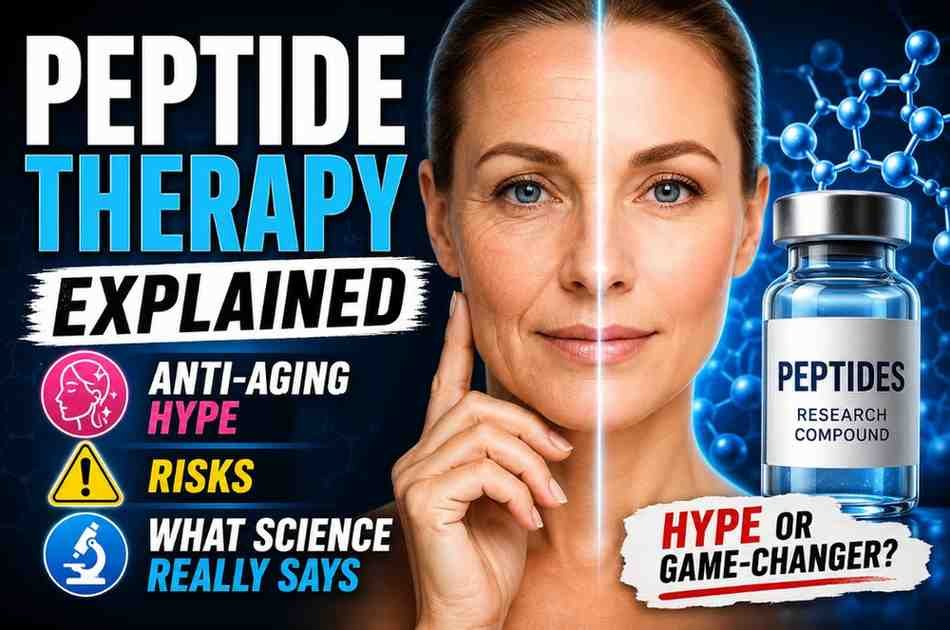
Every generation invents its own fountain of youth. In the 1980s, it was human growth hormone injections administered to aging executives in underground clinics. In the 2000s, it was stem cell tourism wealthy patients flying to Panama or Ukraine for unproven infusions. Today, the anti-aging industry has a new darling: peptide injections. Discreet, injectable, and draped in just enough scientific vocabulary to sound legitimate, peptide therapy has become the fastest-growing offering in the global longevity and wellness market a market projected to exceed $600 billion by 2030.
The promises are extraordinary. Sharper cognition. Deeper sleep. Accelerated fat loss. Faster muscle recovery. Youthful skin. Restored libido. Improved immunity. Proponents a growing army of biohackers, anti-aging physicians, and social media personalities speak of peptides the way alchemists once spoke of the philosopher’s stone: as if the secret to reversing human aging has finally been unlocked, and the only barrier is a prescription and a willingness to self-inject.
There is just one problem. The clinical evidence for most of these claims ranges from preliminary to nonexistent. And in some cases, the risks being quietly ignored are serious enough to warrant significant public health concern.
What Are Peptides, and Why Are They Suddenly Everywhere?
To understand the hype, it helps to understand the biology. Peptides are short chains of amino acids the molecular building blocks of proteins typically comprising between 2 and 50 amino acids. The human body produces thousands of them naturally, and many serve as critical signaling molecules: they tell cells to grow, divide, repair, produce hormones, or initiate immune responses. Insulin is a peptide. So is oxytocin. So are glucagon-like peptide-1 (GLP-1) receptor agonists the class that includes semaglutide, the active compound in Ozempic and Wegovy, which have genuine, robust clinical evidence behind them.
The legitimate therapeutic use of certain peptides in medicine is real and well-established. What is being sold in the anti-aging wellness industry, however, is an entirely different proposition: the idea that injecting a wide range of research-grade or compounded peptides many never studied in humans at the doses being administered will produce dramatic systemic rejuvenation. The scientific credibility of the former is being used to legitimize the latter, and that conflation is precisely where the danger lies.
The Most Hyped Peptides and What the Evidence Actually Shows
The peptide therapy market is not monolithic. It encompasses dozens of compounds, each with its own evidence profile, risk landscape, and marketing mythology. The most commonly promoted ones deserve individual scrutiny.
BPC-157 (Body Protective Compound-157) is perhaps the most aggressively marketed peptide in the wellness space. Derived from a protein found in gastric juice, it has shown genuine regenerative properties in rats. Rodent studies have demonstrated accelerated wound healing, tendon repair, and even some neuroprotective effects. These findings are biologically interesting. They are not, however, evidence that injecting BPC-157 into a human athlete will repair a torn rotator cuff or reverse joint degeneration. No Phase II or Phase III human clinical trials exist for BPC-157. The compound has never been approved by the FDA, the EMA, or any major regulatory body for therapeutic use in humans. It is being widely sold and injected based entirely on animal data a leap of faith that would be considered scientifically indefensible in any other medical context.
CJC-1295 and Ipamorelin are growth hormone-releasing peptides compounds that stimulate the pituitary gland to produce more growth hormone rather than introducing synthetic HGH directly. They are marketed as a “safer” alternative to HGH therapy, with promises of fat loss, muscle gain, and anti-aging effects. The safer-than-HGH framing is technically accurate in a narrow sense but deeply misleading in context. Chronically elevated growth hormone and IGF-1 levels are associated with insulin resistance, fluid retention, joint pain, and critically accelerated tumor growth. The biology of growth hormone is not simply “more is better after the age of 35.” Disrupting the carefully regulated pulsatile secretion of GH with exogenous peptides introduces unpredictable long-term risks that no study has yet tracked across meaningful timeframes.
TB-500 (Thymosin Beta-4) is another peptide with genuine scientific interest it plays a role in cell migration and tissue repair and another compound with no approved human therapeutic application and no robust clinical trial data. It appears regularly on the websites of anti-aging clinics and compounding pharmacies, marketed for everything from injury recovery to hair regrowth.
Epithalon, a synthetic tetrapeptide, is marketed as a “telomere extender” a substance that activates telomerase and theoretically slows cellular aging at its most fundamental level. The telomere-aging connection is legitimate science; Elizabeth Blackburn won the Nobel Prize in Physiology or Medicine in 2009 for related work. The leap from that Nobel-worthy science to “inject this peptide and extend your lifespan” is enormous, unproven, and not supported by any human trial of consequence.
| Peptide | Marketed Claim | Evidence in Humans | Regulatory Status | Known Risks |
|---|---|---|---|---|
| BPC-157 | Tissue repair, gut healing, joint recovery | Animal studies only | Not approved (FDA/EMA) | Unknown long-term; injection site reactions |
| CJC-1295 / Ipamorelin | Fat loss, muscle gain, anti-aging via GH boost | Very limited small human trials | Not approved for anti-aging use | Insulin resistance, fluid retention, potential tumor promotion |
| TB-500 (Thymosin Beta-4) | Injury recovery, hair regrowth | Minimal; no Phase III trials | Not approved | Largely unknown in long-term human use |
| Epithalon | Telomere extension, lifespan increase | Extremely limited; mostly Russian studies | Not approved globally | Unknown; no safety data in large populations |
| Semaglutide (GLP-1) | Weight loss, metabolic health | Extensive Phase III RCTs | FDA/EMA approved | Nausea, pancreatitis risk, thyroid concerns under study |
The Compounding Pharmacy Problem
One of the least-discussed aspects of the peptide therapy boom is where these compounds are actually coming from. The majority of peptides being injected in wellness clinics and anti-aging practices across the United States, the UK, India, and Australia are sourced from compounding pharmacies specialized facilities that mix custom drug formulations on a patient-specific basis. Compounding pharmacies operate under a different regulatory framework than pharmaceutical manufacturers. They are not required to conduct the same purity, potency, and sterility testing that FDA-approved drugs undergo.
This creates a supply chain vulnerability that is not theoretical. The FDA has issued multiple warning letters to compounding pharmacies producing peptide compounds, citing concerns about sterility failures, incorrect dosing, and contamination. In 2023 and 2024, the FDA moved to place several popular research peptides including BPC-157 and TB-500 on its list of substances that cannot be legally compounded, citing safety concerns. These regulatory actions have not stopped the market; they have largely pushed it further underground, toward overseas suppliers and gray-market online vendors operating with even less oversight.
Patients injecting peptides sourced from these channels have no reliable way to verify purity, accurate concentration, or sterility. The risk of injection-site infection, systemic contamination, or receiving a compound bearing no meaningful resemblance to what the label claims is non-trivial.
Who Is Actually Driving This Market and Who Profits
Understanding the peptide therapy boom requires following the financial incentives. Anti-aging medicine has evolved into one of the most lucrative niches in private healthcare, attracting physicians operating outside the reimbursement structures of conventional insurance-based medicine. Direct-pay longevity clinics where patients pay out of pocket for consultations, labs, and treatments charge premium prices for services that insurers would never cover because clinical evidence doesn’t support them.
A monthly peptide protocol at a reputable-seeming longevity clinic can cost anywhere from $300 to $1,500 depending on the compounds, frequency, and ancillary services packaged alongside. Telehealth platforms have further democratized access and further obscured accountability. A patient can receive a peptide prescription from a physician they have never met in person, following a brief online consultation, with compounds shipped directly to their door. The physician may genuinely believe in the therapy. The financial incentive to believe, however, is structurally embedded in every element of the transaction.
Social media has served as the most powerful marketing engine the industry has ever had. Influencers many with no medical background document their peptide protocols in detail on YouTube, TikTok, and Instagram, framing self-experimentation as pioneering biohacking rather than unevaluated risk-taking. The aesthetic results often attributable to simultaneous changes in exercise, nutrition, sleep, and stress management rather than the peptides themselves are presented as proof of efficacy. Correlation is laundered as causation at industrial scale.
The Legitimate Science Being Drowned Out
None of this means peptide research is without genuine scientific merit. It means the legitimate science is being co-opted and dramatically outpaced by commercial application. Several peptide compounds are in active, rigorous clinical development for real therapeutic indications. Peptide-based cancer immunotherapies are among the most promising frontiers in oncology. GLP-1 receptor agonists have transformed the treatment of type 2 diabetes and obesity with an evidence base that is genuinely exceptional. Peptide hormones already underpin critical approved therapies for growth hormone deficiency, diabetes insipidus, and acromegaly.
The scientific community’s interest in peptides as a therapeutic class is well-founded. The problem is that this legitimate interest is being used often deliberately to confer credibility on a wellness industry selling compounds that have skipped the inconvenient, expensive, time-consuming process of proving they work and are safe in humans.
What People Seeking Anti-Aging Solutions Should Actually Consider
The demand driving the peptide therapy market is real and understandable. People are living longer but not always better. The gap between lifespan and healthspan the years of life lived in good health is a genuine medical problem that mainstream medicine has been slow to address comprehensively. The desire for interventions that extend vitality is not vanity; it is rational.
But the interventions with the strongest evidence for extending healthspan remain stubbornly unglamorous. Regular resistance and aerobic exercise produces measurable benefits in muscle mass, insulin sensitivity, cardiovascular function, cognitive health, and longevity biomarkers that no peptide protocol has demonstrated at comparable scale. Dietary patterns emphasizing whole foods, fiber, and minimally processed ingredients show consistent associations with reduced metabolic disease burden and longer healthspan. Quality sleep seven to nine hours consistently regulates the very hormonal axes that peptide therapies claim to optimize, and does so through the body’s own precisely calibrated systems. Chronic stress reduction, social connection, and purpose are associated with longevity outcomes that dwarf most pharmacological interventions in the observational data.
None of these are injected. None of them cost $800 a month. And none of them generate the kind of dramatic before-and-after content that drives social media engagement. They are, however, what the evidence actually supports.
Conclusion: The Fountain of Youth Has Always Been a Sales Pitch
Peptide therapy may yet produce genuinely validated anti-aging interventions. The biology is rich enough, and the research investment significant enough, that some compounds currently being studied will almost certainly demonstrate meaningful human benefit through rigorous trials. Science moves forward, and today’s preliminary finding sometimes becomes tomorrow’s approved therapy.
But that future scientific validation if and when it arrives will look nothing like what is currently being sold in wellness clinics and delivered via telehealth platforms. It will involve established safety profiles, standardized dosing, regulatory approval, and long-term outcome data. The peptide therapy being marketed today as a fountain of youth is, at best, a scientifically premature gamble. At worst, it is a sophisticated extraction of money from people’s legitimate fears about aging, dressed in the borrowed credibility of real biology.
The fountain of youth has been a sales pitch in every era. The peptides are just the latest vessel carrying the same ancient promise and the same old caveat emptor applies now as it always has: if something promises to reverse aging, rejuvenate every system in your body, and deliver results that decades of medical research have not, the burden of proof belongs entirely on the seller. So far, for most peptide therapies being marketed today, that proof simply does not exist.
For breaking news and live news updates, like us on Facebook or follow us on Twitter and Instagram. Read more on Latest Health on thefoxdaily.com.


COMMENTS 0