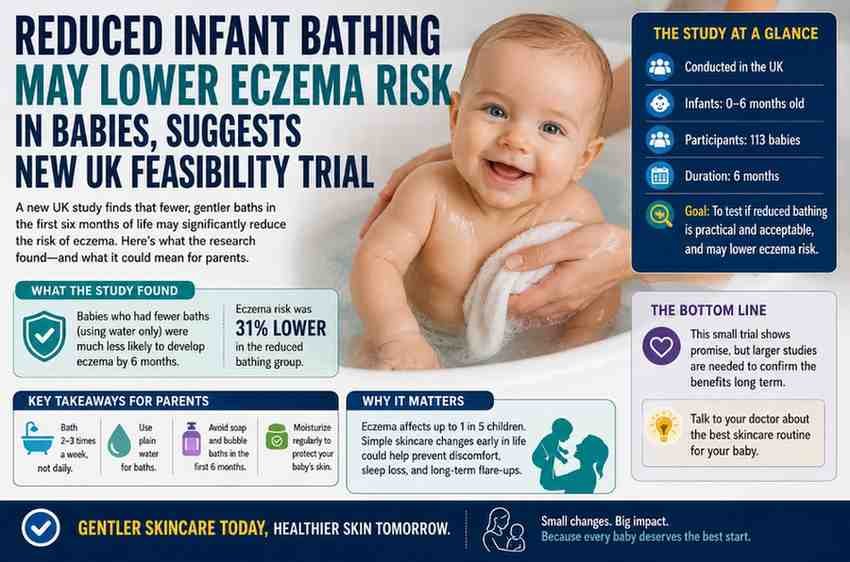
A newly published feasibility trial from the UK has reignited a question that pediatricians, dermatologists, and exhausted new parents have quietly debated for years: are we bathing babies too much? The study, led by researchers including Michael Perkin and published in the British Journal of Dermatology in 2026, randomised 105 pregnant women to test whether cutting back on infant bathing could lower rates of eczema by six months of age. The result 15.8% of infants in the reduced-bathing group developed visible eczema, compared with 29.2% in the group receiving routine postnatal care is striking on paper. But this was a feasibility trial, not a definitive answer, and understanding the difference matters enormously for how parents, clinicians, and public health bodies should respond.
Who ran it: a UK-based research team screening pregnant women across diverse ethnic backgrounds. What they tested: capping baths at once weekly, keeping them short, avoiding hot water, and favouring plain water over soap-based cleansers. When: results published in 2026, with recruitment conducted in the preceding period despite staffing constraints. Where: within NHS-linked maternity and dermatology research infrastructure. Why it matters: eczema affects roughly 15% of infants worldwide and often marks the first step in the so-called “atopic march” toward food allergy, asthma, and allergic rhinitis. How the intervention worked: by minimising two things known to strip the skin’s protective lipid barrier — frequent water exposure and harsh cleansing.
Why Skin Barrier Health Is the Real Battleground in Eczema Prevention
To understand why a bathing trial matters at all, it helps to understand what eczema actually is. Atopic dermatitis isn’t simply “dry, itchy skin” — it’s a breakdown in the skin’s outermost layer, the stratum corneum, which normally acts like mortar between bricks, sealing in moisture and keeping allergens, irritants, and microbes out. When that barrier is compromised, water escapes (a process measurable as transepidermal water loss, or TEWL), and the skin becomes more permeable to environmental triggers.
Infants are especially vulnerable. A newborn’s skin is roughly 30% thinner than adult skin, produces less of the natural lipids that make up the barrier, and hasn’t yet built up the microbiome diversity that helps regulate inflammation. Add frequent bathing particularly with hot water, harsh soaps, or vigorous washing and you accelerate lipid stripping at exactly the moment the barrier is least equipped to cope.
This is where the new trial’s logic holds up scientifically, even if the sample size doesn’t yet allow firm conclusions. Reducing bath frequency, avoiding hot water, and skipping soap where possible are all interventions aimed squarely at preserving that lipid layer rather than eroding it.
Inside the Trial: What the Numbers Actually Show
The trial screened 261 pregnant women and ultimately randomised 105 into two arms. The intervention group was asked to limit baths to once a week for the first six months, keep them brief, avoid hot water, and use plain water rather than soap-based products whenever feasible.
What stands out isn’t just the eczema outcome it’s the adherence and retention data, which are arguably more important for a feasibility study than the headline result. Nearly 80% of the intervention group stuck to the bathing target, compared with under 30% of controls who happened to bathe similarly infrequently anyway. Acceptability ran at 95% among participants following the intervention, and follow-up remained above 80% at six months, with 89% completing questionnaires and 82% attending in-person visits.
Those numbers matter because feasibility trials aren’t designed to prove an intervention works — they’re designed to prove a full-scale trial can be run. On that front, this study succeeded convincingly. Recruiting a diverse, adherent, well-retained cohort of pregnant women into a behavioural skincare trial is genuinely difficult, and the researchers demonstrated it’s achievable despite real-world obstacles, including staffing shortages that limited overall recruitment numbers.
| Outcome Measure | Reduced Bathing Group | Routine Care Group |
|---|---|---|
| Visible eczema at 6 months | 15.8% | 29.2% |
| Adherence to bathing target | 79.6% | 28.6% |
| Intervention rated acceptable | 95% | N/A |
| Six-month follow-up completion | 80%+ overall (89% questionnaires, 82% clinic visits) | |
The Nuance Everyone Skips: Correlation, Confounding, and Confidence
Here’s the part most coverage of this study glosses over: a near-doubling of eczema rates between groups sounds dramatic, but with just over 100 participants split across two arms, the trial was never statistically powered to detect a significant difference. In plain terms, a result this size could plausibly occur by chance alone, and the researchers themselves are explicit that caution is warranted.
There’s also a confounding wrinkle worth flagging: control-group parents who weren’t given any bathing instructions still bathed their infants far more often than the intervention group’s target, but not necessarily as often as a “true” high-frequency baseline. That gap in adherence between arms is exactly what the trial needed to demonstrate feasibility — but it also means the eczema difference reflects a comparison between a strict reduced-bathing protocol and loosely-supervised usual care, not a clean dose-response test across a spectrum of bathing frequencies.
Most of the eczema cases recorded were mild. That’s an important caveat for parents reading headlines: this study offers no evidence about whether reduced bathing prevents moderate-to-severe eczema, which is the form most likely to disrupt sleep, trigger secondary infections, and persist into childhood.
How This Fits Into the Bigger Eczema Prevention Puzzle
Bathing frequency isn’t a new frontier in eczema prevention it’s one piece of a puzzle researchers have been assembling for over a decade. Earlier large-scale trials investigating whether daily emollient (moisturiser) application in the first weeks of life could prevent eczema in high-risk infants generally found no significant protective benefit from moisturisers alone, a result that surprised many in the field given how strongly the “leaky skin barrier” theory predicted otherwise.
That earlier disappointment makes this bathing trial more interesting, not less. If moisturising alone doesn’t reliably prevent eczema, but reducing water and cleanser exposure shows a signal worth chasing, it suggests the mechanism may be less about actively repairing the barrier and more about simply not damaging it in the first place. Prevention, in other words, may hinge more on restraint than intervention doing less, rather than doing more.
This is a subtle but important shift in thinking. For years, skincare advice for at-risk infants emphasised proactive moisturising regimens. This trial nudges the conversation toward a complementary idea: minimising avoidable barrier disruption from the start, particularly around bathing habits that vary enormously by culture, climate, and family routine.
The Global Bathing Culture Gap
One angle largely absent from initial coverage of this trial is how much bathing norms already vary worldwide and what that might mean for generalising the results. In many cultures, daily infant bathing is considered standard practice, sometimes tied to beliefs about hygiene, bonding, or tradition. In others, particularly in colder climates or lower-resource settings, infrequent bathing has long been the norm, often out of necessity rather than skincare philosophy.
If reduced bathing frequency genuinely lowers eczema risk, it raises a fascinating population-level question: are regions with historically infrequent infant bathing seeing lower baseline eczema rates for reasons researchers haven’t yet isolated? Eczema prevalence does vary substantially between countries, and while diet, climate, water hardness, and genetics are the usual suspects, bathing habits have rarely been examined as an independent variable at scale. This trial, small as it is, opens the door to that line of inquiry.
What Parents Should Actually Do With This Information
It’s tempting to read a headline like “fewer baths, less eczema” and immediately overhaul a newborn’s routine. That would be premature. Here’s a more grounded way to think about it:
- This is preliminary evidence, not a guideline change. No major dermatology or paediatric body has yet revised bathing recommendations based on this single feasibility study.
- The mechanism is plausible. Reducing hot water exposure and harsh soap use aligns with well-established skin barrier science, even if this specific trial can’t prove causation.
- Family history still matters most. Infants with a parent or sibling with eczema, asthma, or allergies remain the highest-priority group for any future prevention strategy, bathing-related or otherwise.
- Mild changes carry low risk. Bathing a baby less frequently, keeping water lukewarm, and skipping soap except where needed is unlikely to cause harm and is already common advice from many paediatric sources for reasons unrelated to eczema, including skin dryness and comfort.
- Watch for a larger trial. The real test of this hypothesis will come from a properly powered, multicentre study which the researchers say is now needed.
What Comes Next
The honest headline here isn’t “bathing less prevents eczema.” It’s “researchers have proven they can run this kind of trial, and the early signal is promising enough to justify a much bigger one.” That distinction matters for how the findings should be reported and understood.
If a fully powered multicentre trial replicates this effect with statistical significance and ideally tracks moderate-to-severe eczema cases, not just mild presentations it could meaningfully shift newborn skincare guidance within the next five to ten years, joining moisturiser trials, filaggrin gene research, and microbiome studies as part of a broader, increasingly personalised approach to eczema prevention. Given how heavily current advice already leans on individual family history and skin type, a validated bathing protocol would likely be positioned as one adjustable lever among several, rather than a standalone fix.
For now, this trial’s real contribution isn’t a definitive answer it’s proof that the question is worth asking properly, at scale, with the statistical power to settle it.
Conclusion
This feasibility trial doesn’t prove that reducing infant bathing prevents eczema. What it does prove is that researchers can recruit, retain, and study a diverse group of families around this exact question — and that the early results are promising enough to fund something bigger. Eczema’s roots lie in a fragile, developing skin barrier, and every piece of evidence about what strengthens or weakens that barrier in the first months of life adds to a prevention puzzle that, until recently, offered families frustratingly few actionable answers. A larger multicentre trial will determine whether “less is more” becomes genuine paediatric guidance or simply an interesting hypothesis that didn’t survive a bigger sample size. Either way, parents shouldn’t panic-change their bathing routine based on this study alone but they can reasonably feel that the science of infant skincare is finally asking sharper, more useful questions.
For breaking news and live news updates, like us on Facebook or follow us on Twitter and Instagram. Read more on Latest Health on thefoxdaily.com.

COMMENTS 0