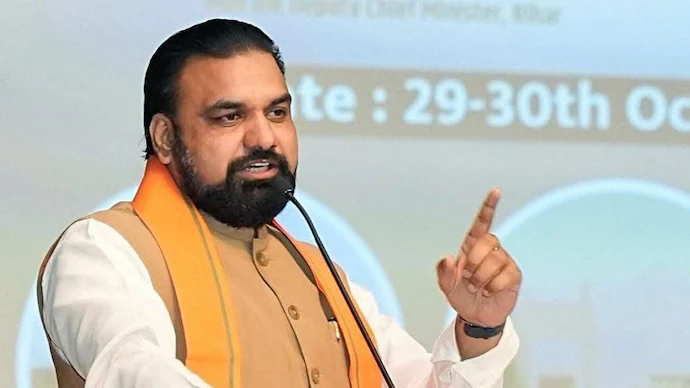
Bihar Chief Minister Samrat Choudhary‘s appeal to income tax-paying households to give up free electricity has brought renewed attention to the financial cost of the state’s expanding welfare programmes. The request, made on November 1 in Patna, raises questions about whether Bihar can continue funding universal benefits while maintaining resources for infrastructure, development and public services.
Speaking at the inauguration of the two-day Pataliputra National Youth Parliament 2.0, Choudhary urged affluent households to voluntarily surrender the benefit of 125 units of free electricity. He said the state was spending around Rs 23,000 crore annually on power subsidies, with the benefit costing approximately Rs 8,000-10,000 per household.
The chief minister pointed out that the subsidy was available to both rich and poor households. Those who could afford to pay their electricity bills, he suggested, should voluntarily give up the benefit and contribute towards Bihar’s development.
However, the appeal was not accompanied by a formal mechanism to identify households capable of surrendering the subsidy. Nor did the government announce a phased withdrawal or an income-based eligibility system. For now, the request remains voluntary.
Why Has Samrat Choudhary Raised the Issue of Free Electricity?
The chief minister’s appeal reflects the growing financial pressure associated with Bihar’s universal welfare commitments. The government has acknowledged that providing free electricity to millions of households involves a substantial recurring expenditure.
The 125-unit free electricity scheme was announced by then chief minister Nitish Kumar in July 2025, just months before the Bihar Assembly elections. It was expected to benefit around 16.7 million domestic consumers.
The announcement provided a direct financial benefit to households across income groups. Because the scheme was universal within its consumption threshold, affluent families received the same electricity benefit as economically weaker households.
The ruling National Democratic Alliance (NDA) won the Assembly election decisively, with the electricity scheme among the major welfare initiatives introduced before the polls. The sequence has now created a political and financial contrast: a benefit announced before the election is being reconsidered publicly after the government has to account for its continuing cost.
Choudhary’s request does not amount to a decision to withdraw free electricity. Instead, it places responsibility on households that can afford their bills to voluntarily relinquish a benefit they are already entitled to receive.
Bihar’s Free Electricity Scheme: A Rs 23,000 Crore Annual Commitment
The scale of the Electricity Subsidy is central to understanding the chief minister’s appeal. Choudhary said the state was spending around Rs 23,000 crore annually on power subsidies, with an estimated cost of Rs 8,000-10,000 for each household receiving the benefit.
The Bihar government’s 2026-27 budget has sanctioned Rs 23,165 crore under the Mukhyamantri Vidyut Upbhokta Sahayata Yojana. This allocation includes consumer assistance supporting the free electricity benefit. However, the budgetary sanction should not be interpreted as the final expenditure exclusively on the 125 free units.
The distinction matters because a budget allocation represents authorised financial provision, while actual expenditure depends on implementation and the amount ultimately spent during the financial year.
Unlike a one-time cash transfer, an electricity subsidy creates a recurring financial obligation. As long as eligible households continue receiving the benefit, the government must make provisions for the associated costs year after year.
This makes the electricity scheme a significant part of Bihar’s long-term expenditure commitments. The question is not simply whether the government can fund the subsidy in one financial year, but whether it can sustain the benefit alongside other development priorities.
Women Employment Scheme: Rs 18,100 Crore Transferred to 18.1 Million Women
Free electricity is not the only major welfare commitment facing the Bihar government. The Mukhyamantri Mahila Rojgar Yojana has also involved a substantial transfer of public money to households across the state.
Under the scheme, the government transferred Rs 10,000 each to 18.1 million women, taking the total disbursement to Rs 18,100 crore by February 2026.
Most of the transfers were made in five phases between September 26 and November 28, 2025, overlapping with the Assembly election campaign. The programme was presented as seed capital for women interested in starting self-employment activities and small businesses.
Beneficiaries were expected to use the initial assistance to begin livelihood activities. The scheme also provided for the possibility of further assistance of up to Rs 2 lakh after a woman established an enterprise and underwent an assessment.
The programme therefore had two distinct objectives: provide immediate financial assistance and create an opportunity for women to develop income-generating activities.
Has the Rs 10,000 Transfer Created Sustainable Livelihoods?
The economic impact of the women’s employment scheme depends on whether the initial financial assistance can translate into sustainable sources of income.
A grant of Rs 10,000 can help a woman purchase a sewing machine, acquire livestock, stock a small shop or meet the initial costs of a modest enterprise. Such support can provide an entry point into self-employment, particularly for women who have limited access to financial resources.
However, establishing a business that generates regular income requires more than initial capital. Access to credit, practical skills, customers, markets and reliable infrastructure can determine whether a small enterprise survives beyond its initial stage.
Ground reports and beneficiary accounts suggest that the money has supported small livelihood activities in addition to household expenses and consumption. Limited pre-election reports also found that slightly more than half of the recipients claimed to have started some form of economic activity.
But there is no comprehensive statewide evidence establishing how many of these activities have survived, generated regular income or created employment.
The distinction between receiving financial assistance and achieving long-term economic independence is important. The scheme has transferred money to an unprecedented number of women, but the extent to which it has created durable livelihoods remains uncertain.
The possibility of receiving further assistance of up to Rs 2 lakh is conditional on establishing an enterprise and undergoing assessment. Therefore, the initial Rs 10,000 transfer should not automatically be treated as proof that beneficiaries have achieved sustainable self-employment.
How Bihar’s Two Major Welfare Schemes Affect State Finances
The electricity subsidy and the women’s employment scheme represent substantial commitments of public resources, but their financial implications are different.
The electricity subsidy is a recurring expense. The government must continue making provisions for the benefit as long as the scheme remains operational. By contrast, the Rs 18,100 crore transferred under the women’s scheme represents expenditure already incurred.
Both programmes have significant welfare objectives. Free electricity can reduce household expenses, while financial assistance for women can help them begin small livelihood activities. However, their costs also raise questions about how the state balances immediate support with longer-term investment.
The following comparison highlights the different financial characteristics of the two programmes:
| Scheme | Financial commitment | Nature of expenditure | Main objective |
|---|---|---|---|
| Mukhyamantri Vidyut Upbhokta Sahayata Yojana | Rs 23,165 crore sanctioned in the 2026-27 budget | Recurring subsidy provision | Support electricity consumers through free power benefits |
| Mukhyamantri Mahila Rojgar Yojana | Rs 18,100 crore transferred by February 2026 | Disbursement already made | Provide initial capital for women’s self-employment |
The figures should not be treated as directly equivalent. One is a budgetary sanction for a financial year, while the other is the total amount transferred under a scheme by February 2026.
Bihar Budget 2026-27: Revenue Surplus and Fiscal Pressures
The broader financial position of Bihar makes the debate over welfare spending more consequential. The state’s 2026-27 budget projects a revenue surplus of Rs 1,143 crore, equivalent to 0.1 per cent of Gross State Domestic Product (GSDP).
This represents a significant change from the budget estimates for 2025-26, when Bihar had projected a revenue surplus of Rs 8,831 crore, or 0.8 per cent of GSDP.
However, the revised estimates for 2025-26 show a revenue deficit of Rs 76,315 crore, equivalent to 6.7 per cent of GSDP. The difference between the original budget projection and the revised estimate highlights the financial challenges the state faced during the year.
The fiscal deficit for 2026-27 is projected at 3 per cent of GSDP, compared with 11.8 per cent in the previous year’s revised estimates.
| Fiscal indicator | Budget or revised estimate |
|---|---|
| Revenue surplus, 2025-26 budget estimate | Rs 8,831 crore (0.8% of GSDP) |
| Revenue deficit, 2025-26 revised estimate | Rs 76,315 crore (6.7% of GSDP) |
| Revenue surplus, 2026-27 budget estimate | Rs 1,143 crore (0.1% of GSDP) |
| Fiscal deficit, 2025-26 revised estimate | 11.8% of GSDP |
| Fiscal deficit, 2026-27 budget estimate | 3% of GSDP |
These figures indicate a sharp projected correction in Bihar’s fiscal position for 2026-27. However, the previous year’s revised estimates also underline the scale of the financial pressure confronting the state.
Bihar has limited own-tax resources and depends substantially on transfers from the Centre. This makes expenditure planning particularly important. The government must balance welfare commitments with the need to maintain investment in infrastructure, public services and economic development.
Government Austerity Measures May Not Be Enough
The Bihar government has also signalled an effort to control administrative expenditure. In May 2026, Chief Secretary Pratyaya Amrit issued an austerity directive covering video-conferencing, car-pooling, office electricity consumption and restrictions on official foreign travel.
These measures are intended to encourage administrative discipline and limit avoidable government spending. However, their potential savings are unlikely to fundamentally change the financial arithmetic of large welfare programmes.
The electricity subsidy and women’s employment scheme involve much larger financial commitments than routine administrative expenses. Reducing electricity consumption in government offices or limiting official travel cannot, by itself, resolve the long-term costs associated with these programmes.
There has also been no formal move to restrict the free electricity benefit according to household income or redesign the initial Rs 10,000 transfer around demonstrated business plans.
Why Voluntary Surrender of Free Electricity May Not Work
Choudhary’s appeal depends on affluent households voluntarily giving up a benefit that is available to them. While the request may encourage some families to reconsider whether they need the subsidy, it does not establish a reliable mechanism for reducing government expenditure.
Without a clear process for identifying eligible households or explaining how surrendered benefits would contribute to development, participation may remain limited.
Most households are likely to retain a benefit to which they are already entitled unless they have a compelling reason to opt out. Voluntary surrender may therefore generate some savings, but it is unlikely to provide a predictable solution to the state’s recurring subsidy burden.
The appeal is consequently better understood as an acknowledgement of financial pressure than as a comprehensive expenditure-control strategy.
Universal Free Power Versus Targeted Welfare
The debate also raises a broader policy question about whether universal subsidies are the most effective way to distribute limited public resources.
Providing free electricity up to a fixed consumption threshold is relatively straightforward to administer and can deliver immediate relief to households. It also avoids some of the difficulties involved in identifying beneficiaries through complicated income-based eligibility systems.
However, a universal benefit does not necessarily direct the greatest assistance towards households that need it most. A family that can comfortably pay its electricity bill receives the same absolute benefit as a household for which the subsidy makes a significant difference to its monthly budget.
In a state with limited public resources, this raises the issue of opportunity cost. Money committed to universal electricity subsidies cannot simultaneously be used for other priorities such as power infrastructure, agricultural investment or more carefully targeted livelihood programmes.
Targeting benefits more precisely could help the government concentrate support on economically vulnerable households. However, any change would require a clear eligibility framework and an assessment of how households would be affected.
Why Cash Transfers Need More Than Initial Financial Assistance
The same policy challenge applies to the Mukhyamantri Mahila Rojgar Yojana. A one-time grant can provide immediate relief and help a woman purchase a productive asset, but long-term economic independence requires continued access to opportunities and resources.
Training, affordable credit, market access and reliable infrastructure can determine whether a small enterprise becomes financially sustainable. Without these supporting conditions, initial assistance may not translate into stable income.
The government’s conditional provision for additional assistance of up to Rs 2 lakh could provide further support to eligible women who establish enterprises and meet the assessment requirements. However, the long-term success of the programme will depend on how many beneficiaries can build viable businesses and generate regular earnings.
Measuring the scheme’s performance therefore requires more than counting the number of transfers made. The government would need to assess business survival, income generation and the extent to which beneficiaries have achieved lasting economic independence.
What Samrat Choudhary’s Appeal Reveals About Bihar’s Welfare Model
Samrat Choudhary’s November 1 appeal has brought the tension between Bihar’s welfare promises and its financial capacity into public discussion. The government is now drawing attention to the cost of a universal electricity benefit introduced before the Assembly election, while continuing to manage the financial consequences of other major welfare programmes.
Welfare transfers are not inherently undesirable, particularly in a state where many households face economic vulnerability. Predictable assistance can reduce financial pressure, support consumption and help families access essential services.
The challenge arises when large commitments are introduced without sufficient attention to their recurring costs, targeting and long-term outcomes. The political appeal of announcing a benefit is immediate, but the financial responsibility continues long after the announcement.
For Bihar, the central question is not simply whether the government should spend money on welfare. It is whether the available resources are being used in ways that provide lasting benefits while protecting investment in infrastructure and public services.
Choudhary’s request that affluent households surrender free electricity does not resolve that challenge. The more difficult decisions involve assessing whether subsidies should be better targeted, measuring the actual livelihood outcomes of the women’s employment scheme and ensuring that welfare spending remains financially sustainable.
Until the government addresses these questions through a clear policy framework, Bihar’s welfare commitments will remain easier to announce than to finance over the long term.
For breaking news and live news updates, like us on Facebook or follow us on Twitter and Instagram. Read more on Latest India on thefoxdaily.com.





COMMENTS 0