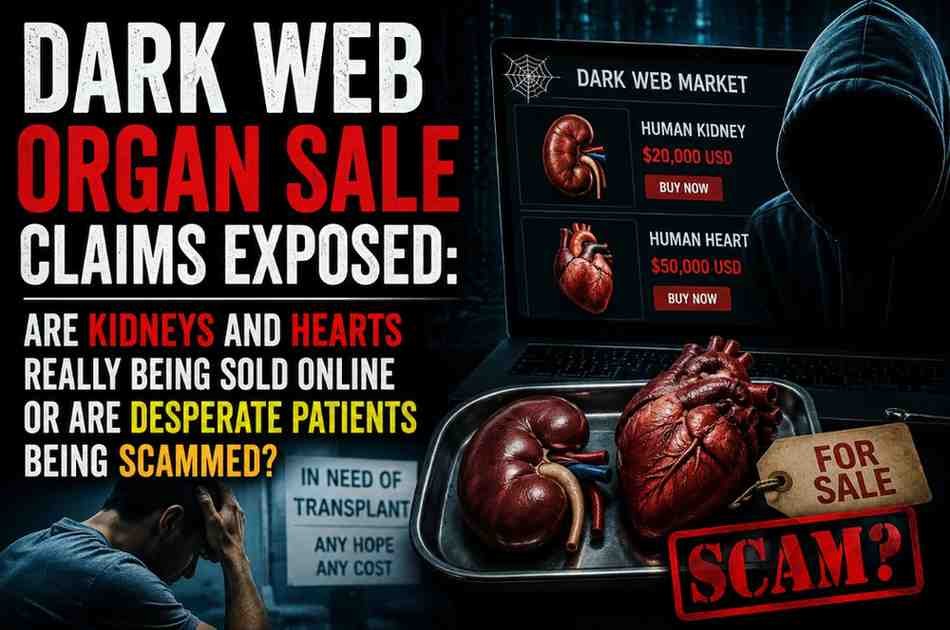
The promise sounds almost unbelievable: a matching kidney within 24 hours, surgery arranged at a reputed hospital, and a donor ready after a small Bitcoin deposit. For patients facing life-threatening illnesses and long transplant waiting lists, such offers can appear to be a last ray of hope.
However, beneath the anonymous marketplaces of the dark web lies a far more troubling reality. Websites advertising human organs as though they were ordinary online products are increasingly appearing on hidden internet networks, complete with price tags, shopping-cart interfaces, and encrypted messaging channels. While these listings project an image of sophisticated international operations, experts say many of their claims directly contradict established medical practices and India’s strict legal framework governing organ transplantation.
The growing presence of these advertisements raises two equally serious concerns. First, they highlight the continuing threat of illegal organ trafficking worldwide. Second, and perhaps more commonly, they point to elaborate advance-payment scams that prey on families willing to do almost anything to save a loved one.
Understanding the difference between genuine criminal trafficking networks and online fraud is essential not only for patients but also for healthcare professionals, policymakers, and cybersecurity agencies.
How the Alleged Dark Web Organ Market Operates
Investigations into hidden online marketplaces have revealed websites advertising organs such as kidneys, hearts, lungs, and livers with detailed descriptions resembling conventional e-commerce platforms.
Prospective buyers are typically instructed to move conversations from anonymous websites to encrypted messaging platforms, where sellers claim they can arrange:
- Matching organ donors.
- Medical evaluations.
- Hospital admissions.
- Surgical procedures.
- International transportation.
- Rapid delivery timelines.
Payments are usually requested through cryptocurrencies such as Bitcoin before any verifiable documentation is provided. The requirement for an upfront deposit is one of the strongest warning signs identified by cybercrime investigators.
Why Bitcoin Is Commonly Requested
Cryptocurrencies have become a preferred payment method in many online fraud schemes because blockchain transactions are difficult to reverse and can complicate efforts to identify recipients.
While cryptocurrencies themselves are legitimate financial technologies used for lawful purposes worldwide, scammers frequently exploit their irreversible nature to collect advance payments from victims.
Once funds are transferred, recovering them can be extremely difficult.
What India’s Organ Transplant Laws Actually Allow
India has one of the world’s most comprehensive legal frameworks governing organ transplantation through the Transplantation of Human Organs and Tissues Act (THOTA), first enacted in 1994 and subsequently amended.
The law establishes strict safeguards designed to prevent organ trafficking and commercial exploitation.
Among its key provisions are:
- Commercial sale or purchase of human organs is prohibited.
- Living donations are generally permitted only between close relatives or in specific legally approved circumstances.
- Non-related donations require detailed scrutiny and authorization.
- Deceased donor organs are allocated through regulated national and state systems.
- Hospitals must comply with rigorous documentation and approval requirements.
These legal safeguards make many of the promises advertised by dark web vendors incompatible with India’s transplantation process.
Why a “24-Hour Kidney” Is Medically Unrealistic
Medical specialists emphasize that organ transplantation involves much more than locating a donor with the correct blood group.
Before any transplant can proceed, multiple evaluations are required, including:
- Blood group compatibility.
- Tissue matching.
- Crossmatch testing.
- Comprehensive medical evaluation of donor and recipient.
- Assessment of infectious diseases.
- Legal verification and documentation.
- Ethics committee or authorization committee approvals where applicable.
These procedures are designed to maximize patient safety and ensure compliance with the law. They cannot ordinarily be completed within a matter of hours simply because a payment has been made online.
Understanding India’s Organ Allocation System
India allocates deceased donor organs through the National Organ and Tissue Transplant Organisation (NOTTO) along with regional and state-level coordinating bodies.
The allocation process is based on established medical criteria, urgency, compatibility, and waiting lists rather than financial transactions.
| Legal Organ Transplant Process | Typical Dark Web Claim |
|---|---|
| Government-regulated allocation. | Immediate purchase after payment. |
| Comprehensive medical testing. | Instant donor availability. |
| Identity verification. | Anonymous transactions. |
| Hospital oversight. | Hospital details revealed only after payment. |
| Legal authorization. | No official documentation required. |
The differences illustrate why experts caution patients against trusting online advertisements that promise immediate organ availability.
The Rise of Advance-Payment Medical Scams
Cybersecurity specialists note that many fraudulent operations follow a familiar pattern.
Scammers often:
- Promise urgent solutions to life-threatening problems.
- Create artificial scarcity.
- Demand immediate deposits.
- Use emotional pressure.
- Claim confidentiality is necessary.
- Provide unverifiable credentials.
Victims are frequently told that revealing hospital names or physician identities before payment would jeopardize the operation or attract law enforcement attention.
These tactics are consistent with numerous advance-fee fraud schemes seen across different sectors.
Why Scammers Target Desperate Patients
Organ failure places enormous emotional, financial, and psychological strain on patients and their families.
Lengthy waiting lists, uncertainty about donor availability, and fear of deteriorating health can make individuals particularly vulnerable to fraudulent promises.
Unlike conventional online scams targeting luxury goods or investments, medical fraud exploits hope itself one of the strongest emotional motivators.
For families facing critical illness, the promise of immediate treatment may override normal caution.
The Role of the Dark Web
The dark web refers to websites accessible only through specialized software rather than standard internet browsers.
While portions of the dark web serve legitimate privacy-related purposes, its anonymity also attracts illegal marketplaces, cybercriminal forums, and fraud operations.
Importantly, merely finding an advertisement on the dark web does not establish that the advertised service genuinely exists.
Many listings are created solely to deceive users into sending money.
Encrypted Messaging Platforms and Anonymous Communication
Investigators have observed that conversations frequently shift from hidden websites to encrypted messaging applications.
Moving discussions away from publicly accessible marketplaces offers several advantages to suspected fraudsters:
- Reduced public visibility.
- Greater anonymity.
- Direct communication with victims.
- Ability to delete conversations.
- Fewer opportunities for external verification.
It is important to note that encrypted messaging services themselves are widely used for lawful communication by millions of users worldwide. Their availability does not imply involvement in illegal activity, though criminals may misuse such platforms.
Global Organ Trafficking: A Real Crime With Complex Networks
Although many online advertisements may be fraudulent, illegal organ trafficking is a genuine international crime recognized by global law enforcement agencies and public health organizations.
Trafficking networks have historically exploited vulnerable populations through coercion, deception, or financial desperation.
Governments and international organizations continue strengthening cross-border cooperation to investigate suspected trafficking networks, improve transplant transparency, and protect both donors and recipients.
However, proving the existence of any particular online marketplace requires substantial investigative evidence beyond anonymous internet claims.
Warning Signs of an Organ Purchase Scam
| Red Flag | Why It Is Concerning |
|---|---|
| Advance cryptocurrency payment. | Funds are difficult to recover. |
| Guaranteed organ availability. | Medical compatibility cannot be guaranteed instantly. |
| Hospital identity withheld. | Legitimate medical providers identify themselves. |
| Pressure to act immediately. | Common manipulation tactic in fraud. |
| No official documentation. | Legal transplantation requires extensive records. |
| Anonymous communication only. | Limits accountability and verification. |
How Patients Can Protect Themselves
Individuals seeking organ transplantation should rely exclusively on authorized medical institutions and official transplant coordination systems.
Before responding to any online offer, patients should:
- Consult their treating physician.
- Verify transplant eligibility through authorized hospitals.
- Check registration with official transplant authorities.
- Never send cryptocurrency to unknown individuals.
- Report suspicious advertisements to cybercrime authorities.
If an offer appears dramatically easier or faster than established medical procedures, it deserves careful scrutiny.
A Bigger Issue: Organ Shortages Fuel Criminal Exploitation
One important aspect often overlooked is that fraudulent schemes flourish because legitimate organ shortages persist worldwide.
The gap between patients awaiting transplants and available donor organs creates an environment in which false promises can thrive.
Increasing public awareness about deceased organ donation, strengthening transplant infrastructure, improving donor registration, and expanding ethical transplantation programs remain among the most effective long-term responses to both organ trafficking and related scams.
The greatest danger posed by dark web organ marketplaces may not be that they can reliably deliver illegal transplants, but that they exploit fear, urgency, and hope to convince vulnerable families to part with life-changing sums of money.
Future Outlook
As cybercriminals become increasingly sophisticated, medical fraud is expected to evolve alongside advances in encrypted communications, anonymous payment systems, and online marketplaces. Law enforcement agencies, cybersecurity experts, healthcare institutions, and transplant authorities will likely continue strengthening cooperation to identify fraudulent networks and protect vulnerable patients.
For the public, awareness remains the strongest defense. India’s organ transplantation system is built upon rigorous legal safeguards designed to protect both donors and recipients. While waiting periods can be emotionally difficult, bypassing official channels through anonymous online sellers exposes patients to significant financial, legal, and health risks.
The investigation into dark web organ advertisements serves as a timely reminder that in healthcare, extraordinary promises deserve extraordinary scrutiny. When a website claims to deliver a life-saving organ within days after a cryptocurrency deposit, the evidence suggests the real product being sold may not be a transplant at all but false hope.
For breaking news and live news updates, like us on Facebook or follow us on Twitter and Instagram. Read more on Latest India on thefoxdaily.com.






COMMENTS 0