
The Reserve Bank of India (RBI) has issued a fresh warning about KYC fraud, highlighting how scammers are using the fear of bank-account suspension to trick customers into revealing sensitive banking information. The fraud often begins with an unexpected WhatsApp message, SMS or phone call claiming that a customer’s KYC is incomplete and must be updated immediately.
The message may appear routine at first. It can mention a bank account, credit card or KYC deadline and warn that services will be blocked if the customer does not act. The urgency is the trap. Once a victim clicks an unfamiliar link, speaks to a supposed bank representative or installs an unofficial application, the scam can move from a fake KYC request to theft of financial credentials and, in some cases, OTP interception.
RBI’s warning asks customers to follow a simple principle: Stop, Think and Act. The advice is particularly relevant because a KYC-related scam does not necessarily depend on a victim voluntarily handing over an OTP. Malicious applications can potentially capture information entered on a device and intercept SMS-based authentication messages.
What is the RBI’s warning about KYC fraud?
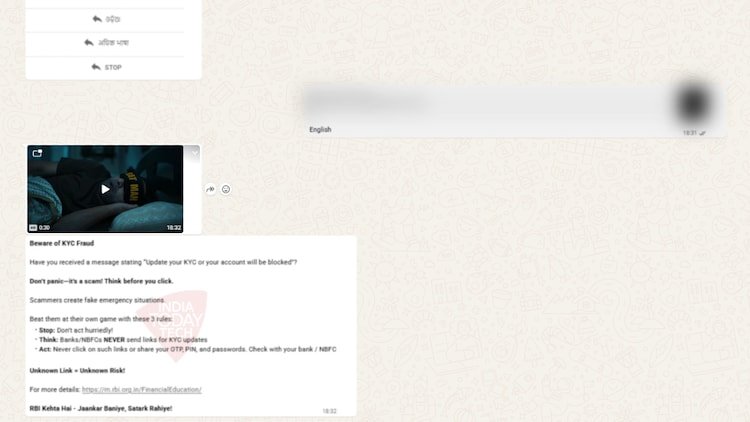
KYC, or Know Your Customer, is the process financial institutions use to establish and maintain customer identity information. Because legitimate banking customers are familiar with KYC requirements, scammers use the term to make fraudulent messages sound official.
A typical KYC scam starts with a message saying that the customer’s account information is outdated or incomplete. The victim may then be told to click a link, download an application, provide card details or contact a number to avoid account restrictions.
RBI is warning customers not to react automatically to such demands. A message that creates panic is not proof that the underlying request is genuine.
The central bank’s warning specifically tells users to be cautious about links presented as KYC-update mechanisms. It says banks and non-banking financial companies do not send links for KYC updates, making an unexpected link in a KYC-blocking message a significant warning sign.
The three RBI rules every banking customer should remember
1. Stop before clicking anything
The first step is deliberately simple: stop.
Fraudsters rely heavily on urgency. A message may say an account will be blocked, a card will stop working or a KYC deadline is about to expire. The purpose is to leave the customer with little time to question the request.
Instead of clicking immediately, users should pause and examine how the request arrived. An unexpected message should never be treated as an instruction simply because it uses a bank’s name or logo.
Do not open an unfamiliar KYC link, download an application from a message or call a phone number supplied by a suspicious sender.
2. Think before trusting the message
The second RBI rule is to think about whether the request makes sense.
If a message claims to come from a bank or NBFC and asks you to click a link to complete KYC, that should be treated as a red flag. Customers should independently verify the request instead of using the contact details supplied by the sender.
For example, if you receive a message saying your bank account will be blocked, open the bank’s official application yourself or visit its official website by entering the address independently. You can then check whether there is actually a KYC requirement attached to your account.
This small change in behaviour can make a major difference. The key is to separate the warning message from the verification process. The sender should not control how you verify the claim.
3. Act only through official channels
The third rule is to act carefully after verifying the situation.
Customers should never disclose their OTP, PIN, password or other sensitive banking credentials to an unknown caller or through an unfamiliar website. If a KYC update is genuinely required, the customer should complete it using the bank’s legitimate channels.
RBI’s message also captures the broader risk with a simple warning: “Unknown Link” means “Unknown Risk.”
That principle applies beyond KYC scams. A link that arrives unexpectedly can lead to a fake login page, a fraudulent payment request or malicious software. The safest approach is to avoid using the link altogether and independently access the institution’s official platform.
How scammers can get access to bank OTPs
One of the most concerning aspects of modern KYC fraud is that scammers may attempt to steal information without simply asking victims to read out an OTP.
In some reported cases, fraudsters have persuaded victims to install an APK file presented as a banking application. APK is the file format commonly used to install Android applications outside the standard app-store process. An application received from an unknown source can create significant security risks.
In a recent case cited in the supplied report, police in Noida busted an alleged cyber-fraud call centre where suspects reportedly posed as bank representatives. They allegedly contacted credit-card users using claims involving KYC updates and reward points.
According to the police investigation described in the report, victims were persuaded to download an APK that appeared to be a banking application. The malicious software could capture sensitive information entered by users and intercept OTPs sent to their phones. The allegedly stolen card information and OTPs were then used to make purchases, including gold and silver coins.
The case illustrates why downloading an application is potentially much more dangerous than simply clicking a suspicious message. Once malicious software is installed, the attack can involve information on the device rather than depending entirely on a victim voluntarily sharing every credential.
Why a fake KYC call can look convincing
Fraudsters often make their approach sound plausible because KYC is a genuine part of the financial system.
A caller may introduce themselves as a bank employee and claim that a customer’s account, debit card or credit card needs immediate verification. The scammer may then provide a reason for the supposed problem, such as incomplete documentation, an expired KYC record or a pending reward.
The objective is to move the conversation away from verification and toward action.
Once the customer is convinced that the call is genuine, the scammer may send a link, request personal information or persuade the victim to install an application. That is why RBI’s “Stop, Think and Act” approach is useful: it interrupts the psychological pressure that makes these scams effective.
Gurugram case shows how quickly money can disappear
The risk is not limited to large-scale Cybercrime operations. The supplied report also refers to a recent case in Gurugram in which a man allegedly lost Rs 1.28 lakh after receiving a call from someone claiming to be an Axis Bank official.
The caller allegedly told the victim that his KYC was incomplete. After the victim clicked a link provided during the interaction, money was subsequently withdrawn from his account.
The reported case demonstrates why a seemingly harmless KYC request should not be treated casually. A customer may believe they are simply completing a verification procedure when, in reality, they are being directed toward a fraudulent process.
It also highlights an important distinction: the presence of a bank’s name in a message or phone call does not establish that the communication actually came from the bank.
KYC fraud red flags you should never ignore
Although scammers can change their scripts, several warning signs repeatedly appear in KYC-related fraud attempts.
- A message unexpectedly says your bank account will be blocked.
- You are pressured to complete KYC immediately or face a penalty.
- The sender asks you to click an unfamiliar link.
- You are asked to install an APK or banking application from an unknown source.
- A caller asks for an OTP, PIN, password or card-related security information.
- The phone number, website address or application does not match the bank’s official channels.
- You are told not to contact the bank directly or are discouraged from verifying the request.
Any one of these signs should be enough to slow the interaction down. Several appearing together should be treated as a strong indication that the communication may be fraudulent.
Why OTP theft is particularly dangerous
An OTP is designed to provide an additional layer of authentication for certain transactions or account actions. That makes it valuable to fraudsters.
If attackers obtain card or account information and also manage to obtain an authentication code, they may have more information needed to attempt unauthorized transactions. The exact protections and authentication process vary between banks and financial services, but customers should never assume that an OTP is harmless information.
That is also why RBI’s warning goes beyond the traditional advice of “don’t tell anyone your OTP.” The method of theft can matter. A malicious application may attempt to access information on the device, which means the safest strategy is to prevent suspicious software from being installed in the first place.
What you should do if you receive a suspicious KYC message
The safest response is not to investigate the message using the message itself.
If an SMS, WhatsApp message or email claims that your KYC needs to be updated, do not click its link. Instead, independently open your bank’s official app or website and check for notifications. You can also use the customer-care details published through the bank’s legitimate channels.
If a caller claims to represent your bank, end the call if necessary and contact the institution independently. Do not call back using a number supplied by the suspicious caller.
If you have already clicked a suspicious link or installed an unfamiliar application, treat the situation seriously. Avoid providing additional information and contact your bank through an official channel as quickly as possible, particularly if you notice an unauthorized transaction or unusual account activity.
What RBI’s warning means for bank customers
The most important lesson from the RBI warning is that customers should not confuse urgency with authenticity.
A message saying an account will be blocked is designed to trigger an immediate response. But legitimate financial decisions should not be made under pressure from an unknown sender. Verification should happen independently through the institution’s established channels.
The warning is also a reminder that Digital Banking fraud is increasingly dependent on social engineering. Criminals do not necessarily need to break into a bank’s systems to target an individual customer. They can instead attempt to manipulate the customer into providing access, installing malicious software or revealing information.
That makes customer behaviour an important part of Financial Security.
What could happen next in KYC scam cases
The specific methods used by fraudsters are likely to change as customers become familiar with existing scam messages. A KYC warning may be replaced by claims about card rewards, account verification, refunds or other banking services.
The underlying tactic remains similar: create urgency, establish false trust and push the customer toward an action that benefits the fraudster.
For customers, the most effective defence is therefore not memorising one particular scam message. It is developing a habit of independent verification.
If a message asks you to update KYC, stop. If it provides a link, think before opening it. If action is genuinely required, contact the bank through an official channel and complete the process there.
RBI’s three-word approach, Stop, Think and Act, is ultimately about breaking the chain before a suspicious message becomes a financial loss. In an environment where a fraudulent link can potentially lead to stolen credentials, malicious software and intercepted OTPs, a few minutes of verification can be far more valuable than immediately following an urgent instruction.
For breaking news and live news updates, like us on Facebook or follow us on Twitter and Instagram. Read more on Latest Business on thefoxdaily.com.






COMMENTS 0