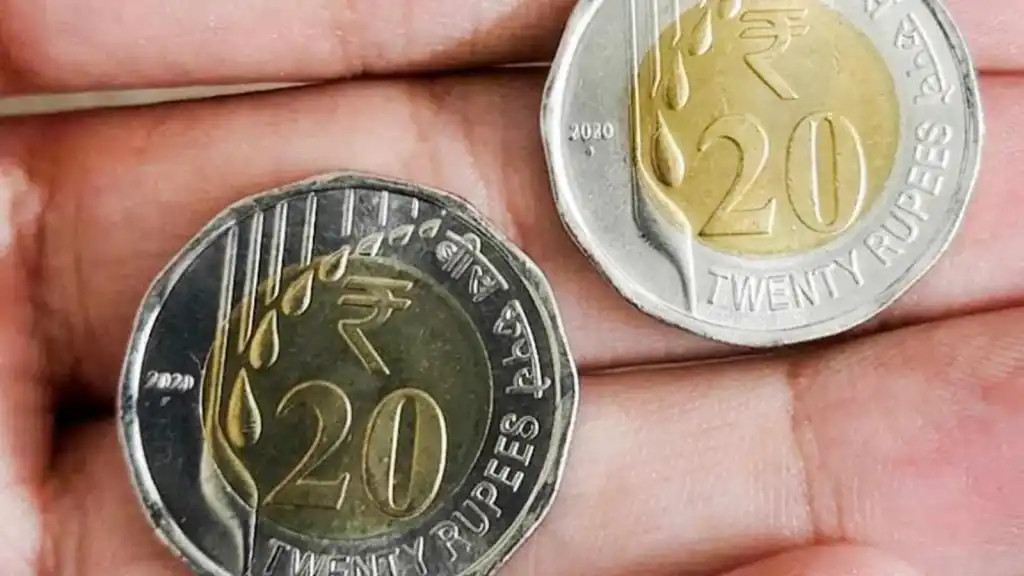
A counterfeit ₹20 coin manufacturing racket operating across several Indian states has come under the scanner after Saharanpur Police uncovered an alleged production unit in Haryana’s Sonipat district. The operation, which reportedly operated under the cover of a screwdriver manufacturing business, allegedly circulated fake coins through a network spanning Haryana, Delhi, Punjab, Uttar Pradesh, Bihar and Jharkhand.
Police said the accused claimed to have circulated counterfeit coins with a combined face value exceeding ₹70 crore, although investigators have not yet verified the figure. The case came to light on September 13, when police intercepted five men allegedly transporting six heavy machines from Sonipat to Uttar Pradesh.
How Police Uncovered the Counterfeit ₹20 Coin Racket
The investigation began after an informer alerted Saharanpur Police that three men were searching for a space of approximately 500 square feet to install six heavy machines. The men reportedly claimed they intended to use the equipment to manufacture tools, but their behaviour raised suspicion.
Police intercepted the group in the Titron area of Saharanpur district. The three men were identified as Upkar Luthra alias Abhay Pratap Singh, 62, Himanshu alias Gullu, and Kuldeep, both in their 30s.
During questioning, police discovered that two associates, Santosh Chaurasia alias Janardhan from Madhubani in Bihar and Anurag Pal alias Lankesh from Sant Ravidas Nagar in Uttar Pradesh, were waiting at a nearby crossing in separate vehicles.
Police moved to the location and apprehended the two men. They recovered six heavy machines from the vehicles, along with 6,400 counterfeit ₹20 coins carrying a face value of ₹1.28 lakh. Semi-finished coins estimated to have a face value of around ₹5 lakh were also seized.
According to investigators, the group had been operating from Sonipat for approximately 10 months, using a screwdriver manufacturing business as a front for producing counterfeit coins.
The operation reportedly came under pressure after one of its associates was arrested by Delhi Police. Fearing another raid, the accused shut down the Sonipat unit and attempted to move the machinery to Uttar Pradesh.
An investigating officer told The Indian Express that the group had not even identified a new location before shifting the equipment. Police said Upkar had allegedly travelled to Saharanpur after Himanshu assured him that he could arrange land for setting up another unit.
Who Were the Main Accused?
Police identified Upkar Luthra as a key figure in the alleged operation. A background check reportedly revealed that he had previously been arrested by Delhi Police in connection with counterfeit coin manufacturing.
Investigating officer and station house officer Rajeev Kumar Kaushik said Upkar had earlier worked as a goldsmith and used his acquired skills to experiment with counterfeit coins.
“He had earlier worked as a goldsmith and used the skills he had acquired to experiment with counterfeit coins, gradually refining the process to make them resemble genuine ones,” Kaushik said.
Police said Upkar met Himanshu in Tihar Jail, after which the two allegedly developed the network. Other members reportedly joined the operation after meeting them in different prisons.
Investigators said the accused had allegedly installed manufacturing machines at different locations across India, including Delhi, and shifted operations whenever they feared police action.
How Were the Fake ₹20 Coins Manufactured?
According to police, the accused used six heavy machines, specially made iron dies and other equipment to manufacture counterfeit ₹20 coins.
During questioning, the accused allegedly told investigators that they procured coin-sized metal rings made from a mixture of aluminium, copper and nickel from a Delhi-based unit. They then obtained specially manufactured dies designed to replicate genuine ₹20 coins from another unit in Delhi.
The metal rings were placed into machines, where the dies were pressed onto them. The coins were subsequently refined to improve their appearance, circular shape and finish.
A police officer explained the process:
“The dies were pressed onto the rings, after which the machines were used to refine the coins, giving them a brighter finish and a more precise circular shape.”
The machinery and tools recovered during the operation included 39 unmarked dies, 20 marked dies, a die-polishing machine, two grinding stones, four brushes, eight files, five hammers, an iron-cutting saw, two pipe wrenches, a vice, 16 wrenches, six spanners, a screwdriver, pliers and a Vernier caliper.
Accused Claimed They Could Produce 12,000 Fake Coins Daily
During interrogation, the accused allegedly claimed that their manufacturing unit could produce between 10,000 and 12,000 counterfeit ₹20 coins every day.
They reportedly told police that each coin cost approximately ₹5 to ₹6 to manufacture. However, investigators said they could not independently verify the production capacity because the machines were not operating when the equipment was recovered in Saharanpur.
Police also described how responsibilities were allegedly divided among the group members:
- Upkar Luthra: Oversaw the finishing of the coins.
- Santosh Chaurasia: Handled the manufacturing process.
- Anurag Pal: Managed the overall factory operations.
- Kuldeep and Himanshu: Oversaw the circulation of counterfeit coins.
How Fake ₹20 Coins Allegedly Entered the Market
Police said the accused allegedly supplied counterfeit coins to intermediaries in packets containing 100 pieces. The coins, carrying a face value of ₹200 per packet, were reportedly sold for ₹160.
These packets were then allegedly distributed to young people who were instructed to circulate the coins at toll plazas, liquor shops, small-town markets and village shops.
According to a police officer, the young distributors were allegedly unaware that the coins were counterfeit. The accused reportedly gave them the impression that they were simply helping dispose of large quantities of genuine coins.
Investigators said the alleged distribution network extended across Haryana, Delhi, Punjab, Uttar Pradesh, Bihar and Jharkhand.
Saharanpur Senior Superintendent of Police Abhinandan said the accused claimed to have circulated counterfeit coins worth more than ₹70 crore.
“The accused claimed they had so far circulated counterfeit coins worth more than Rs 70 crore in the market,” Abhinandan said.
Police have yet to verify the claimed amount or establish the actual volume of counterfeit coins that entered circulation.
Earlier Counterfeit Coin Manufacturing Busts in Delhi and Haryana
The Saharanpur case follows earlier police operations against counterfeit coin manufacturing units in Delhi and Haryana in 2016 and 2019.
2016: Delhi Police Uncover Three Manufacturing Units
In October 2016, Delhi Police uncovered three counterfeit coin manufacturing units in Delhi and Haryana within a period of 10 days. Investigators recovered fake coins with a combined face value of ₹12.24 lakh.
One of the units was operating from a factory in Bawana, on the outskirts of Delhi. Police said the facility had been running for approximately six months and used six hydraulic machines to manufacture counterfeit ₹5 and ₹10 coins.
The accused had allegedly established a Teflon-coating business as a cover before shifting to counterfeit coin production. Aluminium and brass sheets were cut at a separate nearby factory, and the metal pieces were pressed together using hydraulic machines and dies. The finished coins were then packed in gunny bags for distribution.
The investigation reportedly began after police arrested a man in Rohini with counterfeit coins worth ₹40,000. During questioning, he allegedly told investigators that the Luthra brothers were operating the Bawana unit.
Upkar Luthra was allegedly involved in the 2016 case, along with his brother Swikaar Luthra alias Sonu, according to the information provided in the investigation report.
2019: Faridabad Police Bust Another Fake Coin Factory
In May 2019, the Crime Branch of Faridabad Police uncovered another counterfeit coin manufacturing operation in the Ganpati Dham Industrial Area of Bahadurgarh, Haryana.
The factory had reportedly been rented under the pretext of manufacturing thermocol plates. Police first intercepted a vehicle on Surajkund Road and recovered 50,000 counterfeit ₹5 coins hidden in packets beneath the passenger seats.
A subsequent raid at the factory led to the recovery of another 50,000 coins, including some that were still being manufactured. Follow-up investigations also led police to a second unit in the same industrial area, where additional machines and equipment were seized.
Sixth Accused Arrested in Bihar
The investigation continued after the initial arrests. Saharanpur Police recently travelled to Madhubani in Bihar and conducted a joint operation with Bihar Police at a suspected hideout.
During the operation, police arrested Mithlesh Chaurasia, 55, the brother of previously arrested accused Santosh Chaurasia. Investigators alleged that Mithlesh was associated with the group and helped arrange raw materials and labourers.
Investigating officer Rajeev Kumar Kaushik said Mithlesh’s arrest took the total number of people arrested in the case to six.
Kaushik also said another alleged member of the network, Paras Jain, had been arrested by Delhi Police in September.
What the Case Reveals About Counterfeit Currency in India
The Saharanpur investigation has drawn attention to counterfeit coins as a separate challenge for law enforcement agencies. While counterfeit banknotes remain under scrutiny, police say organised groups have allegedly exploited coin manufacturing and distribution networks to circulate fake currency.
According to the figures cited in the report, the number of counterfeit banknotes detected in India increased from 2,17,396 in 2024-25 to 2,29,746 in 2025-26. These figures relate to banknotes rather than coins, but the Saharanpur case highlights the alleged scale of counterfeit coin production and distribution.
India’s currency system also distinguishes between the authorities responsible for banknotes and coins. Banknotes are issued by the Reserve Bank of India, while coins are minted by the Government of India under the Coinage Act, 2011, at government facilities in Mumbai, Kolkata, Noida and Hyderabad. The RBI is responsible for putting coins into circulation.
Producing counterfeit currency is a serious criminal offence that can attract severe punishment, including life imprisonment under the applicable law.
For now, investigators are working to establish the actual scale of the alleged operation, verify the accused’s claim of circulating counterfeit coins worth more than ₹70 crore and identify the full network involved in manufacturing and distributing the fake ₹20 coins.
For breaking news and live news updates, like us on Facebook or follow us on Twitter and Instagram. Read more on Latest India on thefoxdaily.com.






COMMENTS 0