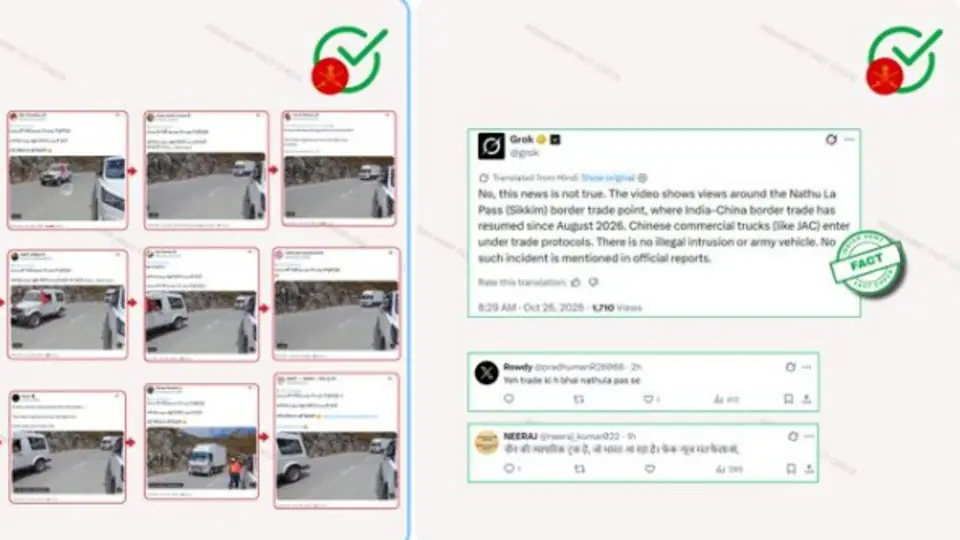
The Indian Army has rejected social media claims that Chinese vehicles entered Indian territory illegally at Nathu La Pass in Sikkim, describing the viral footage as misleading and stripped of its original context. The Army’s fact-checking unit said the video showed Chinese commercial vehicles at a designated India-China Border trade point, not evidence of an unauthorised military intrusion.
The clarification comes amid heightened public sensitivity around India-China border security and the circulation of online content alleging territorial incursions. The Army also identified 12 social media accounts that allegedly circulated the footage within a short period on October 26, 2026, raising concerns about coordinated amplification of misleading claims.
Indian Army Explains What the Nathu La Video Shows
In a post titled “Coordinated Inauthentic Behaviour Exposed”, the Indian Army’s official fact-checking wing said the video showed JAC-branded Chinese commercial vehicles at Nathu La Pass. The location is a designated border trade point between India and China, where commercial movement operates under established bilateral arrangements and regulated procedures.
According to the Army, social media accounts presented the footage as evidence that Chinese vehicles had entered Indian territory without authorisation. Some accompanying captions also alleged that mainstream Indian media was deliberately concealing the incident.
The Army said this portrayal omitted the authorised trade context and falsely suggested that routine commercial vehicle movement amounted to a border security breach.
In its statement on X, the fact-checking unit said accounts were circulating footage of Chinese vehicles near the border while falsely portraying the movement as an unauthorised entry into Indian territory.
Why Nathu La Is Important in India-China Border Trade
Nathu La is a mountain pass in Sikkim that serves as an established point for cross-border trade between India and China. Its location near the international boundary makes it strategically significant, while its trade arrangements provide a regulated framework for permitted commercial activity.
The presence of Chinese commercial vehicles at an authorised trade point does not, on its own, establish that a military incursion has occurred. The nature of the vehicles, the route they are using and the applicable border arrangements are important when assessing claims about activity in the area.
The Army’s clarification focused on this distinction. It said the footage was being presented without the context needed to understand why the commercial vehicles were present at Nathu La.
However, the clarification should be understood within its stated scope: the Army rejected the claim that the particular footage demonstrated an unauthorised entry. The supplied information does not provide additional operational details about the vehicles or a separate account of every movement along the border.
Army Identifies 12 Social Media Accounts
The Army’s fact-checking wing identified 12 social media handles that it said circulated the same content between 8:26 am and 12:56 pm on October 26, 2026.
The handles named in the Army’s post were:
- @VarisRajput01
- @RituChoudhryINC
- @AsdhirDubey
- @imharshchhikara
- @SunilYadav990
- @ANKITVERMA90648
- @Ravipandey4AAP
- @rastrijans19021
- @Pradeep_JAAT_00
- @fahad_4884_
- @vikrampanchal68
- @MohitArjun1
The identification of these accounts reflects the Army’s allegation that the footage was circulated in a coordinated pattern. The supplied information does not establish the identities behind every handle, whether the account holders acted together intentionally or whether any legal action was initiated against them.
How the Army described the alleged disinformation pattern
According to the fact-checking unit, the posts combined three elements: footage of Chinese commercial vehicles, the omission of the authorised border trade context and a claim that the vehicles had entered Indian territory illegally.
The Army said the repeated circulation of the same material amplified a misleading portrayal of the border situation. It urged users to verify the location, original footage and official context before sharing similar claims.
The episode illustrates how authentic video can be used to support an inaccurate conclusion when important contextual information is removed. A clip may genuinely show vehicles near a border while still failing to prove the specific allegation attached to it.
Army Also Debunks Deepfake Video About Arunachal Pradesh
The Nathu La clarification follows another fact-check by the Indian Army concerning a digitally manipulated video that falsely attributed remarks about Chinese control of areas in Arunachal Pradesh to Lt Gen Girish Kalia.
The video claimed that Kalia had made a leaked admission that China had taken control of Asaphila, Longjou and Taksing Circle in Arunachal Pradesh. It also alleged that Indian Army troops deployed in the sector had been denied essential supplies.
The Army’s fact-checking unit rejected those claims, describing the statements attributed to the senior officer as fabricated. It said the video used AI-generated techniques, including lip-syncing and voice cloning, over authentic archival footage.
Original footage came from a 2023 briefing
According to the Army, the original footage came from a press briefing delivered in Kupwara, Jammu and Kashmir, on October 27, 2023. The briefing was conducted by the then General Officer Commanding of the 28 Infantry Division, Maj Gen Girish Kalia.
The manipulated video allegedly overlaid fabricated speech onto the archival footage to make it appear that the officer had made statements about Chinese territorial control and shortages affecting Indian troops.
The distinction is important because authentic video does not guarantee that the audio or statements circulating with it are genuine. AI-enabled voice cloning and lip-syncing can make altered material appear convincing, particularly when it is shared without a link to the original recording.
How to Verify Viral Claims About Border Incidents
Claims involving military activity, territorial control or troop movements can spread quickly on social media. Such reports may cause unnecessary alarm if footage is miscaptioned, manipulated or circulated without enough information to establish where and when it was recorded.
Users can take several steps before sharing content that claims to show a border intrusion or a military admission:
- Check the original source: Look for the earliest available upload and determine whether the footage has been published by an official source or a credible news organisation.
- Verify the location: Compare visible landmarks and other available details with the location claimed in the caption.
- Look for official clarification: Check statements from the Indian Army, government agencies or other relevant authorities when a post makes a serious security claim.
- Inspect the audio and video: Be cautious of clips that lack a full recording, contain unusual audio transitions or present dramatic statements without a verifiable source.
- Separate footage from interpretation: A video may be genuine while the claim attached to it is false or unsupported.
These steps do not replace independent verification, but they can help prevent misleading content from spreading before the relevant facts are established.
What the Clarifications Mean for India-China Border Reporting
India-China border developments attract significant public attention because of the strategic importance of the boundary and the history of tensions between the two countries. Reports of a possible intrusion therefore require careful examination of the location, circumstances and evidence involved.
In the Nathu La case, the Army said the video showed commercial vehicles operating at a designated trade point rather than evidence of an unauthorised entry. In the Arunachal Pradesh case, it said a manipulated video used fabricated statements attributed to a senior officer.
The two incidents involve different forms of misleading content: footage presented out of context in one case and AI-assisted manipulation in the other. Both demonstrate why claims about military activity should be checked against original material and reliable information before being treated as fact.
Key Takeaways
- Nathu La video: The Indian Army said the footage showed JAC-branded Chinese commercial vehicles at an authorised India-China border trade point in Sikkim.
- Alleged coordinated circulation: The Army identified 12 social media handles that it said shared the footage within a period of roughly four and a half hours on October 26, 2026.
- Arunachal Pradesh deepfake: The Army rejected a separate video that falsely attributed claims about Chinese control of Indian areas and shortages of supplies to Lt Gen Girish Kalia.
- AI manipulation: The Army said the second video used AI-enabled lip-syncing and voice cloning over authentic footage from a 2023 press briefing.
- Public caution: The Army urged social media users to verify the original footage, location and official context before sharing claims about border security.
Conclusion
The Indian Army’s fact-checks highlight the importance of context and verification when assessing viral claims about India’s borders. In the Nathu La case, the Army said authorised commercial vehicle movement was being misrepresented as an unauthorised Chinese entry. In the separate Arunachal Pradesh case, it said AI-generated alterations were used to attribute fabricated statements to a senior officer.
As edited videos and misleading captions become easier to circulate, checking original footage and consulting credible sources remain essential. Claims involving national security should be evaluated on the available evidence rather than the emotional impact of a viral post.
For breaking news and live news updates, like us on Facebook or follow us on Twitter and Instagram. Read more on Latest India on thefoxdaily.com.






COMMENTS 0