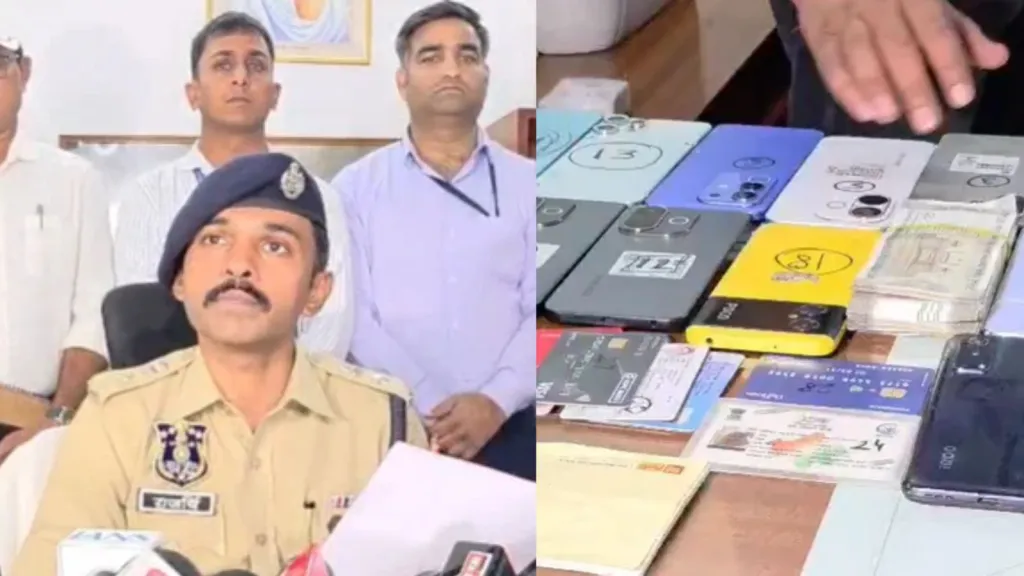
Jaipur South police have arrested 21 people and uncovered an alleged cyber fraud network linked to 101 complaints across multiple states, involving suspected financial fraud worth Rs 18.6 crore. The operation exposed several methods allegedly used by cybercriminals, including fake online vehicle deals, fraudulent social media pages, impersonation of Central Bureau of Investigation (CBI) officers, and the use of bank accounts opened or obtained through commissions.
The investigation also revealed the alleged use of mule bank accounts, forged Know Your Customer (KYC) documents, and fake PAN and Aadhaar cards to move money obtained through Online Scams. According to police, an examination of cheque books and passbooks recovered during the operation helped investigators identify complaints registered on the national cybercrime reporting system.
Police registered 15 cases as part of a special drive against cyber fraud and the misuse of bank accounts. The operation forms part of Rajasthan’s broader efforts to curb online financial crime through the state-wide Cyber Shield campaign, which focuses on identifying fraud networks, tracing money trails, and improving public awareness.
Jaipur cyber fraud case: Rs 18.6 crore linked to 101 complaints
The scale of the alleged fraud became clearer after investigators examined financial documents recovered from the arrested individuals. Police identified 101 complaints across different states, with the alleged financial loss amounting to Rs 18.6 crore. Of this amount, Rs 45.83 lakh was found in bank accounts examined during the investigation.
According to Jaipur South police, the recovered cheque books and passbooks provided important leads into the suspected movement of money through accounts allegedly used by cybercriminals. Such accounts, commonly described as mule accounts, can be used to receive, transfer, or withdraw money obtained through fraudulent activities.
Investigators are examining the suspected links between account holders, people who allegedly arranged the accounts, and individuals accused of carrying out the online scams. The discovery of complaints across several states also points to the wider reach of the suspected network beyond Jaipur.
Police have not only focused on the individuals allegedly carrying out the scams but also on those suspected of facilitating financial transactions. Identifying the people who provide bank accounts and tracing the flow of money can help investigators understand how cyber fraud proceeds are transferred between different individuals and locations.
How the alleged cybercriminals targeted victims
According to DCP Jaipur South Rajarshi Raj, the accused allegedly used several methods to deceive people. These ranged from online advertisements offering vehicles at unusually low prices to social media fraud and impersonation of government officials. Investigators also identified suspected links to online gaming transactions and advance-payment scams involving products advertised on Facebook.
1. Fake car deals on OLX
One of the alleged methods involved offering cars at unusually low prices through OLX, an online marketplace used for buying and selling goods. Such advertisements can attract people searching for affordable vehicles, particularly when the advertised price appears significantly lower than expected.
In a typical advance-payment scam, a fraudster may use an attractive listing to persuade a prospective buyer to pay money before completing a transaction. The person may then face demands for additional payments or discover that the seller, vehicle, or offer cannot be verified. Police said the arrested individuals allegedly used low-priced vehicle offers as one of several methods to cheat people.
Anyone considering a second-hand vehicle purchase through an online marketplace should independently verify the seller and vehicle documents, inspect the vehicle in person where possible, and avoid transferring money solely on the basis of photographs or claims made in an online advertisement.
2. Fake CBI calls and threats of arrest
Another alleged method involved impersonating government officials. Police said some fraudsters posed as CBI officers and threatened victims with arrest to pressure them into transferring money.
This type of impersonation scam exploits fear and the authority associated with law enforcement agencies. A caller may claim that a person is connected to a criminal investigation and demand immediate payment to avoid arrest or other legal consequences. The pressure is intended to prevent the target from verifying the claims or seeking advice from someone they trust.
People receiving such calls should not transfer money simply because a caller claims to represent the CBI or another government agency. They should avoid sharing banking credentials, one-time passwords (OTPs), or other sensitive information and independently contact the relevant authority through verified channels if they believe the matter may be genuine.
The alleged use of fake CBI identities in the Jaipur case illustrates how cybercriminals can combine digital communication with threats to manipulate victims into making payments.
3. Fake social media pages and advance-payment fraud
Police also identified cases involving fraudulent social media pages. One suspected method involved a fake Facebook page offering 3D idols, through which victims were allegedly cheated after paying advances.
In such schemes, a seller may advertise a product, collect an advance payment, and then fail to deliver the item or provide a legitimate explanation for the delay. A professionally presented page, product photographs, and apparently attractive offers can make a fraudulent seller appear credible.
Before paying an unfamiliar online seller, consumers should check the account’s history, look for independent reviews, verify contact details, and be cautious about pressure to pay immediately. A page’s appearance or the number of followers it has should not be treated as proof that the seller is genuine.
4. Fraud linked to online gaming transactions
Investigators also identified cases involving online gaming transactions. The available details do not specify the precise method used in these cases, but their inclusion in the investigation highlights the range of activities being examined by police.
Online financial transactions can become difficult to trace when money passes through multiple accounts or intermediaries. Investigators therefore examine account records and transaction details to identify possible connections between the original complaint and the people suspected of receiving or transferring the funds.
How mule bank accounts allegedly helped the fraud network
A central finding in the investigation was the alleged use of bank accounts obtained from other people. Police said some accused allegedly persuaded individuals to open accounts in exchange for a commission and then sold those accounts to cybercriminals.
The alleged payment for each account ranged from Rs 8,000 to Rs 10,000. According to investigators, these accounts were subsequently used to route money obtained through online fraud. Transactions linked to victims in Odisha and Karnataka were among those identified during the investigation.
This practice can create distance between the victim and the people suspected of organising a scam. When money is transferred to an account registered in another person’s name, investigators must establish who controlled the account, who accessed the funds, and whether the account holder knowingly assisted the suspected criminal activity.
People who agree to provide their bank accounts in exchange for commissions may expose themselves to serious financial and legal risks. An account can be used for transactions they did not personally initiate, and its registered holder may be questioned as investigators trace suspected proceeds of crime.
Individuals should never hand over their bank accounts, debit cards, cheque books, passbooks, banking credentials, or access to mobile banking to another person for a payment or commission. They should also avoid opening accounts for someone else’s use without a legitimate and verified reason.
Fake KYC documents and PAN cards used to open accounts
Police said the investigation uncovered another alleged method involving fake Know Your Customer documents and PAN cards used to open suspicious bank accounts in different states. The operation also led to the seizure of fake PAN and Aadhaar cards belonging to 15 other people.
KYC checks are intended to help financial institutions establish the identity of customers and reduce the misuse of financial services. Documents that have been forged, altered, or used without the knowledge of their legitimate owners can undermine these safeguards and make it harder to establish who is actually controlling an account.
The suspected use of false documents across state boundaries adds another layer to the investigation. Police must establish the identities associated with the documents, determine how the accounts were opened, and trace any transactions that may be connected to reported cyber fraud.
The recovery of identity documents belonging to other people does not, by itself, establish that every named individual participated in a crime. Their relevance and the circumstances in which they were obtained would need to be examined as part of the investigation.
Items recovered during the Jaipur police operation
The operation resulted in the recovery of several items that investigators may examine for financial and digital evidence. These included mobile phones, banking documents, payment cards, cash, and identity documents.
| Item recovered | Quantity or value |
|---|---|
| Cash | Rs 2.04 lakh |
| Mobile phones | 38 |
| Scorpio SUV | 1 |
| Cheque books | 25 |
| Passbooks | 20 |
| ATM and debit cards | 30 |
| Fake PAN and Aadhaar cards | Documents belonging to 15 other people |
| Thai currency notes | 12 |
The seized mobile phones and banking documents could help investigators examine communications, account details, transaction records, and potential connections between the accused. The cheque books and passbooks were particularly significant in identifying complaints associated with the suspected network.
Police have not established in the supplied case details that every recovered item was directly involved in a specific fraudulent transaction. The evidentiary significance of the seized material depends on the findings of the investigation.
Cyber Shield campaign: Rajasthan police step up action
The arrests form part of the Cyber Shield campaign launched by the Rajasthan Director General of Police. The initiative aims to prevent cybercrime, accelerate the disposal of complaints, and improve public awareness about online fraud.
The Jaipur South operation reflects the importance of combining complaint records, financial documents, and evidence recovered from suspects to investigate fraud that may cross state boundaries. An individual complaint can reveal only one part of a suspected scam, while connected complaints may help investigators identify recurring account details, transaction patterns, and links between different incidents.
Cyber fraud investigations can also require coordination among police units and institutions in different states, particularly when victims, account holders, and suspected operators are located in separate jurisdictions. Tracing the movement of money is an important part of determining how a suspected network operated and where funds may have gone.
Jaipur South police report progress on cybercrime complaints
Between January 1 and October 17, 2026, Jaipur South police resolved 25,808 of 31,976 pending cybercrime complaints, according to the figures provided by the department.
During the same period, police recovered 542 lost or stolen mobile phones with a combined reported value of Rs 1.05 crore and returned them to complainants. The recoveries represent a separate measure of enforcement activity alongside investigations into online financial fraud.
Police also reported that Rs 8.84 crore linked to cyber fraud had been put on hold in bank accounts during the period. Under Operation Vajra Prahar 2.0, Rs 1.77 crore was recovered and refunded to complainants. An additional Rs 93.84 lakh was refunded against 1,045 complaints received through the MRM portal.
Putting suspected fraud proceeds on hold can help prevent money from being withdrawn or transferred while a complaint is investigated. However, the amount placed on hold is not necessarily the same as the amount ultimately recovered and returned to victims. These figures should therefore be understood as separate indicators of action taken by police.
| Reported police action | Figures from January 1 to October 17, 2026 |
|---|---|
| Pending cybercrime complaints resolved | 25,808 out of 31,976 |
| Lost or stolen mobile phones recovered | 542 |
| Reported value of recovered mobile phones | Rs 1.05 crore |
| Amount linked to cyber fraud placed on hold | Rs 8.84 crore |
| Amount recovered and refunded under Operation Vajra Prahar 2.0 | Rs 1.77 crore |
| Refunds against complaints received through the MRM portal | Rs 93.84 lakh across 1,045 complaints |
Police trace 944 cybercrime suspects across states
As part of its wider cybercrime enforcement efforts, Jaipur South police said they had traced 944 wanted cybercrime suspects in different states through a coordination portal. Notices were issued, and details were forwarded to the respective police stations for further action.
Tracing suspects across state boundaries is important because online fraud does not necessarily remain confined to the location where a complaint is filed. A victim may be in one state, the bank account receiving the money may be registered in another, and the person controlling the transaction may be elsewhere.
Coordination between police units can help establish these links and direct information to the authorities responsible for further investigation. The figure of 944 refers to suspects traced through the portal, and it should not be interpreted as the number of people convicted of cybercrime.
Cybercrime awareness drives reach more than 7,000 people
Alongside arrests and financial investigations, Jaipur South police conducted public awareness activities to help people recognise online scams. According to the department, these programmes reached more than 7,000 people across 20 schools and colleges.
Awareness efforts are particularly relevant to scams that rely on urgency, attractive offers, or fear of legal consequences. Fraudsters may pressure victims into paying for a vehicle they have not verified, transferring money after a threatening phone call, or sending an advance to an unfamiliar seller on social media.
Understanding these warning signs can help people pause before making payments and verify claims independently. Police and financial institutions may be able to take action after a fraud is reported, but preventing an unauthorised transfer in the first place can reduce the risk of financial loss.
How to protect yourself from OLX scams and fake CBI calls
The Jaipur cyber fraud case highlights several precautions that can help people protect their money and personal information when dealing with online marketplaces, unfamiliar callers, and financial transactions.
- Verify online sellers: Check the seller’s identity and the details of the item before making a payment. For vehicles, verify the relevant documents and inspect the vehicle wherever possible.
- Be cautious of unusually low prices: An offer that appears far cheaper than comparable listings may be intended to attract buyers into an advance-payment scam.
- Do not pay under threats: A caller claiming to be a CBI officer or another government official should not be trusted solely on the basis of that claim. Verify the person’s identity through independently obtained official contact details.
- Never share banking secrets: Do not disclose OTPs, PINs, passwords, or other sensitive banking information to callers or online contacts.
- Do not rent out your bank account: Never provide an account, debit card, cheque book, passbook, or banking access to another person in exchange for a commission.
- Check identity-document requests: Be careful when sharing PAN, Aadhaar, or other identity documents, and use legitimate channels when completing KYC procedures.
- Check social media sellers: Look for credible transaction history and independent information before paying an unfamiliar Facebook or marketplace seller.
- Report suspected fraud quickly: Preserve transaction details, messages, phone numbers, and other relevant evidence, and contact the appropriate cybercrime reporting and banking channels as soon as possible.
Prompt reporting can be important when money has been transferred to a suspected fraudster. Victims should contact their bank immediately and use India’s official cybercrime reporting mechanisms to report the incident. They should not make additional payments to people who claim they can recover lost money in exchange for an advance fee.
What the Rs 18.6-crore cyber fraud investigation reveals
The Jaipur police operation demonstrates how several different online scams can be linked through the financial accounts allegedly used to receive and transfer the proceeds. Fake vehicle advertisements, fraudulent social media pages, impersonation of law enforcement officials, and suspected gaming-related transactions may appear to be separate schemes, but investigators can look for connections in the banking records and other evidence.
The alleged use of mule accounts is especially significant because it can complicate efforts to identify the people controlling the money. Accounts opened by individuals for commissions, along with accounts allegedly created using fake KYC documents, can provide investigators with additional leads into how suspected fraud proceeds were moved.
The arrest of 21 people and the identification of 101 complaints mark a substantial development in the investigation, while the recovered documents and devices may help police establish further connections. The figures also underline the scale of the suspected activity, with complaints spanning multiple states and alleged fraud totalling Rs 18.6 crore.
At the same time, the allegations must be distinguished from findings established through the legal process. The arrests and recovered items are part of the investigation, and the guilt of the accused would have to be determined by the competent courts.
For the public, the key lesson is that cyber fraud can begin with an apparently ordinary interaction: a discounted car listing, a social media product advertisement, a request to use a bank account, or a frightening phone call from someone claiming to be an official. Verifying identities, refusing suspicious payment demands, protecting banking credentials, and reporting incidents quickly can help reduce the risk of becoming a victim.
For breaking news and live news updates, like us on Facebook or follow us on Twitter and Instagram. Read more on Latest India on thefoxdaily.com.




COMMENTS 0