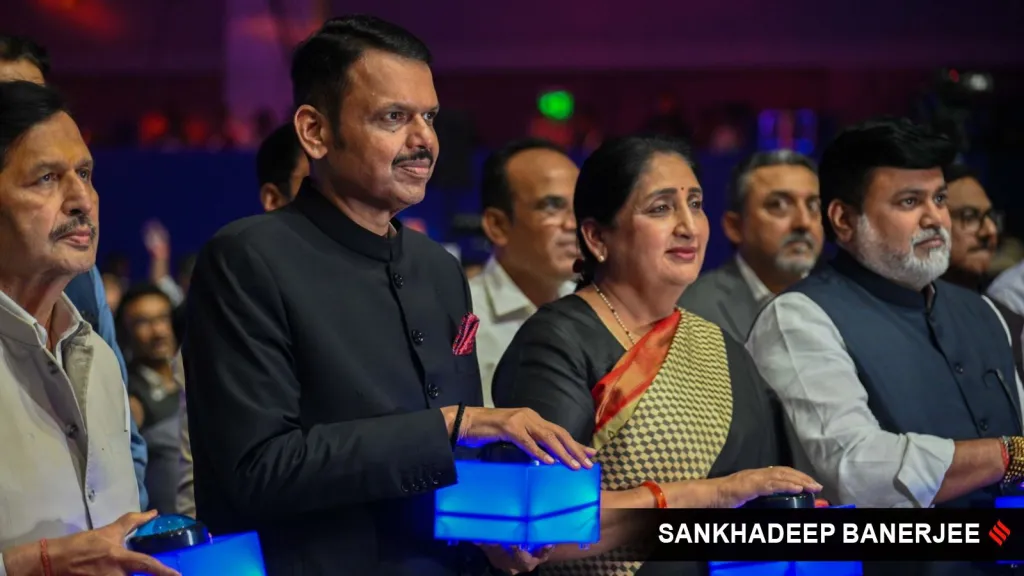
Maharashtra Chief Minister Devendra Fadnavis is facing a series of political and administrative challenges, from growing tensions within the ruling Mahayuti alliance to questions over law and order and the threat of a potentially severe drought. With more than 8,000 farmers staging an indefinite protest in Ahilyanagar district, the pressure on the state government is extending beyond political disagreements to the livelihoods of rural households.
The latest strain within the alliance involves the BJP and Eknath Shinde-led Shiv Sena, whose leaders have traded accusations over a controversial audio clip allegedly referring to money being routed to Maratha quota activist Manoj Jarange-Patil. Meanwhile, a dispute over the Finance portfolio, criticism following high-profile shooting incidents and disagreements over drought relief have added to the chief minister’s workload.
Fadnavis has responded with an investigation into the audio clip and preparations for drought relief. The central question is whether these measures can restore confidence in the ruling alliance while addressing the state’s immediate security and agricultural concerns.
Audio Clip Controversy Deepens BJP-Shiv Sena Tensions
The latest confrontation between the BJP and Shiv Sena followed disagreements over the selection of candidates for Maharashtra Legislative Council seats. The dispute escalated after an audio clip surfaced that allegedly referred to Rs 500 crore being routed to Maratha quota activist Manoj Jarange-Patil through Shiv Sena MP Shrikant Shinde to weaken his agitation.
The allegations have not been established as fact. The authenticity and context of the recording are central to determining what, if anything, it demonstrates.
Some BJP leaders reportedly interpreted the Shiv Sena’s response as an attempt to put Fadnavis and other BJP figures on the defensive. Party sources questioned why senior Shiv Sena minister Uday Samant had named three BJP leaders allegedly heard in the clip before forensic authentication. Ramdas Kadam also alleged that the recording was intended to damage Shinde’s public image.
A senior BJP minister reportedly described the Sena’s renewed criticism of its coalition partner as part of a recurring pattern of pressure on Fadnavis. These are allegations reflecting tensions within the alliance, rather than independently established evidence of a coordinated effort against the chief minister.
The controversy has prompted both parties to begin stepping back from their more aggressive positions. Shinde reportedly instructed his party’s leaders, ministers and elected representatives to stop attacking the BJP. The directive followed concerns communicated by the BJP over the Sena’s response to the audio controversy.
The de-escalation is significant because the Mahayuti government depends on cooperation among its constituent parties to maintain political stability and carry out its legislative and administrative agenda.
Fadnavis Orders SIT Probe Into the Recording
Fadnavis announced that a Special Investigation Team (SIT) would investigate the audio clip and that forensic analysis would be conducted to establish its authenticity.
The decision provides a formal route to examine the recording rather than relying on competing political claims. A forensic assessment could help determine whether the clip has been altered, whether the voices can be reliably identified and what conclusions can reasonably be drawn from its contents.
However, the announcement of an investigation does not itself validate the allegations made by either side. Its significance will depend on the evidence collected, the findings reached and the extent to which the results are communicated transparently.
Fadnavis has also questioned why the recording surfaced approximately two-and-a-half years after the events it allegedly concerns. The timing may be relevant to understanding the controversy’s political context, but it does not independently establish whether the recording is genuine or whether the allegations are true.
For the chief minister, who also holds the Home portfolio, the investigation is both a law-enforcement responsibility and a test of the government’s ability to handle a dispute involving its own political allies without allowing the process to become another source of conflict.
Political Disputes Extend Beyond the Audio Row
The dispute over the recording is not the only source of friction within the ruling coalition. A separate disagreement emerged when a Nationalist Congress Party (NCP) delegation led by Deputy Chief Minister Sunetra Pawar met Fadnavis to seek the return of the Finance portfolio.
Fadnavis had taken charge of the department following the death of former Finance Minister Ajit Pawar in a plane crash in January. The NCP delegation’s demand introduced another sensitive issue into the coalition’s internal negotiations.
Control of the Finance portfolio carries substantial administrative importance because it influences budget preparation, expenditure priorities and the allocation of resources across government departments. In a state facing mounting demands for drought relief and agricultural support, the portfolio also has direct implications for fiscal planning.
The demand therefore highlights the challenge of balancing the interests of coalition partners while ensuring that essential government functions continue without disruption.
For Fadnavis, the immediate task is to prevent disputes over positions and political influence from undermining coordination within the government. The audio investigation, portfolio negotiations and disagreements over relief measures each involve different issues, but together they create a demanding political environment.
Mumbai Shooting Incident Puts Law and Order Under Scrutiny
Fadnavis has also faced criticism over law and order following a firing incident involving actor Tiger Shroff. The incident in Mumbai raised questions about the ability of the police to prevent violent attacks, particularly in prominent urban locations.
Several accused were reportedly arrested within 48 hours, but the speed of the arrests did not prevent the incident from becoming a political issue. Opposition leaders questioned the performance of the police and the Home Department, which falls under Fadnavis’s charge.
The controversy has also revived debate about organised crime and the alleged activities of criminal networks. Opposition politicians have criticised the Centre over its handling of gangster Lawrence Bishnoi, who is lodged at Sabarmati Central Jail in Gujarat.
Shiv Sena (UBT) MP Sanjay Raut made a political allegation linking Bishnoi and Union Home Minister Amit Shah. That statement represents Raut’s accusation and should not be treated as evidence of a relationship or wrongdoing.
The BJP, meanwhile, has sought to counter criticism by pointing to the law-and-order record of the previous Maha Vikas Aghadi (MVA) government led by Uddhav Thackeray.
BJP spokesperson Navnath Ban alleged that the police were misused during the MVA tenure, citing the case involving an explosive-laden vehicle found near industrialist Mukesh Ambani’s residence and allegations of police involvement in illegal fund collection. Those allegations have their own legal and political context and do not, by themselves, resolve questions about the current government’s performance.
The competing responses illustrate how individual criminal incidents can become part of a broader political contest over policing, accountability and public safety.
Other Shootings Add to Security Concerns
The Tiger Shroff-related firing incident came amid wider concerns following other violent incidents in Maharashtra. Earlier in the month, Pradeep Purnekar, a Shiv Sena (UBT) leader, was shot dead in neighbouring Thane, according to the supplied account.
The killing drew additional attention because Thane is closely associated with Shinde’s political base. Reports of an investigation into the alleged role of Meenakshi Shinde’s husband added another politically sensitive dimension to the case. Any suspected involvement must be assessed through the investigation and relevant legal proceedings rather than political association alone.
Maharashtra has also witnessed high-profile shootings in the recent past. Ahead of the 2024 Assembly elections, NCP leader Baba Siddique was shot dead outside the office of his son, Zeeshan Siddique, who was also a political leader.
Such incidents intensify public scrutiny of policing and protection against organised violence. They also place pressure on the state government to demonstrate that investigations are thorough, suspects are identified through evidence and public safety remains a priority.
For Fadnavis, the challenge is to address individual cases while showing that the police can respond effectively to wider security threats. Political arguments over the record of previous governments may shape the debate, but they cannot substitute for credible investigations and demonstrable improvements in public safety.
Maharashtra Faces the Threat of a Severe Drought
While political disputes and law-and-order concerns dominate the headlines, the prospect of a severe drought may present the more consequential challenge for Maharashtra’s rural economy.
Fadnavis has acknowledged that the state could face a drought worse than the devastating drought of 1972. The administration has begun preparatory measures, declaring 304 of Maharashtra’s 358 talukas drought-affected and seeking Rs 35,000 crore in financial assistance from the Centre.
The scale of the declared impact points to the importance of preparing for water shortages, crop losses and the financial pressure that can fall on agricultural households. The effectiveness of the response will depend not only on the amount of funding requested but also on how assistance is assessed, approved and delivered.
Drought declarations can determine which areas become eligible for particular relief measures. They can also influence the distribution of resources, making the criteria and data used in the process important to farmers and elected representatives.
The announcement of the drought-affected talukas itself triggered disagreements within the Mahayuti alliance. Several NCP and Shiv Sena ministers reportedly argued that their constituencies had been left off the list, while Opposition parties criticised the government over what they described as a lack of transparency.
The dispute shows how decisions about drought relief can become politically contentious when communities face competing needs and resources are limited. It also creates an administrative challenge for the government: relief measures must be based on credible assessments while ensuring that affected farmers understand how eligibility is determined.
Why Farmers Say One-Time Financial Assistance Is Not Enough
Farmer leader and former MP Raju Shetti has argued that immediate financial assistance alone will not resolve the distress caused by crop losses and water scarcity.
Shetti said farmers needed sustained support and warned that one-time measures, including crop-loan relief or a payment of Rs 5,000, would not provide a lasting solution. He also alleged that even the announced assistance had not reached farmers who needed it.
His criticism highlights a central issue in agricultural relief policy: emergency payments may help households meet immediate expenses, but they do not necessarily address the underlying effects of repeated crop losses, inadequate water availability and mounting debt.
Farmers facing drought can experience several pressures at once. Lower yields may reduce income, while spending on seeds, fertilisers, labour and other inputs may already have been incurred. Water scarcity can also affect livestock and the next agricultural cycle, extending the impact beyond a single harvest.
Longer-term support can therefore involve a combination of timely financial assistance, access to credit, effective crop-loss assessment, water management and measures that help farmers recover their productive capacity. The appropriate response depends on local conditions and the specific relief programmes available.
The government’s challenge is to ensure that emergency measures reach eligible households quickly while developing a response capable of addressing the wider consequences of drought.
More Than 8,000 Farmers Begin Indefinite Protest
Frustration over the government’s assistance measures has contributed to a major farmers’ protest in Ahilyanagar district. More than 8,000 farmers, led by the All India Kisan Sabha, are staging an indefinite demonstration known as the maha mukkam satyagraha.
The protesters have rejected the proposed Rs 5,000 assistance and warned that they would march towards Fadnavis’s residence in Mumbai if their demands are not met.
The scale and indefinite nature of the protest raise the stakes for the state administration. A prolonged demonstration could intensify pressure on the government to clarify the eligibility criteria for assistance, explain the status of relief payments and respond to farmers’ demands over crop losses and water scarcity.
It also puts the government’s drought preparations to a practical test. Declaring affected areas and requesting central funding are important administrative steps, but farmers will judge the response partly by whether support reaches them in time to address immediate needs.
The protest reflects a broader tension between the government’s relief announcements and the concerns of agricultural communities who say the existing measures are insufficient. Resolving that gap will require clear communication, credible assessment of losses and a transparent process for delivering assistance.
Can Fadnavis Keep the Mahayuti Government United?
Fadnavis faces several challenges that require different responses. The audio clip controversy demands an impartial investigation and careful management of relations between the BJP and Shiv Sena. The Finance portfolio dispute requires negotiations with the NCP. Law-and-order concerns call for effective policing and credible accountability, while the drought demands administrative coordination and timely relief.
The challenges also overlap. Coalition disagreements over the classification of drought-affected areas can complicate the distribution of assistance. Public criticism of policing can weaken confidence in the government, while disputes among ruling partners can make it harder to present a coordinated response to a developing agricultural crisis.
Shinde’s reported instruction to his party leaders to stop attacking the BJP may help reduce the immediate temperature of the audio controversy. But lasting stability will depend on whether the alliance can manage future disagreements through internal negotiations rather than repeated public confrontations.
Similarly, the SIT investigation will need to establish facts rather than merely contain political damage. Its credibility will depend on the quality of the evidence and the handling of its findings.
The drought presents a more immediate test of delivery. The government has declared hundreds of talukas affected and requested substantial financial assistance, but farmers’ concerns about inadequate payments and delayed support underline the importance of implementation.
The Road Ahead for Maharashtra
Maharashtra’s political and administrative pressures are converging at a difficult moment. The BJP and Shiv Sena must contain their differences, the government must respond to questions over public safety, and the administration must prepare for the possibility of a severe drought.
Fadnavis has taken steps to address the audio controversy and initiate drought preparations. Whether those steps are sufficient will depend on the outcomes: a credible investigation, effective coordination among coalition partners and timely support for affected farmers.
The protest by more than 8,000 farmers is a reminder that the consequences of government decisions extend beyond political negotiations. For rural households confronting crop losses and water scarcity, the key question is whether relief arrives in time and provides meaningful assistance.
For the chief minister, holding the line will require more than damage control. It will mean balancing coalition management with law enforcement, transparent decision-making and a practical response to agricultural distress. The government’s ability to deliver on those fronts will shape both its immediate political stability and public confidence in its handling of Maharashtra’s growing challenges.
For breaking news and live news updates, like us on Facebook or follow us on Twitter and Instagram. Read more on Latest India on thefoxdaily.com.




COMMENTS 0