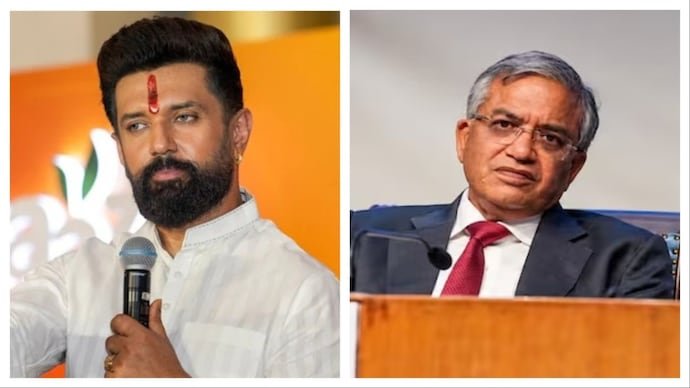
The Election Commission is facing renewed scrutiny over reported differences among its three commissioners, with NDA allies Chirag Paswan and Upendra Kushwaha calling for a clear public explanation from Chief Election Commissioner Gyanesh Kumar to address growing concerns about the electoral process.
The controversy has intensified around the Special Intensive Revision (SIR) of Electoral Rolls and reports that Election Commissioners Sukhbir Singh Sandhu and Vivek Joshi raised objections on multiple occasions over aspects of the exercise. Against this backdrop, Paswan said the responsibility for explaining the Election Commission’s position rests with the constitutional body itself, particularly its chief.
Speaking to reporters in Patna on Friday, the Union Minister and Hajipur MP said any clarification should not be treated as a response to Opposition criticism. Instead, he argued that the Election Commission should communicate directly with voters so that doubts about the credibility of the electoral system do not take root.
Chirag Paswan Calls for Public-Facing Clarification
Paswan made a distinction between political criticism of the Election Commission and the institution’s responsibility to explain its own decisions. He said Opposition parties would naturally take positions based on their political interests, but argued that this should not determine whether or how the poll panel communicates with the public.
“Let me make it clear that as part of the government, I do not intend to defend what is a constitutional body,” Paswan said, adding that he was not particularly concerned about allegations made by the Opposition.
According to Paswan, the Election Commission should not issue a clarification simply to answer Rahul Gandhi or other Opposition leaders. Its priority, he said, should be taking voters into confidence and ensuring that the public understands the institution’s position.
He further argued that public confidence is an important part of the functioning of any electoral system. If voters begin to doubt the process through which electoral rolls are prepared or Elections are conducted, the issue can extend beyond an ordinary political dispute.
“It would not be favourable for democracy if people were to lose faith in the electoral process or harbor doubts about it,” Paswan said, stressing that the Commission should articulate its position more vigorously to prevent confusion among voters.
Upendra Kushwaha Also Seeks Immediate Clarification
Rashtriya Lok Morcha chief and NDA ally Upendra Kushwaha also called for the Election Commission to address what he described as confusion among the public.
In a post on X, the Rajya Sabha MP said there was a need to clarify the situation surrounding the controversy and explain the “correct position” to voters. His comments came as questions surrounding the functioning of the three-member Election Commission continued to generate Political Debate.
Kushwaha specifically referred to confusion surrounding the controversy over electronic voting machines, while calling on the Election Commission to issue a clarification. His intervention added to calls from within the ruling alliance for the poll panel to communicate more directly with the electorate.
The comments from both NDA allies are significant because they place the emphasis not on answering individual Opposition allegations but on institutional communication. Their stated concern is that unresolved questions could create uncertainty among voters about the electoral system.
What Is the EC Dissent Controversy About?
The latest controversy follows an Indian Express investigation that reported that Election Commissioners Sukhbir Singh Sandhu and Vivek Joshi had formally raised objections on 14 occasions over a period of 10 months concerning different decisions and processes connected to the SIR exercise.
The reported objections covered several aspects of electoral-roll management, including new voter registration, deletion and restoration of names, appeals against decisions concerning electoral rolls and access to software used to maintain voter records.
The report has led to questions from Opposition parties about how decisions are being made within the three-member Election Commission and about the role played by Chief Election Commissioner Gyanesh Kumar in the implementation of the SIR exercise.
Opposition leaders have used the reported objections to question the functioning of the poll panel. Leader of Opposition in the lok Sabha Rahul Gandhi has accused the Election Commission of failing to protect voters’ rights and has called for action against the Chief Election Commissioner.
Other Opposition leaders have similarly raised concerns that changes associated with the electoral-roll revision process could result in eligible voters being left out of the rolls.
The Election Commission, however, has rejected the interpretation that the reported differences represent a rupture within the institution.
The poll panel has maintained that differing views, written observations and technical suggestions are part of normal institutional deliberations. It has also stated that decisions taken by the Commission, including those connected to the SIR exercise, were unanimous.
Why SIR Has Become the Centre of the Debate
The Special Intensive Revision of electoral rolls has become the central issue in the broader dispute because of the scale of the exercise and its potential impact on voter records.
According to the Indian Express report cited in the controversy, the exercise began in Bihar in June 2025 and was later extended to other states and Union Territories. More than 13 crore names were reportedly struck off draft electoral rolls as part of the process.
The Election Commission has explained the purpose of SIR as identifying and removing voters who are ineligible, deceased, registered more than once or who have shifted from their recorded addresses. The Commission has also maintained that the process is intended to protect the rights of eligible voters.
The scale of the exercise has nevertheless made its implementation a major political issue. Electoral rolls determine who is formally registered to vote, meaning that any large-scale revision inevitably attracts close attention from political parties, civil society groups and voters.
Opposition parties have alleged that the revision process could result in genuine voters being excluded. They have also questioned whether changes to electoral-roll systems and procedures could affect the independence of the poll panel.
The Election Commission has rejected allegations of political manipulation and maintained that the revision process and its decisions are being carried out according to law.
Reported Objections and the EC’s Explanation
At the heart of the controversy is the question of how reported differences among commissioners should be understood.
The Indian Express report presented multiple instances in which Sandhu and Joshi reportedly raised objections concerning different aspects of electoral-roll management. These included operational and procedural matters related to registration, deletion, restoration and appeals.
The Election Commission has not accepted the suggestion that such differences demonstrate an institutional breakdown. Instead, its position is that commissioners can record observations, raise technical concerns and express differing views during internal deliberations without that necessarily indicating a division over final decisions.
The distinction matters because the existence of internal objections and the final decision of the Commission are not necessarily the same thing. The Election Commission has said that its decisions relating to SIR were unanimous.
That explanation has not ended the political controversy. Opposition parties continue to question the manner in which the exercise has been conducted, while the Commission has defended the process and its institutional functioning.
Paswan Says the EC Should Speak Directly to Voters
Paswan’s intervention shifts the focus from the political dispute itself to the Election Commission’s communication with citizens.
Rather than asking the poll panel to respond point-by-point to Opposition leaders, the Union Minister said the Commission should explain its position in a manner that gives voters clarity. His argument is that public confidence should be the central consideration when an electoral institution faces sustained scrutiny.
This also explains why Paswan directed his remarks toward Chief Election Commissioner Gyanesh Kumar. The call for clarification is not framed as a demand for the CEC to engage in a political exchange with Rahul Gandhi or other Opposition leaders, but as a request for the constitutional institution to explain its position to the electorate.
For voters, the debate involves questions about the accuracy of electoral rolls, the procedures used to add or remove names and the way decisions are made within the Election Commission. Clear communication from the institution can therefore become an important part of how the public understands the controversy.
The Larger Question of Voter Confidence
The dispute over SIR goes beyond the technical process of updating electoral rolls. It has also raised broader questions about transparency, institutional decision-making and public confidence in elections.
Electoral rolls are a fundamental part of the voting process because they determine which individuals are formally listed as eligible electors. Any significant revision can therefore have direct consequences for voters, particularly when large numbers of names are removed from draft lists.
At the same time, maintaining accurate electoral rolls requires authorities to identify duplicate, deceased, shifted and otherwise ineligible entries. The challenge is to carry out that process while ensuring that eligible voters are not wrongly excluded.
This tension is central to the arguments surrounding SIR. The Election Commission has emphasised the need for accurate rolls and the removal of ineligible entries, while Opposition parties have focused on the risk of genuine voters being left out.
The reported differences among commissioners have added another layer to the debate because they have prompted questions about the internal processes through which such decisions are considered.
Why the Clarification Matters
Paswan and Kushwaha’s calls for clarification underline the importance of direct institutional communication during a controversy involving the electoral system.
For the Election Commission, the issue is not simply whether individual allegations made by political leaders are accurate. It is also whether voters have enough information to understand how electoral-roll revisions are being conducted, what safeguards exist for eligible voters and how disagreements within the Commission are handled.
The Commission has already rejected the suggestion that the reported objections amount to a rupture and has maintained that final decisions concerning SIR were unanimous. However, continued political scrutiny means that the institution’s explanations remain central to the public debate.
The calls from two NDA allies indicate that the demand for greater clarity is not limited to Opposition criticism. Their stated concern is that uncertainty surrounding the controversy should not undermine public confidence in the electoral process.
What Happens Next in the EC Dissent Row
The immediate focus is likely to remain on how the Election Commission responds to questions surrounding the reported objections and the implementation of SIR. The political debate is also expected to continue as parties examine the implications of changes to electoral rolls.
The Election Commission’s existing position is that internal observations and technical disagreements are part of institutional deliberations and do not establish a breakdown within the panel. It has also maintained that its decisions on SIR were unanimous.
Against that backdrop, the central issue raised by Paswan and Kushwaha is whether the Commission can provide enough clarity to prevent confusion among voters while maintaining its constitutional role.
The controversy therefore extends beyond the political exchanges between the ruling alliance and the Opposition. It concerns how an electoral institution communicates with citizens when questions are raised about voter registration, deletion of names, internal decision-making and the wider conduct of electoral-roll revisions.
As scrutiny of the SIR process continues, the Election Commission’s explanations and the information available to voters will remain central to the debate over the credibility and transparency of the electoral process.
For breaking news and live news updates, like us on Facebook or follow us on Twitter and Instagram. Read more on Latest India on thefoxdaily.com.






COMMENTS 0