- What Are the Anaimangalam Copper Plates?
- Why the Chola Dynasty Still Fascinates Historians
- The Remarkable Story Hidden Inside the Copper Inscriptions
- How the Copper Plates Reached Europe
- Why Europe Is Reconsidering Colonial-Era Artefacts
- India’s Expanding Cultural Diplomacy Strategy
- Why the Return Matters for Tamil Identity and Historical Memory
- The Modern Relevance of Chola Maritime History
- What Happens Next?
- Conclusion
The Netherlands’ decision to return the Chola-era Anaimangalam Copper Plates to India during Prime Minister Narendra Modi’s visit marks one of the most historically significant cultural restitutions involving Indian heritage in recent years. While the diplomatic optics of the moment are important, the deeper story stretches far beyond modern politics.
The copper plates, often referred to as the Leiden Plates because they were housed for decades at Leiden University, are among the most valuable surviving records from the reign of Emperor Rajaraja Chola I and his successor Rajendra Chola I. Created during the height of Chola power between the 10th and 11th centuries, the inscriptions reveal how South India once stood at the center of a thriving maritime world connected to Southeast Asia through trade, religion, Diplomacy, and cultural exchange.
The return also reflects a broader global reckoning with colonial-era collections held in European institutions. Museums and universities across Europe are increasingly facing pressure to examine how artefacts were acquired during imperial expansion. In this context, the repatriation of the Chola copper plates is not just about restoring metal inscriptions to India; it is about restoring historical memory, ownership, and civilisational continuity.
What Are the Anaimangalam Copper Plates?
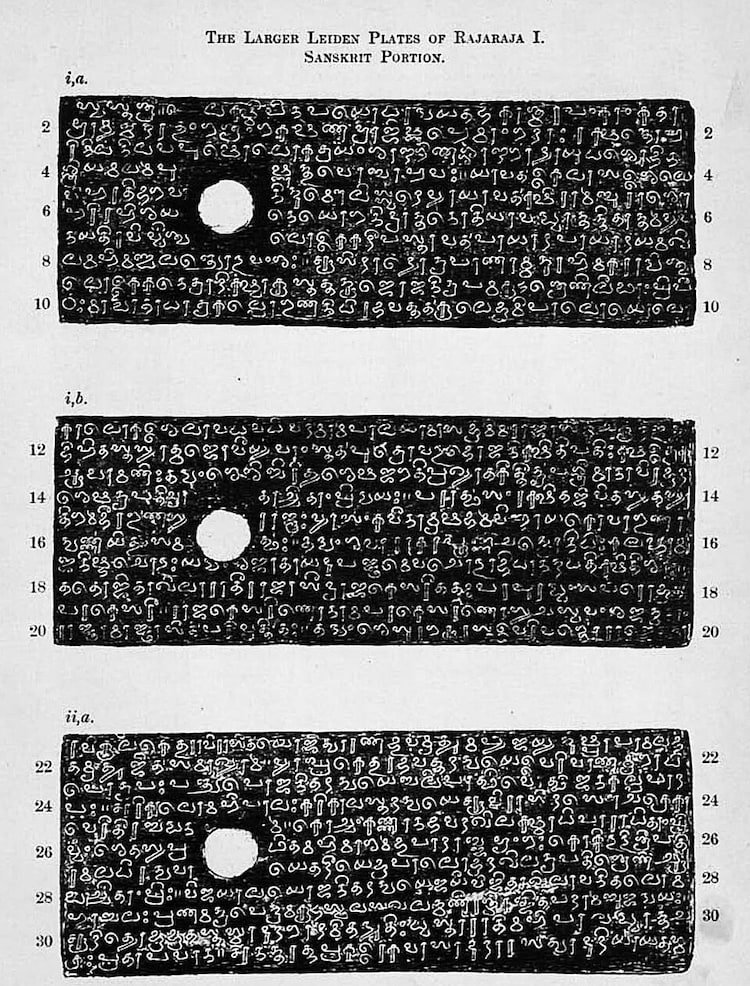
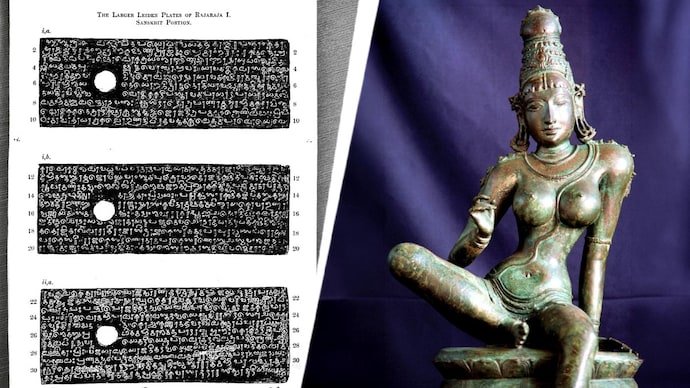
The Anaimangalam Copper Plates are a set of copper inscriptions issued during the Chola Empire, one of the most influential dynasties in Indian history. The plates record royal grants made to the Chudamani Vihara, a Buddhist monastery located in Nagapattinam on the Tamil coast.
The monastery itself was established by Sri Mara Vijayotunga Varman, a ruler associated with the Srivijaya kingdom in present-day Indonesia. This single detail alone reveals the extraordinary international connections that existed across the Indian Ocean more than a thousand years ago.
The inscriptions contain information about:
- Land grants and tax revenues
- Administrative systems under the Cholas
- Religious patronage by Hindu rulers
- Maritime connections between India and Southeast Asia
- The cosmopolitan nature of medieval South India
The plates are physically monumental as well. They consist of multiple large copper sheets weighing nearly 30 kilograms and are bound together with a copper ring bearing the royal Chola seal. Unlike stone inscriptions fixed to temples, copper plates were portable records intended to preserve royal orders permanently.
Why the Chola Dynasty Still Fascinates Historians

Modern discussions about Indian history often focus heavily on land empires, but the Cholas were different. They were one of Asia’s greatest maritime powers.
From their capital in Thanjavur, the Cholas developed naval capabilities that allowed them to project influence across the Bay of Bengal. Their fleets connected South India with Sri Lanka, Southeast Asia, and important trading centers across the Indian Ocean.
The return of the Leiden Plates is therefore significant because it highlights a lesser-discussed reality: medieval India was deeply connected to global trade and diplomacy long before European colonial expansion.
The Cholas built massive temple complexes, managed sophisticated administrative systems, and supported flourishing trade networks involving spices, textiles, precious stones, and metalwork. Their influence reached regions that are now part of Indonesia, Malaysia, Thailand, and beyond.
In many ways, the Chola world resembled an early maritime globalization system.
| Aspect | Chola Empire Significance |
|---|---|
| Maritime Trade | Connected India with Southeast Asia and the Indian Ocean economy |
| Religious Exchange | Supported Hindu and Buddhist institutions simultaneously |
| Architecture | Built monumental temples including Brihadisvara Temple |
| Administration | Maintained detailed land and taxation records |
| Cultural Influence | Spread Tamil cultural influence across Asia |
The Remarkable Story Hidden Inside the Copper Inscriptions
One of the most fascinating aspects of the Anaimangalam Copper Plates is what they reveal about religious coexistence in medieval India.
Although Rajaraja Chola I was a Shaivite Hindu ruler who built the grand Brihadisvara Temple dedicated to Lord Shiva, the copper plates document royal support for a Buddhist institution. This demonstrates that political authority during the Chola period often operated with a level of religious pragmatism and inclusiveness that challenges simplistic modern assumptions about medieval kingdoms.
The inscriptions also reveal how interconnected the Indian Ocean world had become by the 11th century. Southeast Asian rulers were funding religious centers in India, while Indian traders, scholars, and monks moved regularly across maritime routes.
Historians frequently describe the Bay of Bengal during this era not as a barrier, but as a cultural highway.
The Chudamani Vihara itself stood at Nagapattinam, a crucial port city that connected merchants from China, Southeast Asia, and the Indian subcontinent. Chinese pilgrims traveling toward Nalanda often passed through these maritime routes.
This broader context transforms the copper plates from administrative records into evidence of an interconnected Asian world centuries before European colonial empires dominated global trade.
How the Copper Plates Reached Europe
The journey of the copper plates to the Netherlands reflects the complicated history of colonial collecting.
During Dutch control over parts of the Coromandel Coast in the 18th century, the artefacts were reportedly acquired through intermediaries linked to colonial administration and missionary networks. At the time, European powers frequently removed manuscripts, sculptures, inscriptions, and ritual objects from colonized regions.
Such collections were often justified as scholarly preservation, but many acquisitions occurred in contexts shaped by unequal political power.
The plates later became part of Leiden University’s Asian collections, where they remained for more than a century. Scholars and epigraphists studied them extensively, and they gained near-legendary status among historians of Tamil civilization.
Ironically, colonial-era removals often helped preserve certain artefacts physically while simultaneously disconnecting them from their original cultural environments.
That tension lies at the heart of modern restitution debates.
Why Europe Is Reconsidering Colonial-Era Artefacts
The return of the Chola copper plates is part of a larger international shift in how museums and universities approach colonial collections.
Over the past decade, pressure has intensified on Western institutions to examine the origins of artefacts acquired during imperial expansion. Countries in Asia, Africa, and Latin America have increasingly argued that many historical objects were removed under exploitative conditions.
Several high-profile restitution debates have shaped this global conversation:
- The Benin Bronzes returned to Nigeria
- Greece’s campaign for the Parthenon Marbles
- Egypt’s calls for the return of ancient antiquities
- India’s efforts to recover stolen idols and manuscripts
The Netherlands has emerged as one of the European countries more willing to adopt formal restitution frameworks. Its 2022 policy on colonial collections created pathways for provenance research and repatriation claims.
That policy shift became crucial in enabling the return of the Leiden Plates.
The broader implication is significant: museums are no longer viewed simply as neutral custodians of world heritage. Increasingly, they are being asked to confront the historical conditions under which collections were assembled.
India’s Expanding Cultural Diplomacy Strategy
The return of the Anaimangalam Copper Plates also highlights how India is increasingly using culture and heritage as instruments of diplomacy.
For decades, international relations focused mainly on trade, military cooperation, and political alliances. Today, soft power has become equally important.
India’s civilisational identity including yoga, Buddhism, ancient universities, temple architecture, literature, and classical traditions now plays a growing role in foreign policy messaging.
The repatriation of artefacts fits into this broader strategy.
In recent years, India has successfully recovered hundreds of smuggled idols and antiquities from countries including the United States, Australia, and the United Kingdom. Each return strengthens the narrative that cultural heritage is inseparable from national identity.
The Leiden Plates carry particular symbolic weight because they connect multiple themes simultaneously:
- Tamil heritage
- Maritime history
- Religious pluralism
- Colonial restitution
- India-Southeast Asia connections
- India-Netherlands cultural cooperation
This multidimensional significance makes the repatriation more important than a routine diplomatic transfer.
Why the Return Matters for Tamil Identity and Historical Memory
For Tamil historians and cultural scholars, the return of the copper plates is emotionally and intellectually significant.
The Chola period is often regarded as one of the golden ages of Tamil civilization. It was an era marked by literary growth, architectural achievement, administrative sophistication, and international trade.
Yet many important records and artefacts connected to this history remain scattered across foreign institutions.
The return of the Leiden Plates restores direct access to a foundational historical source. Researchers, students, and the wider public in India will now have greater opportunities to engage with these inscriptions within their original cultural context.
There is also a psychological dimension to restitution that is often overlooked.
Colonialism did not only involve territorial control; it also disrupted cultural ownership and historical continuity. Returning artefacts can therefore serve as acts of symbolic restoration.
In simple terms, objects carry memory. And when historically important objects leave their homeland for centuries, a part of that memory becomes distant.
The Modern Relevance of Chola Maritime History
One of the most overlooked aspects of the story is how strongly it resonates with contemporary geopolitics.
Today, India is increasingly focused on the Indo-Pacific region, maritime security, and stronger ties with Southeast Asia through initiatives such as the Act East policy.
The Chola Empire represents an earlier period when South India already played a central role in maritime Asia.
This historical continuity matters because nations often use history to shape modern strategic identity. The rediscovery and restoration of maritime heritage can reinforce India’s image as a long-standing Indian Ocean civilization rather than merely a continental power.
In that sense, the return of the copper plates aligns with broader efforts to reconnect modern India with its historical maritime legacy.
What Happens Next?
The repatriation of the Leiden Plates may encourage further discussions regarding Indian artefacts held abroad.
However, future restitution efforts are unlikely to be simple. Each case involves legal complexities, provenance research, museum policies, diplomatic negotiations, and political considerations.
Still, the return establishes an important precedent.
It demonstrates that collaborative restitution is possible without turning every cultural dispute into a geopolitical confrontation. The process involving India, the Dutch government, and Leiden University also shows that academic institutions can play constructive roles in addressing colonial-era legacies.
For historians, the event may spark renewed interest in Chola studies, maritime archaeology, and Tamil epigraphy. For diplomats, it reinforces the importance of cultural cooperation in international relations.
And for ordinary readers, it offers a reminder that history is not frozen in museums. It continues to shape identity, politics, and global conversations even today.
Conclusion
The return of the Chola-era Anaimangalam Copper Plates from the Netherlands to India is far more than a ceremonial transfer of historical objects. It is a rare convergence of history, diplomacy, cultural memory, and global debate over colonial-era collections.
The copper plates illuminate a remarkable period when the Chola Empire connected India to Southeast Asia through trade, religion, and maritime influence. They also reveal a sophisticated and cosmopolitan society that valued administration, international engagement, and cross-cultural exchange.
At the same time, their repatriation reflects a changing global attitude toward historical ownership and cultural justice.
As museums and governments increasingly reassess colonial collections, the return of the Leiden Plates may become part of a much larger movement redefining how nations preserve, share, and reclaim their heritage.
For India, the event is both symbolic and strategic. It restores a priceless piece of Tamil history while reinforcing the country’s growing emphasis on cultural diplomacy and civilisational identity in the modern world.
More importantly, it reminds us that artefacts are not merely objects locked behind glass. They are storytellers from another age and sometimes, after centuries abroad, they finally find their way home.
For breaking news and live news updates, like us on Facebook or follow us on Twitter and Instagram. Read more on Latest India on thefoxdaily.com.






COMMENTS 0