National Hydroelectric Power Corporation (NHPC) has sought forest clearance to divert 3,278 hectares of forest land in Arunachal Pradesh for its proposed 1,720-megawatt Kamala hydroelectric project. If the proposal is approved, the project will require the felling of approximately 23.4 lakh trees across three districts in the ecologically sensitive lower Himalayan region.
The project, planned on the Kamala River, is part of a series of hydropower developments proposed in the Subansiri River basin. The forest diversion proposal is scheduled to be examined by the Union Environment Ministry’s Forest Advisory Committee (FAC) on October 23, according to its official agenda.
The proposed diversion covers forest areas in Kra Daadi, Kurung Kumey and Kamle districts. The plans have brought attention to the project’s potential environmental consequences, including forest loss, wildlife habitat disruption, biodiversity conservation and the rehabilitation challenges facing affected communities.
NHPC’s Kamala Hydroelectric Project: Key Details
The Kamala hydroelectric project is designed to generate 1,720 MW of electricity by harnessing the waters of the Kamala River, a right-bank tributary of the Subansiri River. Conceived as a run-of-the-river project with storage facilities, it will include a large concrete gravity dam and a reservoir.
According to official project documents, the proposal involves diverting 3,278 hectares of forest land for non-forest purposes. The planned development includes infrastructure and submerged areas that would permanently or temporarily alter parts of the existing forest landscape.
The dam is proposed to stand 216 metres high and will incorporate flood moderation features. The reservoir and the area around the dam are expected to account for approximately 2,960.49 hectares of forest land, according to the available documents.
The project’s proposed capacity makes it a significant hydropower development in Arunachal Pradesh. However, the scale of forest diversion and the number of trees identified for felling mean that its environmental implications will be a key consideration during the clearance process.
Over 23.4 Lakh Trees Marked for Felling
The forest diversion proposal identifies 23,40,213 trees for felling across the affected forest divisions. The figures indicate that the proposed project would involve substantial vegetation loss across the landscape earmarked for development.
The division-wise distribution of trees proposed for felling is as follows:
- Hapoli forest division: Approximately 15.08 lakh trees.
- Kra Daadi forest division: Approximately 8.31 lakh trees.
The combined total is approximately 23.4 lakh trees. These figures are based on the project proposal and do not mean that the trees have already been cut. The forest diversion application remains subject to the relevant approval process.
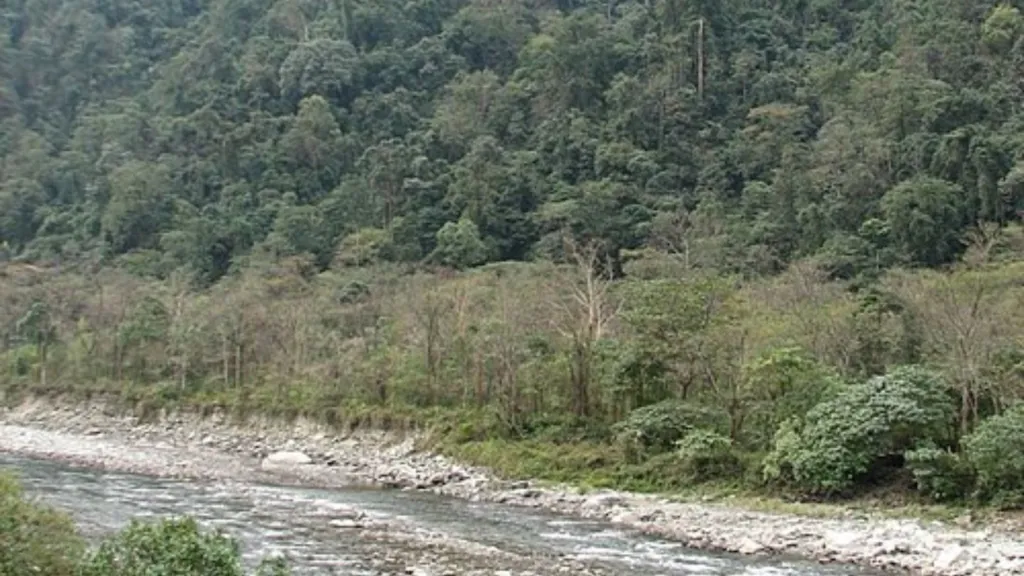
The scale of the proposed felling is particularly significant because the Kamala River valley is predominantly hilly and largely covered by dense forests. Forest ecosystems in such terrain can support diverse plant and animal species while contributing to soil stability, watershed protection and the regulation of local ecological conditions.
The eventual impact will depend on the final project design, the area approved for diversion, the implementation of mitigation measures and the conditions imposed by the authorities. The FAC’s appraisal will be an important step in determining whether the proposed forest diversion can proceed.
Forest Diversion Proposal Covers 3,278 Hectares
NHPC has requested permission to use 3,278 hectares of forest land for non-forest purposes associated with the Kamala hydropower project. The proposal covers forests in Kra Daadi, Kurung Kumey and Kamle districts of Arunachal Pradesh.
Forest diversion allows land legally classified as forest to be used for activities such as infrastructure construction and power generation, subject to applicable laws and approvals. For a large hydroelectric project, the affected area may include land needed for the dam, reservoir, access infrastructure and other associated facilities.
The proposal identifies different categories of forest within the area under consideration. Of the 3,278 hectares proposed for diversion, 439 hectares are classified as very dense forest, while 1,119 hectares are classified as moderately dense forest.
These classifications underline the ecological significance of the land involved. The loss of dense forest can affect more than the number of trees removed: it can also alter habitat connectivity, local vegetation patterns and the ecological conditions on which wildlife and nearby communities depend.
The remaining forest area also forms part of the broader landscape that could experience changes resulting from construction, reservoir formation and related infrastructure. The precise effects will depend on the final footprint of the project and the environmental safeguards required during implementation.
Forest Advisory Committee to Examine the Proposal
The Union Environment Ministry’s Forest Advisory Committee is scheduled to appraise NHPC’s forest diversion proposal on October 23. The committee examines proposals involving the use of forest land for non-forest activities and provides recommendations as part of the regulatory approval process.
The proposed appraisal does not, by itself, mean that forest clearance has been granted. The application must proceed through the applicable review process, and any eventual approval may be subject to conditions designed to address environmental and conservation concerns.
The committee’s consideration is especially important because the proposal involves a large area of forest, more than 23 lakh trees and a project located in a predominantly hilly region with substantial forest cover.
Among the relevant considerations are the extent and classification of the forest proposed for diversion, the proposed compensatory afforestation arrangements, wildlife impacts and the mitigation measures required to reduce environmental damage.
The forest clearance process is also connected to the project’s environmental approval. The available documents indicate that a sectoral expert panel of the Environment Ministry recommended the Kamala project for environmental clearance in January, subject to the condition that final environmental clearance would be granted only after in-principle forest clearance.
This means the project has been considered under the environmental appraisal process, but the forest diversion decision remains a separate and significant requirement. The status of the proposed forest clearance will be central to determining the project’s next regulatory steps.
Compensatory Afforestation Proposed Across Madhya Pradesh
As part of the forest diversion proposal, compensatory afforestation has been proposed across 7,018 hectares of land in several districts of Madhya Pradesh. The arrangement is intended to address the loss of forest land associated with the hydropower development.
Under the general framework for forest diversion, compensatory afforestation obligations normally require suitable non-forest land to be identified for planting trees. The aim is to establish new plantations to compensate, in part, for the forest area being diverted to non-forest uses.
However, identifying suitable land can be difficult in states that already have extensive forest cover. The applicable forest conservation framework allows compensatory afforestation obligations to be fulfilled in other states with lower forest cover when the necessary land is not available locally, subject to the relevant rules and approvals.
Arunachal Pradesh has substantial forest cover, and the project documents propose carrying out compensatory afforestation in Madhya Pradesh. The planned area of 7,018 hectares is more than twice the 3,278 hectares of forest proposed for diversion.
Under the framework described in the proposal, where equivalent non-forest land is unavailable, compensatory plantations may be required on degraded forest land at twice the area being diverted. The proposed afforestation programme in Madhya Pradesh is intended to meet the applicable obligation, subject to regulatory requirements.
Nevertheless, planting trees elsewhere does not automatically recreate the ecological characteristics of an established forest in Arunachal Pradesh. Forest ecosystems differ according to their location, vegetation, wildlife, soil, climate and ecological connections with surrounding habitats.
Compensatory afforestation can contribute to increasing tree cover, but its long-term effectiveness depends on factors such as species selection, survival rates, plantation management and protection from degradation. The ecological effects of losing mature forest in the Kamala valley therefore remain an important consideration separate from the area proposed for new plantations.
Wildlife Habitats Could Be Affected by the Project
An inspection report prepared by officials from the Environment Ministry’s regional office in Shillong noted that the proposed project site does not fall within a national park, wildlife sanctuary, biosphere reserve or elephant corridor.
However, the report also highlighted potential impacts on wildlife. It observed that the project would affect the habitats of various wild animals and that the increased width of the submerged area could adversely affect their movement between the two banks of the river.
The observation is significant because wildlife depends not only on formally designated protected areas but also on forests and other habitats outside their boundaries. Animals may use these areas for feeding, shelter, breeding and movement between different parts of their range.
A reservoir can alter existing habitat conditions by submerging land, changing the river valley’s physical characteristics and creating a barrier across parts of the landscape. Construction activity and associated infrastructure can also change the way animals move through affected areas.
In its inspection observations, the regional office called for a wildlife mitigation plan or biodiversity conservation plan. Such plans can identify potential risks and establish measures to minimise disruption, although their effectiveness depends on the quality of the assessment and how the measures are implemented.
Further details of the proposed mitigation arrangements, including the measures that may ultimately be required, would need to be assessed through the applicable approval process. The available information does not establish the full extent of the project’s eventual impact on individual wildlife species.
155 Plant Species Recorded During Field Surveys
The ecological assessment cited in the project documents recorded 155 plant species belonging to 69 families in the study area. The findings were based on field surveys conducted across different seasons.
Seasonal surveys can help researchers document vegetation that may not be visible or identifiable at every point in the year. Recording a range of plant species also provides a baseline for assessing the area’s botanical diversity before major construction and land-use changes take place.
The survey findings indicate that the project area supports a variety of plant life. However, the number of species recorded alone does not establish whether any particular species is threatened, endemic or protected. Such conclusions would require species-level information and an assessment against the relevant conservation criteria.
Forest loss can affect plant communities directly through clearing and submergence. It can also change surrounding conditions by altering sunlight, moisture, soil stability and habitat connectivity. The nature and severity of these effects will vary across different parts of the project area.
The presence of very dense and moderately dense forest within the proposed diversion area makes the assessment of vegetation and habitat impacts an important part of the project’s environmental review. Mitigation and conservation measures will need to account for the ecological characteristics of the affected landscape rather than relying only on the number of trees planted elsewhere.
Kamala Project Could Affect 5,440 Families in 126 Villages
The proposed hydropower development also has significant social implications. According to the project’s Social Impact Assessment report, a total of 5,440 families across 126 villages will be affected by the project.
The scale of the potentially affected population highlights the importance of assessing the consequences for people living in and around the project area. Large dam and reservoir developments can change land use, access to local resources and patterns of movement, depending on the final design and the areas directly affected.
The specific nature of the impacts on individual households and villages would need to be established through the project’s detailed social assessments and applicable procedures. The available figures do not, by themselves, specify how many families may face displacement or identify the precise effects on each community.
For affected communities, important considerations can include access to land, livelihoods, local infrastructure and natural resources. The extent of these impacts will depend on the project’s footprint, the land and assets affected, and the measures adopted by the authorities and project developer.
As the project advances through its approval process, social safeguards and consultation with affected communities will remain relevant to understanding the overall consequences of construction and reservoir development.
Part of a Larger Hydropower Development Plan in the Subansiri Basin
The Kamala hydroelectric project is one of several hydropower projects planned in the Subansiri River basin. The basin’s rivers and steep terrain offer opportunities for hydropower generation, but development across multiple sites can also raise questions about the cumulative effects of infrastructure on river systems and surrounding landscapes.
When projects are planned within the same river basin, environmental assessments may need to consider not only the direct footprint of an individual dam but also how multiple developments could affect habitat connectivity, river conditions and local communities.
The Kamala River is a right-bank tributary of the Subansiri River. The proposed 1,720 MW project would introduce a major dam and reservoir into this landscape, with forest diversion representing one of its most substantial land-use requirements.
The available project information establishes that the development is part of a wider hydropower programme in the basin. However, the combined environmental effects of all planned projects cannot be quantified from the details provided for the Kamala proposal alone.
Assessing those broader effects would require information about other projects, their construction schedules, their reservoir areas and their potential impacts on connected ecosystems and communities.
How the Forest Clearance Decision Could Shape the Project
The Forest Advisory Committee’s appraisal is an important step in the approval process for NHPC’s Kamala hydroelectric project. The proposal involves a substantial area of forest, a large number of trees proposed for felling, wildlife habitat concerns and compensatory afforestation arrangements outside Arunachal Pradesh.
If the forest diversion proposal receives approval, the project will still need to comply with the conditions attached to the relevant clearances and other applicable requirements. These may address environmental safeguards, afforestation, wildlife protection and measures intended to manage the effects of construction and reservoir formation.
If changes or additional safeguards are required during appraisal, they could influence how the project is designed or implemented. The exact outcome will depend on the committee’s recommendations and subsequent regulatory decisions.
The environmental clearance process and forest clearance process must also be distinguished. Although the project was recommended for environmental clearance in January, the available documents state that final environmental clearance was conditional on in-principle forest clearance.
Until the necessary decisions are made, the proposed diversion of 3,278 hectares and the felling of 23,40,213 trees should be understood as elements of the application rather than completed actions.
Key Environmental Questions Surrounding the Kamala Hydel Project
The proposal raises several issues that will be relevant to the forest clearance decision and the project’s eventual implementation.
- Forest loss: The proposed diversion covers 3,278 hectares, including very dense and moderately dense forest.
- Tree felling: Project documents identify 23.4 lakh trees for felling across the Hapoli and Kra Daadi forest divisions.
- Wildlife movement: An official inspection report warns that reservoir submergence could affect wildlife habitats and movement between riverbanks.
- Biodiversity conservation: Field surveys recorded 155 plant species belonging to 69 families, making the protection of local vegetation an important consideration.
- Compensatory afforestation: Plantations have been proposed over 7,018 hectares in Madhya Pradesh to meet the relevant forest diversion obligations.
- Community impacts: The Social Impact Assessment identifies 5,440 families in 126 villages as potentially affected by the project.
- Regulatory approval: The forest diversion proposal is scheduled for appraisal by the Forest Advisory Committee on October 23, while final environmental clearance is linked to in-principle forest clearance.
These issues illustrate the range of factors involved in evaluating a major hydropower development in a forested Himalayan landscape. Electricity generation is the project’s stated purpose, but its implementation also requires scrutiny of land-use changes, biodiversity, wildlife movement and the implications for affected communities.
What Happens Next?
The next major step is the Forest Advisory Committee’s scheduled appraisal of the forest diversion proposal on October 23. The committee’s consideration will help determine the regulatory path for NHPC’s request to use 3,278 hectares of forest land for the Kamala hydroelectric project.
The key questions include whether the proposed diversion can be approved, what conditions may be imposed, how compensatory afforestation will be implemented and what additional safeguards may be needed to address wildlife and biodiversity concerns.
The project’s environmental clearance status will also depend on the forest clearance process, according to the conditions outlined in the official documents. The scale of the proposed tree felling, the ecological characteristics of the affected forest and the number of potentially affected families are likely to remain central considerations as the proposal moves through the approval process.
For now, NHPC’s application represents a proposal to develop a 1,720 MW hydropower project in Arunachal Pradesh, with major implications for forest land and the surrounding environment. The final outcome will depend on the decisions of the relevant authorities and the conditions established to address the project’s environmental and social impacts.
For breaking news and live news updates, like us on Facebook or follow us on Twitter and Instagram. Read more on Latest India on thefoxdaily.com.


COMMENTS 0