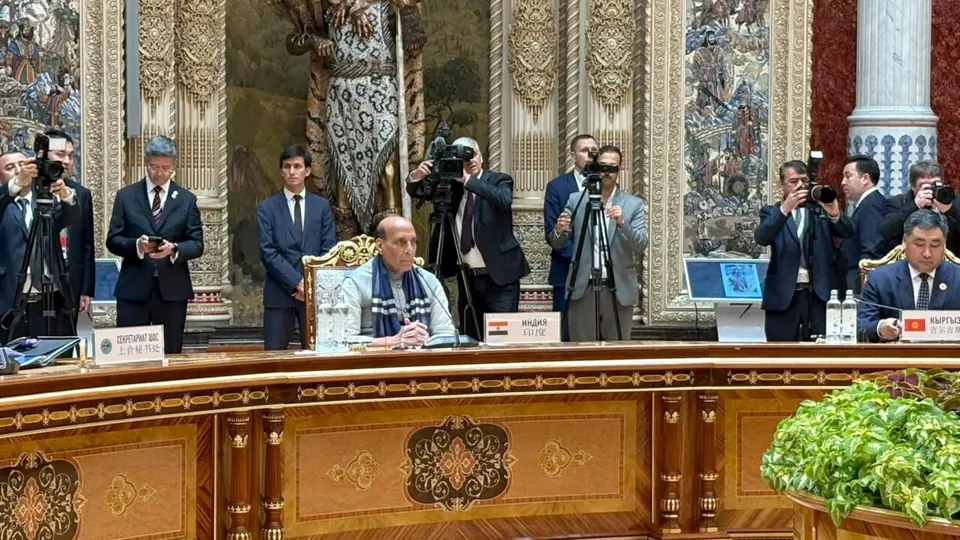
India’s Defence Minister Rajnath Singh called for a unified international response to Terrorism at the Shanghai Cooperation Organisation (SCO) Council of Heads of Government meeting in Dushanbe, Tajikistan, on Tuesday, stressing that no justification or double standards should be permitted when confronting terrorist activities.
Speaking in the presence of Pakistan’s Deputy Prime Minister and Foreign Minister Ishaq Dar, Singh said terrorism threatens not only human lives but also economic development, investment, trade and opportunities for young people. He called on SCO member countries to work collectively to dismantle the networks that finance, support and shelter terrorist groups.
Singh’s remarks placed India’s longstanding position on cross-border terrorism at the centre of a regional diplomatic gathering attended by representatives of countries with differing security priorities. The meeting also highlighted the importance of cooperation among SCO members on issues that affect regional stability and economic progress.
Rajnath Singh Calls for Collective Action Against Terrorism
Addressing the SCO Council of Heads of Government in the Tajik capital, Singh described terrorism as one of the gravest threats to development. He argued that its consequences extend beyond immediate violence, damaging the conditions necessary for societies to prosper.
According to Singh, terrorism can undermine investment and commerce while depriving young people of opportunities. He also warned that radicalisation damages societies, making the challenge relevant to economic development and social stability as well as national security.
Singh delivered a clear message on the need for a consistent international approach to tackling the threat.
“So, there can be no justification for terrorism. There can be no double standards in tackling it. There can be no space for people who finance and support terrorists or provide them a safe haven. The entire ecosystem of terrorism should be ended strongly and collectively,” Singh said.
His statement covered several parts of the terrorist ecosystem: the groups that carry out attacks, the individuals and networks that provide financial or logistical support, and those accused of offering safe havens. By addressing these elements together, Singh emphasised India’s position that counterterrorism efforts should extend beyond the perpetrators of individual attacks.
The message was delivered in a multilateral setting, where cooperation between governments is central to discussions on shared security concerns. Singh’s call for collective action placed responsibility on member countries to address terrorism consistently rather than treating it differently according to political circumstances.
Remarks Delivered in Ishaq Dar’s Presence
Pakistan’s Deputy Prime Minister and Foreign Minister Ishaq Dar was present when Singh made the remarks. The two officials were seated across from each other at the meeting, according to the account of the proceedings. Pakistan’s Foreign Ministry also shared a video showing Singh and Dar seated at the same table.
The setting gave Singh’s comments particular diplomatic significance because India has repeatedly accused Pakistan’s government and military of supporting or harbouring terrorist groups. Pakistan’s position on such allegations has been disputed, and the broader security relationship between the two countries remains a major issue in South Asian diplomacy.
Singh did not need to name Pakistan in the quoted remarks for the statement to reflect India’s established approach to counterterrorism. His emphasis on terrorist financing, support networks and safe havens aligns with New Delhi’s argument that governments must address the wider infrastructure that enables attacks.
However, the presence of officials from both countries at the same meeting should not be mistaken for a resolution of their bilateral differences. The SCO provides a forum for regional engagement, but statements delivered there do not, by themselves, establish agreement among members on specific allegations or policy measures.
Why the SCO Meeting Matters for Regional Security
The Shanghai Cooperation Organisation is a regional grouping through which member countries engage on security, economic and political issues. Its meetings bring together governments with different national interests but shared reasons to discuss stability, trade and cross-border challenges.
Terrorism is an important subject in this setting because militant networks, financing channels and radicalisation can affect more than one country. Governments may need to exchange information, coordinate law-enforcement efforts and address the movement of money and individuals across borders to respond effectively to such threats.
Singh’s appeal for a collective response highlighted the difference between condemning an attack and addressing the systems that allow terrorist organisations to operate. A response focused only on the immediate perpetrators may leave financial backers, recruitment networks and logistical support structures untouched.
His statement also connected security cooperation with economic development. Businesses are more likely to face uncertainty in environments affected by violence, while communities dealing with insecurity can lose access to investment, employment and education. Singh’s argument was that counterterrorism should therefore be treated as part of a broader effort to protect the conditions needed for development.
For the SCO, translating such statements into practical cooperation remains a separate challenge. Member countries must reconcile their security priorities and political differences if they are to coordinate effectively. Singh’s call for consistency underscored India’s expectation that terrorism should be addressed through common standards rather than selective responses.
PM Modi Had Earlier Urged the SCO to Dismantle Terrorist Networks
Singh’s remarks followed a similar message from Prime Minister Narendra Modi at an SCO meeting in September. Modi had called on member countries to work together against the wider infrastructure that supports terrorism, including financing, recruitment, radicalisation and safe havens.
Modi’s statement was delivered at a gathering attended by several prominent leaders, including Pakistan Prime Minister Shehbaz Sharif, Chinese President Xi Jinping, Russian President Vladimir Putin and Iranian President Masoud Pezeshkian.
“We must dismantle the entire ecosystem of terrorist financing, recruitment, radicalisation and safe havens,” Modi said.
The two statements reflect a consistent theme in India’s diplomatic messaging: counterterrorism should address the networks that enable violence, not merely the individuals who carry out attacks.
Financing allows terrorist organisations to obtain resources and sustain operations. Recruitment brings new members into their networks, while radicalisation can encourage individuals to support or participate in violence. Safe havens, meanwhile, can provide places from which groups organise, communicate or operate with reduced risk of disruption.
By highlighting these elements, Modi and Singh have called for an approach that treats terrorism as a connected system rather than a collection of isolated incidents. Their statements also place responsibility on governments to cooperate in tackling the infrastructure associated with terrorist activity.
Whether this shared language produces stronger coordination depends on the willingness of individual countries to implement measures and cooperate in practice. Diplomatic declarations can establish common expectations, but sustained action requires follow-through by the participating governments.
India’s Position Following the Pahalgam Terror Attack
India’s statements at the SCO come against the background of its longstanding concerns about cross-border terrorism. New Delhi has accused Pakistan’s government and military of supporting or sheltering terrorist organisations, allegations that form part of the continuing dispute between the two neighbours.
The issue became particularly prominent following the April 2025 terror attack in Pahalgam, Jammu and Kashmir, which claimed 26 lives. India subsequently launched Operation Sindoor, targeting what it described as terrorist infrastructure in Pakistan and Pakistan-occupied Kashmir.
The operation was followed by a military confrontation between India and Pakistan. The episode underscored how a terrorist attack can lead to a wider security crisis between two nuclear-armed neighbours, with consequences extending beyond the immediate location of the violence.
After the cessation of hostilities was announced, Prime Minister Modi used strong language to contrast India’s emphasis on tourism with what he described as Pakistan’s association with terrorism. His remarks reflected New Delhi’s argument that terrorism and the networks supporting it pose a threat not only to India but also to wider regional and international security.
India has maintained that responsibility for terrorism cannot be separated from the individuals or organisations that enable it. This position is central to Singh’s latest comments, particularly his insistence that there should be no safe haven for those who finance or support terrorist groups.
The wider diplomatic challenge is to prevent terrorist attacks from triggering further instability while ensuring that allegations of support for militant groups are addressed through credible evidence and appropriate international cooperation. For India, the central demand remains that all countries apply consistent standards when confronting terrorism.
Operation Sindoor and the Broader Counterterrorism Debate
Operation Sindoor remains an important reference point in India’s security messaging following the Pahalgam attack. By targeting infrastructure that India identified as connected to terrorism, the operation reflected New Delhi’s stated approach of responding to attacks by addressing the networks it believes enable them.
The subsequent military confrontation demonstrated the risks associated with counterterrorism operations when they take place amid an unresolved interstate dispute. Even when a government presents an operation as a security measure, military action can create the possibility of escalation and further instability.
This context helps explain why India continues to raise the issue in international forums. Diplomatic engagement allows New Delhi to present its position to other governments and seek support for a broader approach to terrorist financing, recruitment and the provision of safe havens.
Singh’s remarks at the SCO were therefore part of a wider diplomatic effort to frame terrorism as a collective security concern. The emphasis on ending the entire ecosystem suggests that India wants international attention to extend beyond individual attacks to the networks and support structures that make them possible.
At the same time, multilateral cooperation requires countries to agree on definitions, evidence-sharing and practical measures. Political disagreements can complicate these efforts, particularly when governments make competing claims about responsibility for violence or the activities of armed groups.
The effectiveness of international counterterrorism commitments ultimately depends on whether countries translate declarations into coordinated action, including efforts to disrupt financing, prevent recruitment and investigate support networks.
Rajnath Singh Begins Two-Day Official Visit to Tajikistan
Singh is in Tajikistan on a two-day official visit to represent India at the SCO Council of Heads of Government meeting. His participation provides an opportunity for India to present its positions on regional security while engaging with representatives of other member countries.
According to news agency PTI, Singh received a ceremonial welcome at Dushanbe airport upon his arrival. Tajikistan’s Defence Minister Emomali Sobirzoda and Sherali Jonon of the country’s Ministry of Foreign Affairs greeted him.
The visit places the Indian defence minister in a regional diplomatic setting where security issues intersect with broader questions of economic cooperation and political relations. His address focused on terrorism as a threat to both human security and development, while calling on governments to take collective responsibility for tackling the networks behind it.
The presence of Ishaq Dar at the meeting also illustrated the importance of multilateral forums as venues where officials from countries with difficult bilateral relationships can hear each other’s positions. Such encounters do not automatically resolve disagreements, but they allow governments to communicate their priorities in front of a wider regional audience.
What Singh’s Message Means for the SCO
Singh’s central demand was that countries should not apply different standards to terrorism depending on political relationships or strategic interests. His remarks called for action against both terrorist organisations and the networks that finance, support or shelter them.
The statement also connected counterterrorism with the everyday consequences of insecurity. By pointing to damage to investment, commerce and youth opportunities, Singh argued that terrorism can weaken the foundations of economic and social development well beyond the immediate loss of life.
For the SCO, the next question is how member countries can turn shared declarations into meaningful cooperation. This may involve strengthening coordination against terrorist financing, addressing recruitment and radicalisation, and improving efforts to prevent terrorist groups from finding safe havens.
India’s position, reiterated by both Modi and Singh, is that these efforts must be comprehensive and consistent. The message is that condemning attacks is not enough if the systems that allow terrorist groups to function remain in place.
Singh’s address in Dushanbe reinforced that position at a meeting attended by representatives of countries with varied interests and security concerns. His appeal was directed at the SCO as a whole: terrorism, he argued, must be confronted collectively, without justification, selective treatment or tolerance for the networks that sustain it.
For breaking news and live news updates, like us on Facebook or follow us on Twitter and Instagram. Read more on Latest India on thefoxdaily.com.






COMMENTS 0