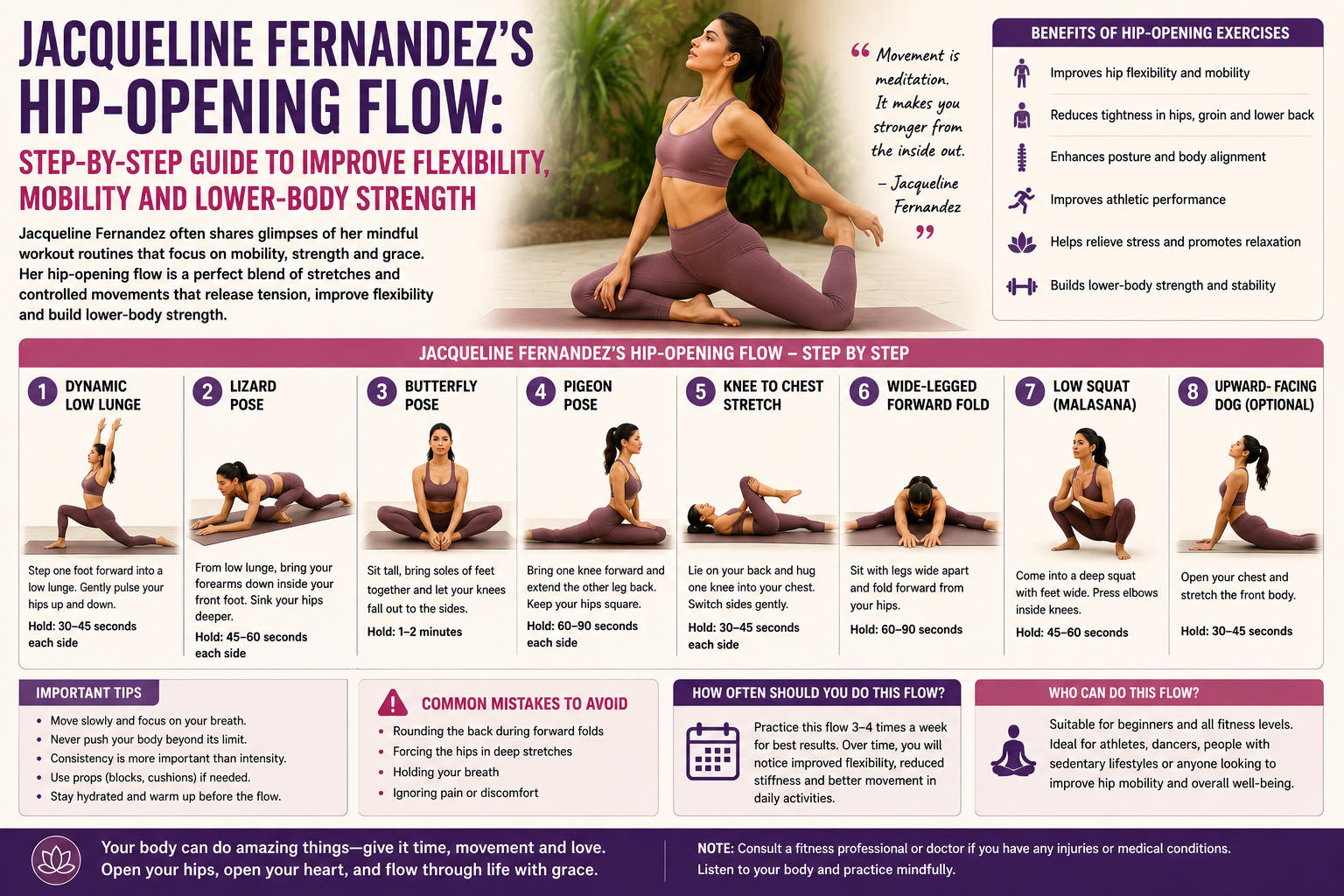
Whether you’re an athlete, a Fitness enthusiast, or someone who spends long hours sitting at a desk, your hips play a central role in almost every movement you make. Tight hips can contribute to lower back discomfort, poor posture, reduced mobility, and limited athletic performance. That’s why hip-opening routines have become an essential part of many wellness practices, including yoga, Pilates, and functional fitness.
Actor and fitness enthusiast Jacqueline Fernandez is known for incorporating mobility work into her workouts, emphasizing slow, controlled movements rather than forcing flexibility. Her hip-opening flow is designed to improve joint mobility while encouraging mindful breathing and body awareness.
Unlike stretching routines that chase quick results, this sequence encourages gradual progress. As mobility experts often advise, deep hip openers should never be rushed. Moving one breath at a time allows the muscles and connective tissues to relax naturally, making the practice safer and more effective over time.
Why Hip Mobility Matters
The hips are among the body’s largest and most complex joints. They connect the upper and lower body and are involved in walking, running, climbing stairs, squatting, lifting, and maintaining balance.
Healthy hip mobility supports:
- Better posture.
- Improved walking and running mechanics.
- Reduced lower back strain.
- Greater flexibility.
- Enhanced athletic performance.
- More comfortable daily movement.
Limited hip mobility can affect the knees, pelvis, and spine, making mobility training beneficial for people of all fitness levels.
Before You Begin
Spend five to ten minutes warming up with gentle movement such as walking, light marching, or dynamic leg swings. Warm muscles respond better to stretching than cold muscles.
Throughout the routine:
- Breathe slowly.
- Never force a stretch.
- Move only within a comfortable range.
- Stop if you experience sharp pain.
Step 1: Deep Squat Hold
Begin by standing with your feet slightly wider than shoulder-width apart and your toes turned out comfortably.
Slowly lower into a deep squat while keeping your chest lifted. Bring your palms together in front of your chest and gently press your elbows against your knees.
Benefits:
- Improves hip mobility.
- Opens the groin.
- Enhances ankle flexibility.
- Strengthens postural muscles.
Step 2: World’s Greatest Stretch
Step one foot forward into a deep lunge while extending the opposite leg behind you.
Place both hands inside the front foot, then gently rotate your upper body toward the front leg, raising one arm toward the ceiling if comfortable.
Hold for several slow breaths before switching sides.
Benefits:
- Mobilizes the hips.
- Improves spinal rotation.
- Stretches hip flexors.
- Activates the core.
Step 3: Low Lunge Hip Opener
Lower your back knee to the floor while keeping the front knee bent.
Allow the hips to gently sink forward without arching the lower back excessively.
Lift your chest and breathe deeply.
This position provides a gentle stretch across the front of the hip, particularly for people who sit for prolonged periods.
Step 4: Butterfly Stretch
Sit comfortably on the floor and bring the soles of your feet together.
Hold your feet lightly while allowing your knees to move toward the floor naturally.
Avoid bouncing or forcing the stretch.
Focus on long, slow breaths and maintaining an upright spine.
| Exercise | Main Target Area | Primary Benefit |
|---|---|---|
| Deep Squat Hold | Hips and ankles | Improves mobility |
| World’s Greatest Stretch | Hip flexors and spine | Increases flexibility |
| Low Lunge | Hip flexors | Reduces stiffness |
| Butterfly Stretch | Inner thighs | Opens the hips |
| Pigeon Pose | Glutes and hips | Deep hip opening |
Step 5: Pigeon Pose
From an all-fours position, bring one knee toward your wrist while extending the opposite leg straight behind you.
Keep your hips as level as possible and gradually lower your upper body if comfortable.
This is one of the deepest hip-opening poses, so patience is essential.
As with all deep openers, allow the stretch to develop naturally instead of pushing into discomfort.
Step 6: Seated Forward Fold
Extend both legs in front of you.
Lengthen your spine before gently folding forward from the hips rather than rounding your back.
Reach only as far as your flexibility comfortably allows.
This movement complements hip-opening exercises by stretching the hamstrings and lower back.
Step 7: Gentle Hip Rotations
Finish the sequence with controlled hip circles while standing or on all fours.
Move slowly through the full comfortable range of motion.
This helps integrate the increased mobility gained during the session.
Why Breathing Is Just as Important as Stretching
Deep breathing allows muscles to relax, reducing unnecessary tension during stretching.
Each slow inhale encourages spinal lengthening, while every exhale allows the body to settle more comfortably into each position.
Rather than counting seconds, many mobility specialists recommend moving one breath at a time.
Common Mistakes to Avoid
- Forcing flexibility.
- Bouncing during stretches.
- Holding your breath.
- Ignoring pain.
- Skipping the warm-up.
- Moving too quickly.
Mobility improves through consistency, not intensity.
| Do | Avoid |
|---|---|
| Move slowly | Rushing through poses |
| Breathe deeply | Holding your breath |
| Warm up first | Stretching cold muscles |
| Practice regularly | Expecting instant flexibility |
| Listen to your body | Pushing through pain |
Who Can Benefit from Hip Mobility Exercises?
Hip-opening routines may benefit:
- People with desk jobs.
- Runners and cyclists.
- Strength-training enthusiasts.
- Yoga practitioners.
- Older adults seeking better mobility.
- Anyone experiencing general hip stiffness.
Individuals recovering from injury or living with chronic joint conditions should consult a qualified healthcare professional before beginning a new mobility routine.
How Often Should You Practice?
Most people can safely perform gentle hip mobility exercises three to five times per week. Short sessions of 10–20 minutes are often more effective than occasional long workouts.
Consistency gradually improves flexibility, joint movement, and muscular control while reducing stiffness over time.
Conclusion
Jacqueline Fernandez’s hip-opening flow highlights an important principle of mobility training: flexibility develops through patience, not force. By moving slowly, coordinating each stretch with mindful breathing, and respecting your body’s natural limits, you can steadily improve hip mobility while reducing stiffness and supporting better overall movement.
Whether your goal is improved athletic performance, better posture, or simply moving more comfortably throughout the day, incorporating regular hip-opening exercises into your fitness routine can provide lasting benefits. Remember, every body progresses at its own pace—and with deep hip openers, allowing the pose to unfold naturally is often the safest and most effective path to greater flexibility.
For breaking news and live news updates, like us on Facebook or follow us on Twitter and Instagram. Read more on Latest Lifestyle on thefoxdaily.com.





COMMENTS 0