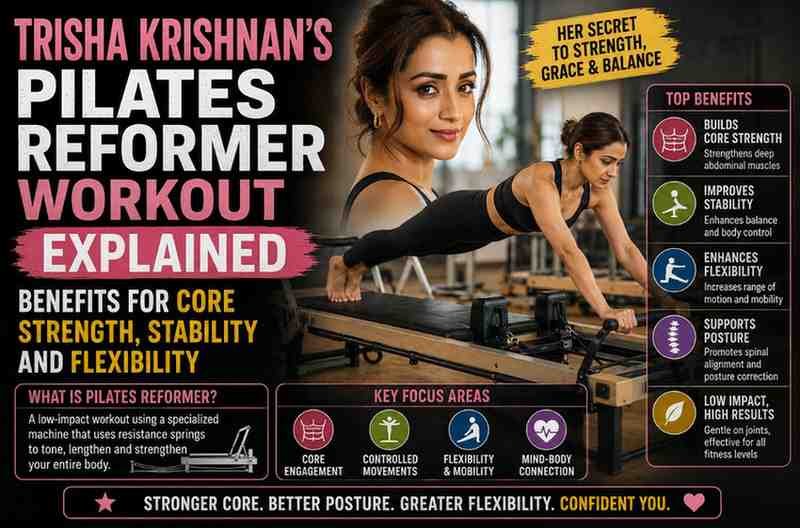
When actor Trisha Krishnan recently offered fans a peek into her Pilates reformer workout with the playful note, “I am happy but…”, it sparked curiosity among Fitness enthusiasts. While strength training and cardio exercises often dominate gym routines, Pilates reformer workouts have quietly become one of the most sought-after forms of exercise among celebrities, athletes, and wellness experts.
Far from being just another social media trend, reformer Pilates is built around controlled movements that improve core strength, flexibility, posture, and body awareness. Experts say its appeal lies in the fact that it offers a full-body workout without placing excessive stress on joints.
As more people look for sustainable fitness routines that prioritize function over aesthetics, Pilates reformers are emerging as a powerful tool for building strength from the inside out.
What Is a Pilates Reformer?
A Pilates reformer is a specialized exercise machine designed with a sliding carriage, springs, ropes, straps, and adjustable resistance mechanisms. Unlike traditional mat Pilates, the reformer adds resistance and support, allowing users to perform hundreds of movements targeting different muscle groups.
The machine enables exercises in various positions, including:
- Lying down.
- Sitting.
- Standing.
- Kneeling.
- Side-lying positions.
Its versatility makes it suitable for beginners, athletes, and even individuals recovering from injuries under professional supervision.
Why Core Strength Matters More Than Six-Pack Abs
One of the biggest misconceptions about core workouts is that they are only about achieving visible abdominal muscles.
In reality, the core consists of multiple muscles that stabilize the spine, pelvis, and trunk. These muscles are essential for everyday movements, balance, posture, and injury prevention.
A strong core helps with:
- Improved posture.
- Better balance and coordination.
- Reduced back pain.
- Enhanced athletic performance.
- Greater stability during movement.
- Lower risk of injuries.
Pilates reformer workouts are particularly effective because they target deep stabilizing muscles often neglected during traditional exercises.
How Reformer Pilates Strengthens the Core
Unlike high-intensity workouts that rely on rapid repetitions, reformer Pilates emphasizes slow, controlled movements.
The resistance provided by springs requires constant engagement of:
- Abdominal muscles.
- Pelvic floor muscles.
- Lower back muscles.
- Hip stabilizers.
- Gluteal muscles.
- Shoulder stabilizers.
This continuous activation helps improve functional strength and movement efficiency.
Why Celebrities and Athletes Love Pilates Reformer Workouts
Many actors and professional athletes incorporate Pilates into their routines because it complements other forms of training.
Benefits include:
- Improved flexibility.
- Enhanced posture.
- Greater body awareness.
- Better recovery from intense workouts.
- Balanced muscle development.
- Lower impact on joints.
For individuals with demanding schedules, Pilates provides a combination of strength, mobility, and mindfulness.
Comparison: Traditional Gym Workouts vs Pilates Reformer
| Feature | Traditional Strength Training | Pilates Reformer |
|---|---|---|
| Focus | Muscle size and power | Core stability and functional strength |
| Impact on joints | Moderate to high | Low impact |
| Flexibility training | Limited | Integrated into movements |
| Balance and posture | Secondary focus | Primary focus |
| Suitable for rehabilitation | Depends on exercise | Often recommended with supervision |
An Insight Competitors Often Miss: Pilates Is About Movement Quality, Not Exhaustion
Modern fitness culture often celebrates intense workouts and exhaustion as indicators of success. However, experts increasingly emphasize that effective exercise is not necessarily about burning the most calories or lifting the heaviest weights.
Pilates focuses on precision, breathing, alignment, and controlled movement. This approach helps train muscles and the nervous system simultaneously, improving how the body moves rather than simply how it looks.
In other words, Pilates teaches the body to move better, not just harder.
Can Beginners Try Reformer Pilates?
Yes. One of the strengths of reformer Pilates is its adaptability.
Exercises can be modified according to:
- Fitness level.
- Age.
- Flexibility.
- Strength.
- Specific health conditions.
However, beginners are advised to learn under certified instructors who can ensure proper form and safe progression.
Potential Benefits Beyond Core Strength
Research and clinical experience suggest Pilates may help improve:
- Posture.
- Joint mobility.
- Balance.
- Coordination.
- Breathing mechanics.
- Body awareness.
- Stress management.
Its emphasis on mindful movement also provides psychological benefits that many practitioners appreciate.
Who Should Be Careful?
Although generally considered safe, certain individuals should consult healthcare professionals before beginning reformer Pilates, including those with:
- Recent injuries.
- Severe osteoporosis.
- Acute spinal problems.
- Post-surgical restrictions.
- Balance disorders.
Proper supervision is essential to avoid strain and ensure exercises are tailored appropriately.
Why Core Training Is Becoming More Important in Modern Life
Long hours spent sitting, working on computers, and using smartphones have contributed to poor posture and weak stabilizing muscles in many people.
As lifestyles become increasingly sedentary, experts believe core-focused exercises like Pilates will play a growing role in maintaining musculoskeletal health.
Strong core muscles support everything from walking and lifting groceries to preventing back pain and improving athletic performance.
Prediction: Functional Fitness Will Overtake Pure Aesthetic Training
The fitness industry is gradually shifting away from appearance-driven goals toward functional health and longevity.
Workouts that improve mobility, posture, balance, and overall quality of movement are likely to gain popularity.
Pilates reformers, once associated mainly with dancers and celebrities, are increasingly finding a place in mainstream fitness and rehabilitation programs.
The future of exercise may focus less on six-pack abs and more on building bodies that move efficiently and age gracefully.
How Often Should You Do Reformer Pilates?
Experts generally recommend consistency over intensity.
- Beginners may start with two sessions a week.
- Intermediate practitioners often benefit from three sessions weekly.
- Advanced users can combine Pilates with strength and cardiovascular training.
Recovery and balanced training remain important components of any fitness routine.
Conclusion
Trisha Krishnan’s glimpse into her Pilates reformer routine reflects a broader shift toward functional fitness and mindful movement. More than just a celebrity wellness trend, reformer Pilates offers a comprehensive approach to strengthening the core, improving posture, enhancing flexibility, and promoting overall body awareness.
By focusing on movement quality rather than sheer intensity, Pilates provides benefits that extend beyond aesthetics. In a world increasingly shaped by sedentary habits and high-stress lifestyles, strengthening the body’s foundation may prove more valuable than ever.
After all, true fitness is not only about how strong you look—it is about how well your body supports you through every movement of life.
For breaking news and live news updates, like us on Facebook or follow us on Twitter and Instagram. Read more on Latest Lifestyle on thefoxdaily.com.





COMMENTS 0