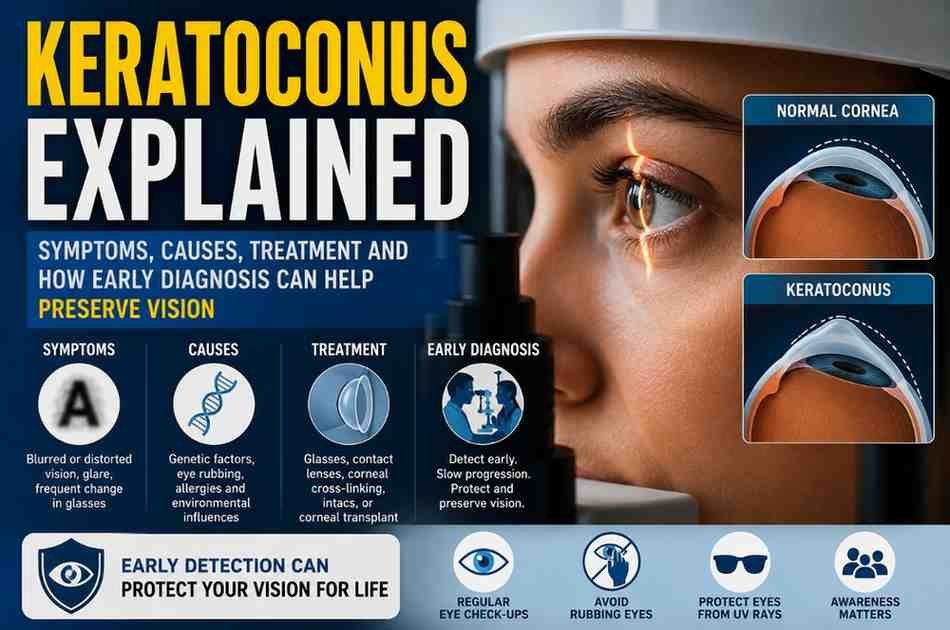
Blurry vision in teenagers or young adults is often dismissed as a simple need for stronger glasses. However, in some cases, it may signal keratoconus a progressive eye disorder that affects the shape of the cornea and is recognized as one of the leading causes of visual impairment and corneal transplantation in younger individuals.
Although keratoconus cannot currently be cured, advances in ophthalmology have dramatically improved the outlook for people diagnosed early. Treatments are now available to slow disease progression, improve vision, and reduce the likelihood of severe complications.
The biggest challenge is awareness. Because the condition often develops gradually, many people remain undiagnosed until significant vision changes have already occurred.
What Is Keratoconus?
Keratoconus is a progressive eye disease in which the normally round, dome-shaped cornea gradually becomes thinner and bulges outward into a cone-like shape. Since the cornea is responsible for focusing light onto the retina, any change in its shape can significantly distort vision.
The irregular curvature causes light rays to scatter instead of focusing properly, resulting in blurred or distorted eyesight that glasses may no longer fully correct.
The condition typically affects both eyes, although one eye may be more severely affected than the other.
Why the Cornea Matters
The cornea is the transparent front surface of the eye and plays a crucial role in vision. It contributes most of the eye’s focusing power, helping direct incoming light accurately onto the retina.
When the cornea becomes thinner and irregular, visual clarity declines because light can no longer be focused precisely.
This explains why people with keratoconus often experience vision problems even after updating their spectacle prescription.
Who Is Most at Risk?
Keratoconus most commonly begins during adolescence or early adulthood, although it can develop at other ages. The disease often progresses over several years before stabilizing.
Risk factors may include:
- Family history of keratoconus
- Frequent or vigorous eye rubbing
- Certain allergic eye conditions
- Some inherited genetic disorders
- Chronic eye irritation
Not everyone with these risk factors develops keratoconus, but awareness allows earlier evaluation when symptoms appear.
Early Symptoms Can Be Easy to Miss
One reason keratoconus is frequently diagnosed late is that its earliest symptoms resemble common refractive errors.
Warning signs include:
- Progressively blurred vision
- Frequent changes in eyeglass prescription
- Increasing astigmatism
- Sensitivity to bright lights
- Glare and halos around lights
- Difficulty seeing clearly at night
- Double or distorted vision in one eye
If vision continues to worsen despite repeated prescription updates, an eye examination by an ophthalmologist becomes particularly important.
How Keratoconus Is Diagnosed
Modern eye care has greatly improved the ability to detect keratoconus in its early stages. Comprehensive examinations may include:
- Visual acuity testing
- Refraction assessment
- Slit-lamp examination
- Corneal topography
- Corneal tomography
- Measurement of corneal thickness
Among these, corneal topography has become one of the most valuable tools because it creates a detailed map of the cornea’s surface and can identify subtle changes before severe vision loss occurs.
| Diagnostic Test | Purpose |
|---|---|
| Vision Test | Measures visual clarity |
| Refraction | Determines corrective lens requirements |
| Slit-Lamp Examination | Evaluates eye structures |
| Corneal Topography | Maps corneal shape and curvature |
| Corneal Thickness Measurement | Detects progressive thinning |
Why Early Diagnosis Makes a Big Difference
Keratoconus is progressive, meaning the condition can worsen over time. Early diagnosis allows ophthalmologists to intervene before significant structural damage occurs.
Detecting the disease during its initial stages may help preserve vision and reduce the likelihood of advanced complications that require more complex treatment.
This is especially important for teenagers and young adults, when progression tends to occur more rapidly.
Is There a Cure?
At present, there is no cure that reverses keratoconus completely. However, this does not mean that nothing can be done.
Modern treatment focuses on:
- Slowing disease progression
- Improving visual quality
- Correcting refractive errors
- Preventing severe corneal damage
- Reducing the need for corneal transplantation
Many people with keratoconus maintain useful vision for decades with appropriate management.
Treatment Options Available Today
The choice of treatment depends on disease severity, rate of progression, and visual needs.
Eyeglasses
In the earliest stages, standard spectacles may provide satisfactory vision correction.
Contact Lenses
As the cornea becomes more irregular, specially designed rigid gas-permeable, hybrid, or scleral contact lenses often provide better visual correction than glasses.
Corneal Collagen Cross-Linking
Corneal collagen cross-linking has become one of the most significant advances in keratoconus management. The procedure strengthens corneal tissue with the goal of slowing or stopping disease progression.
While it does not cure keratoconus, it may help preserve existing vision and reduce future deterioration.
Corneal Transplantation
In advanced cases where significant scarring or severe thinning develops, corneal transplantation may become necessary. Improvements in surgical techniques have increased the success of these procedures, although many patients today are diagnosed early enough to avoid transplantation.
Can Keratoconus Lead to Blindness?
Keratoconus rarely causes complete blindness, but untreated progression can result in severe visual impairment that significantly affects education, employment, driving, and daily activities.
The encouraging news is that early diagnosis and modern treatment have substantially improved long-term outcomes.
Most patients who receive appropriate care retain functional vision throughout their lives.
The Importance of Avoiding Excessive Eye Rubbing
One lifestyle factor that ophthalmologists frequently emphasize is avoiding vigorous eye rubbing. Although occasional rubbing is unlikely to cause keratoconus on its own, repeated forceful rubbing may contribute to disease progression in susceptible individuals.
People with allergies should seek appropriate treatment to reduce persistent itching that encourages rubbing.
Simple preventive habits may help protect corneal health over time.
Living With Keratoconus
A diagnosis of keratoconus can initially feel overwhelming, particularly for young people whose education or careers depend on clear vision. However, advances in eye care mean that many individuals continue to lead active, independent lives.
Regular follow-up appointments, timely treatment, and adherence to specialist recommendations are essential for preserving vision.
With modern management, keratoconus has become increasingly treatable, even though it remains incurable.
| Disease Stage | Common Management |
|---|---|
| Early | Eyeglasses and regular monitoring |
| Mild to Moderate | Specialized contact lenses and consideration of collagen cross-linking |
| Progressive | Cross-linking with customized visual correction |
| Advanced | Specialized lenses or corneal transplantation when necessary |
The Bigger Picture: Why Awareness Matters
One of the greatest challenges in keratoconus is delayed diagnosis. Many young people assume worsening eyesight simply requires stronger glasses, allowing the disease to progress unnoticed.
Increasing public awareness, encouraging regular eye examinations, and improving access to advanced corneal imaging can help identify patients before significant vision loss occurs.
As research continues, scientists are exploring new technologies and therapies that may further improve treatment options in the future.
Conclusion
Keratoconus is a progressive eye disorder that can significantly affect vision during adolescence and early adulthood, making it one of the leading causes of visual impairment in younger individuals. Although there is currently no cure, modern treatments—including specialized contact lenses and corneal collagen cross-linking—have transformed disease management and greatly improved long-term outcomes.
The key lies in early recognition. Persistent changes in vision, increasing astigmatism, or repeated prescription updates should never be ignored. Timely evaluation by an ophthalmologist can make the difference between preserving vision and facing avoidable complications.
As awareness grows and technology continues advancing, the future for people living with keratoconus is becoming increasingly hopeful—proving that early diagnosis remains one of the most powerful tools in protecting eyesight.
For breaking news and live news updates, like us on Facebook or follow us on Twitter and Instagram. Read more on Latest Lifestyle on thefoxdaily.com.


COMMENTS 0