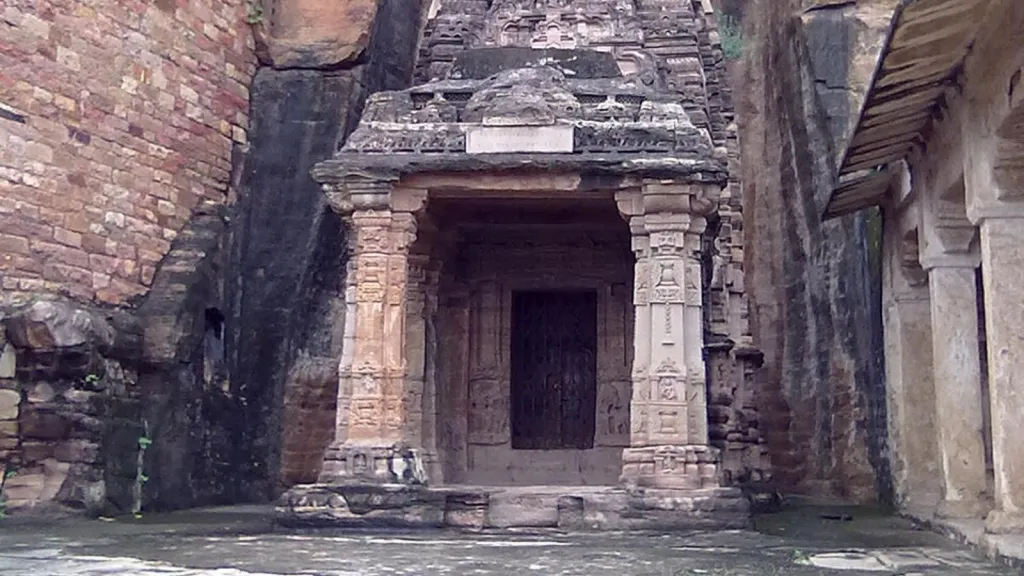
Long before the modern world embraced digital technology, computers, and advanced Mathematics, a simple symbol transformed human civilization forever: zero. While today it is impossible to imagine mathematics without zero, its invention remains one of humanity’s greatest intellectual achievements. Hidden within the historic walls of Gwalior Fort in Madhya Pradesh lies a remarkable monument known as the Chaturbhuj Temple, often referred to as India’s “Zero Temple.” The temple preserves one of the world’s oldest known recorded symbols representing zero, making it an extraordinary destination for historians, mathematicians, archaeologists, and travelers alike.
The inscription carved into the temple’s stone walls is more than an ancient engraving—it is evidence of a revolutionary mathematical concept that changed commerce, astronomy, engineering, science, and eventually the digital age. The Chaturbhuj Temple stands as a powerful reminder of India’s profound contribution to global knowledge and the evolution of mathematics.
What Is the ‘Zero Temple’?
The Chaturbhuj Temple, located inside the imposing Gwalior Fort, is popularly known as the “Zero Temple” because it contains one of the earliest surviving inscriptions featuring the symbol for zero used as a numeral.
Unlike symbolic references to the concept of “nothingness,” this inscription demonstrates zero being used within a numerical system, an innovation that fundamentally changed mathematical calculations.
The temple itself is dedicated to Lord Vishnu in his four-armed (Chaturbhuj) form and dates back to the early medieval period.
Where Is the Chaturbhuj Temple Located?
The temple is situated within Gwalior Fort, one of India’s most magnificent hill forts. Rising dramatically above the city of Gwalior, the fort has witnessed centuries of political, cultural, and architectural history.
Although many visitors come to admire its grand palaces and defensive structures, the Chaturbhuj Temple quietly preserves one of the most important milestones in the history of mathematics.
Why Is the Zero Symbol So Important?
Zero may appear to be a simple numeral, but its invention revolutionized mathematics.
Without zero, modern mathematics would struggle to support:
- Algebra
- Calculus
- Computer programming
- Digital technology
- Engineering
- Astronomy
- Physics
- Financial accounting
Zero serves two essential purposes: it represents the absence of quantity and functions as a placeholder in the decimal place-value system.
The Historic Inscription
The famous inscription at the Chaturbhuj Temple dates to the 9th century CE and records the donation of land for maintaining the temple.
Within this inscription, zero appears as part of numerical values describing land measurements, demonstrating that the symbol was already being used in everyday administrative and practical contexts.
This makes the inscription especially valuable because it shows zero as a functioning numeral rather than merely a theoretical concept.
| Feature | Details |
|---|---|
| Location | Chaturbhuj Temple, Gwalior Fort, Madhya Pradesh |
| Historical Period | 9th Century CE |
| Significance | Contains one of the world’s oldest recorded zero symbols |
| Purpose of Inscription | Records land donation and measurements |
| Mathematical Importance | Evidence of zero used in the decimal number system |
The Difference Between the Concept of Zero and the Symbol Zero
Historians distinguish between understanding the idea of “nothing” and developing a numerical symbol representing zero.
Ancient civilizations understood the absence of objects, but creating a numeral that could be used consistently within arithmetic represented a major intellectual breakthrough.
India played a pivotal role in transforming zero from a philosophical idea into a practical mathematical tool.
How Zero Changed Mathematics Forever
The introduction of zero made the decimal place-value system far more powerful and efficient.
Instead of requiring different symbols for increasingly large numbers, a limited set of digits combined with positional value made calculations simpler and more accurate.
For example:
- 10 differs from 1 because of zero.
- 100 differs from 10 because zero changes place value.
- 1000 continues the same principle.
This positional notation became the foundation of modern arithmetic used worldwide today.
India’s Contribution to the Decimal Number System
Indian mathematicians made groundbreaking contributions to numerical notation, arithmetic, algebra, and astronomy.
The decimal place-value system developed in the Indian subcontinent eventually spread through trade, scholarship, and cultural exchange to the Islamic world and later Europe.
This transmission transformed global mathematics and scientific development.
The Role of Ancient Indian Mathematics
Ancient India produced several influential mathematicians whose work advanced number theory, geometry, algebra, and astronomy.
Their achievements included:
- Place-value notation
- Rules involving zero
- Algebraic equations
- Trigonometric calculations
- Astronomical observations
These developments laid the groundwork for many later scientific discoveries across civilizations.
Why Historians Value the Chaturbhuj Temple Inscription
Archaeological inscriptions provide direct physical evidence of how mathematics was used in everyday life.
The Chaturbhuj Temple inscription demonstrates that numerical notation involving zero had moved beyond scholarly texts into administrative and practical applications.
This strengthens historical understanding of how mathematical knowledge spread throughout society.
How Zero Made Modern Science Possible
Without zero, many scientific disciplines would be dramatically different.
Zero enables:
- Binary computing
- Advanced engineering calculations
- Space exploration
- Statistical analysis
- Financial systems
- Artificial intelligence
- Modern telecommunications
The binary language that powers every computer relies entirely on combinations of zeros and ones.
Exploring Gwalior Fort Beyond the Zero Temple
Visitors to Gwalior Fort can also explore several remarkable monuments that showcase centuries of Indian architecture and history.
The fort complex includes:
- Ancient temples
- Royal palaces
- Historic gateways
- Water reservoirs
- Intricate carvings
- Defensive walls stretching across the hilltop
Together, these structures make Gwalior Fort one of India’s richest heritage destinations.
Why the Zero Temple Deserves Greater Recognition
Despite its extraordinary historical importance, the Chaturbhuj Temple remains relatively less known than many other Indian monuments.
Greater awareness could help highlight India’s scientific heritage alongside its architectural and cultural achievements.
The temple represents not only religious history but also one of humanity’s greatest intellectual milestones.
Frequently Asked Questions
Why is the Chaturbhuj Temple called the Zero Temple?
It preserves one of the world’s oldest surviving inscriptions featuring the numeral zero used within a mathematical context.
Where is the Zero Temple located?
The Chaturbhuj Temple is located inside Gwalior Fort in Madhya Pradesh.
Why is zero considered such an important invention?
Zero forms the foundation of the decimal number system and enables modern mathematics, computing, engineering, and science.
Does the temple contain the oldest zero in history?
It contains one of the world’s oldest surviving recorded zero symbols used as a numeral in an inscription, making it one of the most important historical examples.
Key Takeaways
- The Chaturbhuj Temple inside Gwalior Fort preserves one of the world’s oldest recorded zero symbols.
- The inscription dates to the 9th century and records land donations using the numeral zero.
- Zero revolutionized mathematics through the decimal place-value system.
- India played a foundational role in developing numerical notation that later spread worldwide.
- The invention of zero made modern science, engineering, finance, and computing possible.
- The Zero Temple stands as one of India’s most significant yet underappreciated scientific heritage sites.
Conclusion
The Chaturbhuj Temple is far more than an ancient place of worship—it is a monument to one of the greatest intellectual breakthroughs in human history. Hidden within the historic Gwalior Fort, its modest stone inscription represents an idea that reshaped civilization. The simple symbol of zero transformed mathematics from a limited counting system into a powerful language capable of describing the universe, enabling everything from architectural engineering to artificial intelligence.
As visitors walk through the temple’s centuries-old corridors, they encounter not merely an archaeological artifact but a testament to India’s enduring contribution to global knowledge. The “Zero Temple” reminds us that some of the world’s most revolutionary ideas are often preserved not in grand monuments alone, but in quiet inscriptions that continue to influence every calculation, every computer, and every scientific discovery made today.
For breaking news and live news updates, like us on Facebook or follow us on Twitter and Instagram. Read more on Latest Lifestyle on thefoxdaily.com.


COMMENTS 0