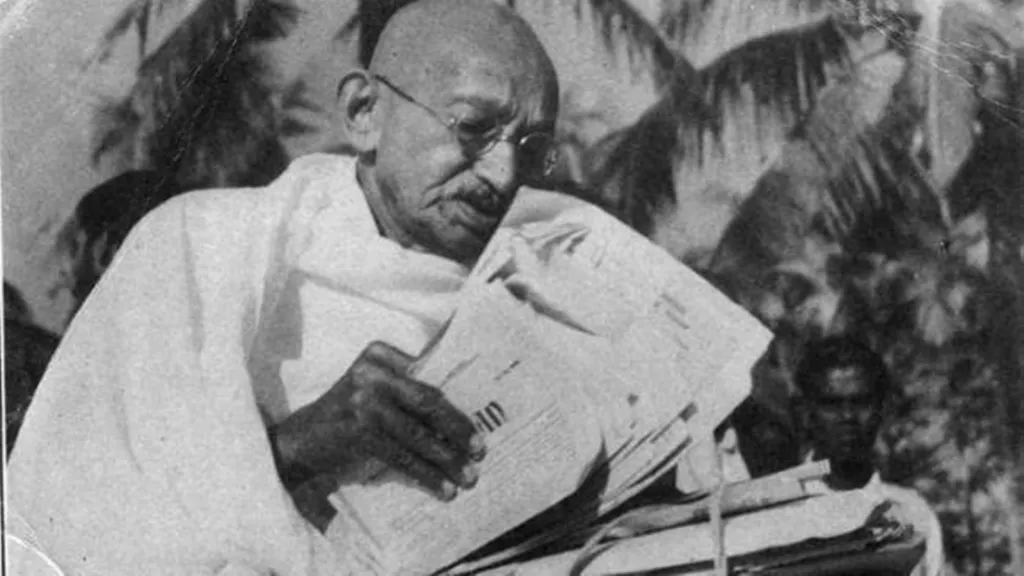
India celebrated its first Diwali as an independent nation on November 12, 1947, less than three months after Independence. But for Mahatma Gandhi, the festival was not an occasion for elaborate decorations, fireworks or public celebrations. With Partition having uprooted families, spread communal violence and pushed thousands into overcrowded refugee camps, he believed the country had a greater responsibility: to share the suffering of displaced people and help them rebuild their lives.
Gandhi’s message was particularly clear in the days surrounding the festival. He rejected the suggestion that people should simply forget their sorrows and celebrate, arguing that the suffering of refugees could not be separated from the responsibilities of the wider Indian community.
On November 12, he used his first and only visit to All India Radio’s Delhi broadcasting studio to address refugees at Kurukshetra. His message was that the spirit of Diwali should be expressed through service, brotherhood and practical assistance rather than outward displays of celebration.
His words also carried a wider political and moral appeal. Gandhi believed independent India could not become a peaceful and united nation while people continued to regard members of other religious communities as enemies. For him, the first Diwali after Independence was a test of whether the country could turn the promise of freedom into compassion and reconciliation.
Why Gandhi Opposed Grand Diwali Celebrations in 1947
Three days before Diwali, Gandhi received a letter from a woman who was herself a refugee. She suggested that people should put aside the sorrows of the past and celebrate the festival with a positive spirit.
Gandhi appreciated the sentiment behind her suggestion but disagreed with its central idea. He questioned why families who had lost their homes, relatives and livelihoods should be expected to celebrate while the rest of society treated their suffering as something separate from its own experience.
He argued that a family facing deep grief would ordinarily avoid festivities. The same sensitivity, he believed, should apply to a nation whose people were experiencing widespread displacement and insecurity.
In a written message read out after his prayer meeting on November 9, 1947, Gandhi explained that India needed to move beyond narrow definitions of family and community.
Break through the crust of limitation, and India becomes one family. If all limitations vanish, the whole world becomes one family, which it really is.
Gandhi observed silence that day, so his written remarks were read aloud. The message, preserved in Post Prayer Speeches – Part II, referred directly to the refugee woman’s letter and her suggestion for celebrating the first Diwali of independent India.
His objection was rooted in the conditions facing displaced Hindus, Muslims and Sikhs. Large numbers of people needed food, clothing and shelter, while the newly established government was struggling to organise relief. In such circumstances, Gandhi believed that spending resources and attention on elaborate celebrations would be difficult to justify.
His position was not simply an appeal for a quieter festival. He wanted the meaning of Diwali to reflect the suffering of people who had lost almost everything during Partition.
Partition Had Turned Delhi Into a City of Refugees
The humanitarian crisis in Delhi in 1947 helps explain why Gandhi considered conventional Diwali celebrations inappropriate. The city was dealing with a massive influx of refugees from West Pakistan, while violence and insecurity were also displacing Muslim residents from their homes.
Contemporary reports estimated that approximately 1.3 lakh refugees from West Pakistan had reached Delhi within a week of Independence. The total number of Hindu and Sikh refugees who arrived in the city following Partition has been estimated at around five lakh.
Many newcomers were living in overcrowded camps, temporary shelters and public spaces. Delhi’s railway station had become a particularly difficult location as families arrived with limited belongings and few immediate options for accommodation.
Muslim residents were also seeking safety in different parts of the capital. Families gathered at locations including Purana Qila, Nizamuddin, Humayun’s Tomb and Jama Masjid. Communal violence, fear and disputes over housing made it difficult for many displaced Muslims to return to their neighbourhoods.
The crisis affected people across religious communities, although the circumstances and experiences of different groups varied. Partition had created a situation in which ordinary families faced the loss of homes, security and familiar social networks on both sides of the newly established border.
For Gandhi, these experiences demonstrated why the idea of treating India as one family mattered. He believed that the suffering of a Hindu refugee should matter to a Muslim neighbour, just as the displacement of a Muslim family should concern Hindus and Sikhs.
Nehru Warned Patel About the Refugee Crisis in Delhi
The scale of the emergency was also evident in correspondence between India’s political leaders. On November 4, 1947, eight days before Diwali, Prime Minister Jawaharlal Nehru wrote to Deputy Prime Minister and Home Minister Sardar Vallabhbhai Patel about the condition of refugees arriving in Delhi from East Punjab.
Nehru described overcrowded camps and deteriorating conditions at the railway station. He specifically mentioned Wavell Canteen, where the available space had become insufficient for the number of people seeking shelter.
The condition of East Punjab refugees in Delhi is also very bad. Some of the small camps, like Wavell Canteen, are full to overflowing and the railway station is in a very bad way.
Nehru acknowledged that the government had been reluctant to establish another refugee camp. However, he believed there was little alternative because people wandering through Delhi without proper shelter were at risk.
If we do not do this, these people, wandering about Delhi and squatting down at odd places, will do harm to themselves and to us.
His concerns extended beyond the immediate humanitarian emergency. In a November 1 letter to the Maharaja of Patiala, Nehru had also expressed concern about growing estrangement between Hindus and Sikhs and reports of Hindus leaving Amritsar and surrounding areas.
He warned that communal and separatist tendencies could undermine the country’s future.
We can never build up a strong and stable nation if we encourage communal or separatist tendencies.
These concerns closely reflected Gandhi’s appeal for reconciliation. Both leaders recognised that political independence alone could not create a stable nation if communal divisions continued to shape public life.
Gandhi’s Historic Radio Address to Kurukshetra Refugees
On November 12, 1947, Gandhi visited Broadcasting House in New Delhi to deliver a radio message to refugees staying at Kurukshetra. Akashvani records the occasion as his first and only visit to the Delhi broadcasting studio.
It was not his first experience of broadcasting. Gandhi had also delivered a radio address during his visit to London for the Round Table Conference in 1931. However, the November 1947 broadcast carried particular significance because it directly addressed people affected by Partition during India’s first Diwali as an independent country.
According to the chronology maintained by the Gandhi Smriti and Darshan Samiti, the Kurukshetra broadcast took place in the afternoon. Gandhi was in Delhi for a Congress Working Committee meeting and also addressed his regular prayer gathering later that day.
The English text of the broadcast began with the words, “My suffering brothers and sisters.”
Gandhi said he had been deeply distressed to hear that more than two lakh refugees had reached Kurukshetra, with more people continuing to arrive. He had wanted to visit the camp personally but could not leave Delhi because of his responsibilities at the Congress Working Committee meeting.
The idea of sending a radio message came from industrialist Ghanshyamdas Birla. Instead of making the journey to Kurukshetra, Gandhi could communicate directly with the refugees through the broadcast.
His message expressed the central purpose of his public life: standing alongside people experiencing hardship and trying to reduce their suffering.
To suffer with the afflicted and try to relieve their suffering has been my life’s work.
The address was subsequently published in Harijan on November 23, 1947. It discussed the difficulties faced by refugees, the approaching winter, the need for shelter and the responsibilities of both the government and camp residents.
Gandhi’s Diwali Message: Celebrate Through Service, Not Lights
Gandhi’s most direct message about the festival came during his Kurukshetra broadcast. He told refugees that their suffering made conventional Diwali celebrations inappropriate. Instead, he wanted the festival to become an occasion for service and mutual support.
Today is Diwali. But there can be no lighting of chirags for you or for anyone. Our Diwali will be best celebrated by service of you, and you will celebrate it by living in your Camp as brothers and looking upon everyone as your own.
The message placed responsibilities on both the wider public and the displaced families. People outside the camps had a duty to provide relief, while those living in the camps were encouraged to treat one another as members of a shared community.
Gandhi also addressed practical aspects of camp life. He urged residents to maintain sanitation, distribute available rations fairly and cooperate with the officials responsible for managing the camps.
These instructions were important because overcrowded refugee settlements faced serious challenges. Limited supplies, poor living conditions and the pressure of accommodating large numbers of people required cooperation among residents and administrators.
Gandhi’s approach connected the moral meaning of Diwali with everyday responsibilities. Helping a neighbour, maintaining cleanliness, sharing food and cooperating with relief workers were not secondary activities. They were ways of expressing the festival’s spirit under extraordinary circumstances.
His message also avoided treating refugees merely as recipients of government assistance. He encouraged them to participate in improving conditions within their camps and supporting others who were facing similar hardships.
Why Gandhi Said India Had No Ramarajya Yet
At his prayer meeting on the evening of November 12, Gandhi turned to the religious significance of Diwali. He discussed the traditional association of the festival with the return of Lord Rama after his victory over Ravana and the celebration of the triumph of good over evil.
For Gandhi, however, the symbolic victory of good over evil needed to be reflected in the behaviour of people. Lighting lamps and decorating homes could not, by themselves, establish the values associated with Rama’s rule.
He questioned whether India could genuinely celebrate Diwali in the traditional spirit when the country was still witnessing violence, displacement and hostility between communities.
But alas! Today there is no Ramarajya in India. So how can we celebrate Diwali?
His reference to Ramarajya was connected to his broader understanding of an ideal society built on justice, moral responsibility and concern for the weakest. Independence had ended British colonial rule, but the violence surrounding Partition showed that the country had not yet achieved the social harmony he hoped to see.
Gandhi also spoke about the situation in Kashmir. He described Jawaharlal Nehru’s return after visiting the wounded region and mentioned the flowers Nehru had brought him from Baramulla.
Although Gandhi cherished the gift, he was distressed by reports of looting, arson and bloodshed that had damaged the region’s beauty and affected its people.
The reference to Kashmir reinforced his wider point: the festival’s message of goodness could not be separated from the responsibility to protect human life and prevent violence.
Gandhi Asked India to Bring Displaced Muslims Home
One of the strongest parts of Gandhi’s November 12 prayer address was his appeal for the return of Muslims who had fled their homes in fear. He wanted people to recognise that the suffering of minorities was a national concern, regardless of which community they belonged to.
His appeal extended beyond India’s borders. He argued that Pakistan also had a responsibility to ensure that Hindus and Sikhs who had fled in fear could return safely.
Diwali cannot be celebrated till you bring back all the Muslims who have fled in fear. Pakistan also would not survive if it does not do likewise with the Hindus and Sikhs who have run away from there.
The statement reflected Gandhi’s belief that the safety of minorities was essential to the moral legitimacy and stability of both newly independent countries.
He did not want the displacement of one community to become a justification for hostility towards another. Instead, he called for reciprocal responsibility and the restoration of trust between people separated by communal violence.
His appeal was particularly significant at a time when fear and insecurity had made the return of displaced families extremely difficult. Reconciliation required more than public statements. It demanded protection, practical arrangements and a willingness to accept neighbours from different religious backgrounds.
Gandhi’s Message the Day After Diwali
On November 13, Gandhi returned to the subject of Diwali and reflected on how Delhi had observed the festival.
The capital was traditionally known for its elaborate Diwali illuminations. However, Gandhi said he was pleased to hear that people had understood that the circumstances did not justify large-scale celebrations that year.
He had received reports that oil lamps had been lit in some places, while electric lighting was limited. He clarified that he was relying on information reaching him rather than describing personal observations.
Gandhi did not suggest that celebrations should be abandoned permanently. Instead, he connected the possibility of returning to elaborate festivities with the restoration of communal harmony.
He said that if the atmosphere improved and Hindus and Muslims began living together peacefully, people would have the right to celebrate the following Diwali with illuminations.
We can accomplish nothing by regarding one another as enemies.
The statement captured the continuing theme of his messages throughout the festival. The problem was not the religious celebration itself but the contradiction between celebrating light and goodness while allowing fear, hatred and violence to dominate society.
What Gandhi’s First Diwali Message Meant for Independent India
Gandhi’s position on Diwali in 1947 reflected the difficult circumstances in which India began its independent journey. Freedom had brought an end to colonial rule, but Partition had left behind a humanitarian emergency involving mass displacement, communal violence and the breakdown of relationships between communities.
For Gandhi, the country’s first Diwali was therefore an opportunity to reconsider what independence should mean in everyday life. Political freedom would remain incomplete if people could not live safely, return to their homes and regard neighbours from different religious communities as fellow citizens.
His messages also highlighted the importance of public responsibility during a crisis. Government relief efforts were essential, but ordinary citizens had a role in sharing resources, helping displaced families and resisting communal hostility.
He wanted refugees to receive practical assistance rather than sympathy alone. At the same time, he encouraged displaced people to support one another and contribute to a more cooperative environment within their camps.
Nearly eight decades later, Gandhi’s first Diwali message remains a reminder that festivals can carry responsibilities beyond rituals and celebrations. His appeal was not simply to avoid lighting lamps during a difficult year. It was to recognise that the light associated with Diwali had little meaning if people continued to suffer because of religious divisions and indifference.
In 1947, Gandhi wanted independent India to celebrate Diwali by serving refugees, protecting minorities, rebuilding trust and treating the suffering of others as its own. His idea of a meaningful festival began not with decorations or fireworks, but with the effort to make the country one family.
For breaking news and live news updates, like us on Facebook or follow us on Twitter and Instagram. Read more on Latest India on thefoxdaily.com.






COMMENTS 0