Some writers document the world around them. Others force readers to confront the realities that society would rather leave unseen. Mahasweta Devi belonged to the latter category. Her stories did not offer comfortable observations about inequality or injustice. They brought readers face to face with exploitation, institutional violence, caste discrimination and the everyday struggles of people denied dignity.
In her fiction, the human body frequently becomes a site of political conflict. Women face violence not only from individuals but also from systems that treat their bodies as instruments of control. Adivasi communities struggle against the destruction of their land and livelihoods, while Dalits confront social structures designed to deny them equality. Yet Devi’s characters are rarely defined only by their suffering. Their resistance, anger and refusal to surrender give her writing its extraordinary force.
Her best-known short story, Draupadi (1978), captures this approach with unsettling clarity. Through a tribal woman who turns the violence inflicted on her into an act of defiance, Devi challenges conventional ideas of power, shame and resistance. The story remains one of the most striking literary confrontations with state violence and gendered oppression in modern Indian writing.
As the centenary of her birth brings renewed attention to her work, Devi’s literary legacy also invites a wider question: who gets to tell stories, whose experiences enter mainstream publishing, and what happens when literature refuses to soften its anger?
Who was Mahasweta Devi? The writer who made marginalised lives visible
Born in 1926 into a Bengali Brahmin family in what is now Dhaka, Mahasweta Devi grew up in a household shaped by literature and social engagement. Her father, Manish Ghatak, was a poet and novelist, while her mother, Dharitri Devi, was a writer and social worker.
Devi wrote primarily in Bengali and built an extensive body of work over more than six decades. She left behind over 100 novels and 20 collections of short stories, establishing herself as one of the most influential literary voices concerned with social inequality in India.
Her writing focused particularly on people who remained outside the centre of political and cultural attention. Adivasis, Dalits, landless labourers, women and communities facing exploitation appeared not as background figures but as the central subjects of her stories.
What distinguished her approach was the refusal to separate literary storytelling from social reality. Her fiction examined how power operated through land ownership, caste, gender, poverty and state institutions. Rather than presenting oppression as an abstract social problem, she showed how it shaped individual lives, relationships and choices.
Several of her works have become part of college curricula, introducing generations of readers to questions about the female body, social exclusion and resistance. Her writing also challenged the assumption that literary importance should be measured by how closely a story reflects the experiences of privileged communities.
Draupadi: How Mahasweta Devi turned a victim of violence into a symbol of resistance
Among Mahasweta Devi’s most widely discussed works, Draupadi remains especially powerful because of its confrontation with sexual violence and state authority.
The story follows Dopdi Mejhen, a Santal tribal woman associated with the Naxalite movement in West Bengal during the period of violent peasant uprisings in the 1970s. She is pursued by state forces, captured and subjected to repeated sexual violence while in custody on the orders of a senior official.
After the assault, she is instructed to dress and appear before the officer. Instead, Dopdi tears her clothes and walks towards him naked, her body marked by the violence she has endured. Rather than displaying the shame expected of her, she laughs at the men who have assaulted her.
The moment reverses the expected relationship between victim and authority. The officials have the power to capture and physically brutalise her, but they cannot make her perform the submission they demand. Her refusal to cover herself becomes an act of confrontation.
The politics of the female body
The significance of Draupadi lies in the way it exposes the connection between gender, political power and state violence. Dopdi is targeted not simply as an individual but as someone associated with a movement challenging established authority. Her body becomes a site through which that authority attempts to demonstrate control.
Yet Devi refuses to let the story end with the violence inflicted on her. Dopdi’s final act challenges the assumptions that shame belongs to the survivor or that physical power automatically produces political victory.
The story also complicates conventional representations of female resistance. Dopdi does not defeat her attackers through physical force or escape. Her defiance comes from refusing to behave as they expect. She turns the consequences of their violence into an accusation against them.
This is why the story continues to be discussed in classrooms and literary debates. It asks difficult questions about consent, institutional responsibility, the treatment of marginalised women and the limits of conventional ideas of resistance.
Aranyer Adhikar: Mahasweta Devi’s tribute to Birsa Munda and tribal resistance
Mahasweta Devi’s engagement with marginalised communities extended beyond fictional portrayals of contemporary exploitation. She also turned to history to recover the struggles of people whose contributions had often received limited attention in mainstream narratives.
Her novel Aranyer Adhikar (Rights to the Forest) tells the story of Birsa Munda, the tribal leader and freedom fighter whose movement challenged colonial authority and the exploitation of Adivasi communities.
Published in Bengali, the novel examines the relationship between tribal identity, land and political resistance. Its depiction of forests is particularly significant. The forest is not merely a geographical setting or a source of resources. It represents the foundation of community life, livelihood, memory and belonging.
For communities whose existence is closely connected with their land, the loss of forests can mean much more than the loss of property. It can threaten traditional practices, economic survival and cultural continuity. By placing these concerns at the centre of her narrative, Devi presented tribal resistance as a struggle over the right to live with dignity.
In 1979, she received the Sahitya Akademi Award for Aranyer Adhikar. The recognition brought further attention to a literary project that challenged readers to look beyond familiar accounts of India’s past and acknowledge the experiences of Adivasi communities.
Mahasweta Devi was an activist as much as a writer
For Devi, writing and activism were closely connected. Her social work was not separate from her literary interests; both emerged from a commitment to people whose experiences were routinely ignored by powerful institutions.
She worked with marginalised communities, helped establish unions of bonded labourers and used her editorial position to encourage people from disadvantaged backgrounds to record their own experiences.
One important part of this effort involved Bortika, the literary journal established by her father and later edited by Devi. She opened its pages to people who were rarely treated as legitimate contributors to literary culture, including rickshaw pullers and Adivasis.
This approach challenged the conventional idea of who could be a writer. Literary expression was not to be restricted to people with formal education, established publishing connections or privileged social backgrounds. People who understood exploitation through their own lives could also describe it, interpret it and shape the public conversation.
Her encouragement helped create opportunities for voices that might otherwise have remained unheard. One of the most remarkable examples was Manoranjan Byapari, whose journey from working-class hardship to literary recognition began with an encounter with Devi.
Beyond Mahasweta Devi: Writers carrying forward the language of resistance
Devi’s legacy can also be understood through the writers and storytellers whose work continues to challenge social hierarchies. Their subjects and literary approaches differ, but they share an interest in exposing structures that shape people’s lives without always being visible to those who benefit from them.
From Dalit autobiography to sports journalism and working-class memoir, contemporary writing continues to ask questions about representation, identity and the right to narrate one’s own experience.
Bama: Using language to challenge caste discrimination
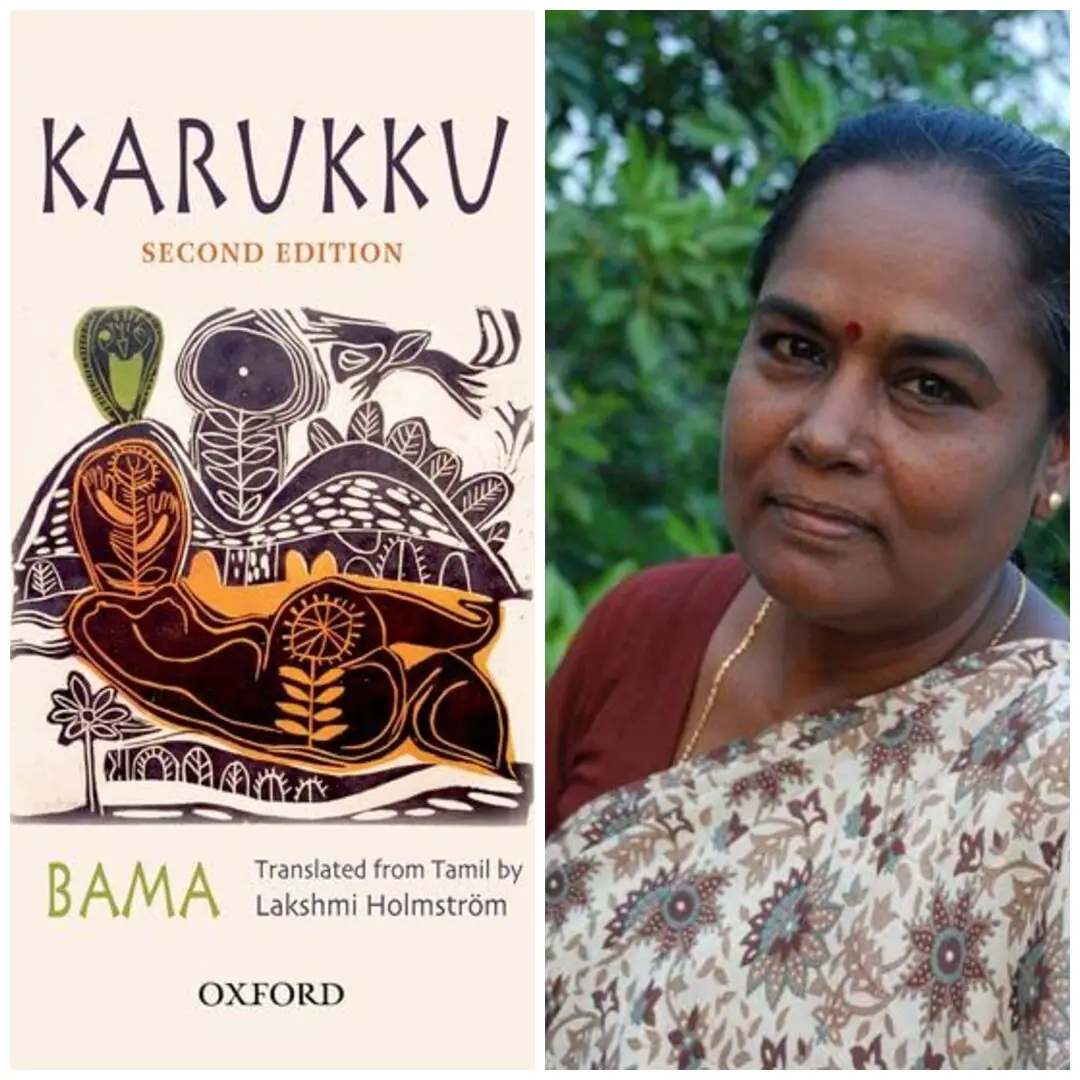
Tamil writer Bama Faustina Soosairaj, widely known as Bama, brought the experiences of Dalit women into literary focus through writing that directly confronted caste and religious discrimination.
Her 1992 autobiography, Karukku, was the first memoir by a Dalit woman published in Tamil. The title refers to the sharp-edged palmyra leaf, an image that reflects the book’s forceful engagement with social injustice and the pain of exclusion.
Written from her own perspective, the memoir examines caste, religion and Tamil identity. It also recounts her experiences in a Catholic convent, where she witnessed discrimination against Dalit children and nuns. Her decision to leave the institution and write about what she had experienced became central to the book’s account of suffering, self-examination and healing.
Karukku generated a backlash but also received critical acclaim. Its importance extended beyond autobiography: it challenged established literary conventions by placing a Dalit woman’s experience at the centre of the narrative.
Bama continued exploring caste and community through works such as Sangati (1994) and Kisumbukkaran (1996). Her novel Vanmam (2010) examined how caste politics can produce conflict and violence within rural communities.
Her approach to language is equally important. Bama has argued that language should be militant when confronting a dehumanising practice such as caste. For readers new to her work, The Stomach That Chewed Hunger and Other Stories (2022), published by Zubaan Books, offers an introduction through 12 stories rooted in caste and gender.
Sohini Chattopadhyay: What does it take for women to become runners?
Journalist and award-winning film critic Sohini Chattopadhyay approaches questions of gender and inequality through sport in her book The Day I Became a Runner (2023).
The book begins with an argument that running, because it is a solitary activity performed in public spaces, can pose a direct challenge to patriarchy. Women who run must claim space in environments where their presence and freedom of movement may be questioned.
To explore this idea, Chattopadhyay presents the stories of eight runners from different social backgrounds. Their experiences reveal that sporting participation is not simply a matter of physical ability or personal motivation. Poverty, social expectations, institutional neglect and unequal access to opportunities can determine whether an athlete gets the chance to continue.
The book also examines the trauma associated with invasive gender-verification procedures imposed on athletes, including Santhi Soundarajan and Pinki Pramanik. These experiences raise difficult questions about who gets to define gender in sport and the consequences of institutions exercising control over athletes’ bodies.
Through the stories of women runners, Chattopadhyay examines the larger realities of being a woman in India. She is also working on a biography of Mahasweta Devi, bringing her journalistic interest in marginalised lives to the story of a writer who made those lives central to literature.
Manoranjan Byapari: From rickshaw puller to celebrated writer
The story of Manoranjan Byapari offers one of the clearest examples of Mahasweta Devi’s belief that literary expression should be open to everyone.
Born into a family of fisherfolk in the Barishal district of present-day Bangladesh, Byapari grew up in refugee camps across West Bengal. As a young man, he joined the Naxalite movement but left after a friend was killed.
His life involved a series of difficult and often precarious jobs. He worked as a dishwasher, cook and crematorium helper, among other occupations. He also spent years moving in and out of prison, where he began writing.
Eventually, Byapari found work as a rickshaw puller. One day, a passenger who hired his rickshaw turned out to be Mahasweta Devi.
In his autobiography, Itibritte Chandal Jiban (Chronicle of a Chandal Life, 2012), Byapari recalls initially assuming that Devi might be a professor because she had taken his rickshaw from Jyotish Roy College, where she taught English. Their conversation turned towards books and language, and Devi eventually invited him to contribute to Bortika.
The encounter became a turning point. Byapari went on to establish himself as a writer, producing accounts of working-class lives and people often overlooked by mainstream literature. His subjects included goatherds, cowherds, teashop helpers, coolies, lorry drivers’ assistants, toilet cleaners and night guards.
His writing drew attention to the experiences of people whose labour sustains everyday life but whose stories rarely occupy the centre of public discussion. He also received literary recognition for work rooted in his own experiences and those of other marginalised communities.
In a tribute published in Borderless Journal soon after Devi’s death, Byapari described her as a mother who had shown him a new direction and opened up the possibility of an endless life. His words capture the personal significance of a relationship that began with a simple rickshaw ride but eventually changed the course of his literary journey.
Why Mahasweta Devi’s writing still matters today
Mahasweta Devi’s work remains relevant because the questions it raises are not confined to the period in which she wrote. Who controls land and resources? Whose suffering is recognised by institutions? Why are some communities repeatedly excluded from social and political power? What does resistance look like when conventional routes to justice are unavailable?
Her stories insist that these questions must be examined from the perspective of people who experience their consequences. Rather than treating marginalised communities as passive recipients of sympathy, she gave them voices, histories, anger and agency.
Her writing also challenges the relationship between literature and comfort. Stories such as Draupadi do not make injustice easier to consume. They confront readers with violence and force them to consider the systems that enable it. Her work on Birsa Munda, meanwhile, demonstrates how historical storytelling can restore attention to struggles that have been pushed to the margins.
The writers associated with this wider tradition of resistance show that the project continues in different forms. Bama challenges caste through language and autobiography. Sohini Chattopadhyay examines gender and institutional power through sport. Manoranjan Byapari turns working-class experience into literature and demonstrates the importance of creating space for voices outside established literary circles.
A legacy written in anger, dignity and resistance
Mahasweta Devi’s literary legacy cannot be reduced to a list of awards, novels or celebrated stories. Its deeper significance lies in the people she chose to write about and the systems she refused to ignore. Her work brought Adivasi and Dalit lives, women’s struggles and working-class experiences into the centre of literary conversation.
Her anger was not simply an emotion expressed through powerful prose. It was a way of exposing injustice and questioning the social arrangements that allowed it to continue. In her stories, resistance could emerge through a woman’s refusal to display shame, a community’s struggle to protect its forest or an ordinary worker’s decision to write about his own life.
As readers revisit her work a century after her birth and a decade after her death, the force of her writing lies in its refusal to become comfortable history. The scars in her stories remain reminders of lives shaped by inequality, but also of the determination to challenge it. Mahasweta Devi gave those struggles a literary language, and her work continues to ask readers not merely to witness injustice, but to recognise the people resisting it.
For breaking news and live news updates, like us on Facebook or follow us on Twitter and Instagram. Read more on Latest Lifestyle on thefoxdaily.com.

COMMENTS 0