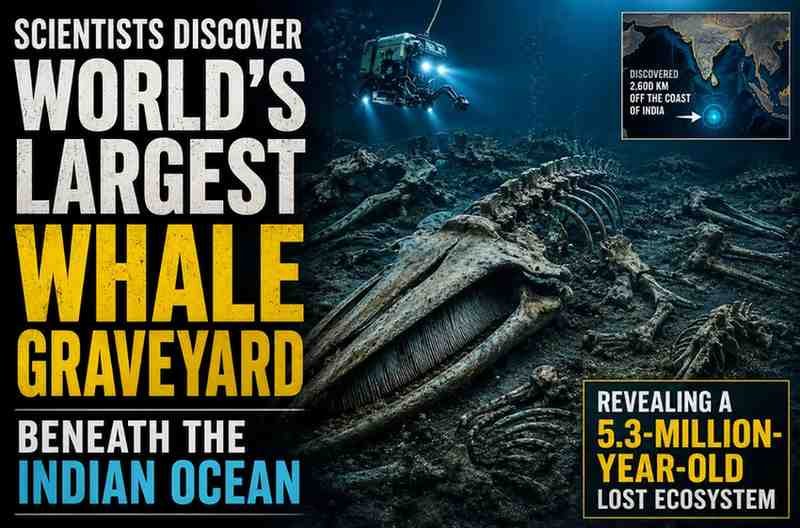
The depths of the Indian Ocean have yielded an extraordinary discovery that is reshaping scientists’ understanding of marine ecosystems and the afterlife of Earth’s largest creatures. Researchers have identified what is believed to be the world’s largest whale graveyard, containing fossilized remains that are up to 5.3 million years old.
The finding represents more than a collection of ancient bones. It provides evidence of a remarkable process known as whale fall, in which the carcasses of whales descending to the seafloor create entire ecosystems capable of sustaining life for decades. The newly discovered site is also the deepest and oldest whale graveyard ever documented, making it one of the most important marine paleontology discoveries in recent years.
What Is a Whale Graveyard?
A whale graveyard refers to an area where the remains of multiple whales accumulate over time. Unlike terrestrial fossils, whale carcasses that sink to the ocean floor become ecological hotspots, nourishing specialized organisms in otherwise nutrient-poor environments.
These whale falls support a succession of marine communities, including:
- Bacteria that break down fats and proteins.
- Deep-sea worms and mollusks.
- Crustaceans and scavenging fish.
- Chemosynthetic organisms that thrive without sunlight.
- Species found nowhere else in the ocean.
Scientists describe whale falls as underwater oases, capable of sustaining life for decades after a whale’s death.
Why This Discovery Is So Significant
The newly identified graveyard stands out because of both its scale and age. Some fossils date back approximately 5.3 million years, making them older than any previously documented whale graveyard.
The depth of the site also adds to its uniqueness. Conditions at such depths preserve remains differently from shallower environments, allowing researchers to reconstruct ancient ecosystems with remarkable precision.
The discovery offers clues about:
- Whale evolution.
- Ocean circulation patterns.
- Ancient biodiversity.
- Climate changes over millions of years.
- The evolution of deep-sea organisms.
Understanding the Science of Whale Falls
When a whale dies, its body embarks on a remarkable ecological journey.
Stage 1: Mobile Scavengers
Sharks, fish, and crustaceans consume soft tissues over several months.
Stage 2: Enrichment Opportunists
Worms and smaller organisms colonize sediments enriched by organic matter.
Stage 3: Sulfophilic Stage
Bacteria break down lipids trapped inside bones, producing chemicals that sustain unique life forms for decades.
Stage 4: Reef Stage
Remaining bones become habitats for sponges, corals, and other organisms.
This process transforms a single whale into an ecosystem supporting hundreds of species.
| Whale Fall Stage | Duration | Dominant Life Forms |
|---|---|---|
| Scavenger Stage | Months | Sharks, fish, crustaceans |
| Enrichment Stage | Up to 2 years | Worms and marine invertebrates |
| Sulfophilic Stage | 10–50 years | Bacteria and chemosynthetic species |
| Reef Stage | Decades | Corals, sponges, small marine animals |
An Overlooked Reality: Whales Help Sustain Life Even After Death
One fascinating aspect often overlooked is that whales continue to play a vital ecological role long after they die.
Because whale carcasses contain enormous amounts of carbon and nutrients, their descent to the ocean floor effectively transfers energy from surface ecosystems to the deep sea.
This process supports biodiversity and contributes to the ocean’s carbon cycle. In some ways, whales act as biological bridges connecting entirely different layers of marine life.
The newly discovered graveyard demonstrates how these giants have shaped ecosystems for millions of years.
What Ancient Whale Fossils Reveal About Earth’s Past
Fossils provide scientists with invaluable records of ancient climates and ecosystems.
By studying the remains, researchers can investigate:
- Changes in ocean temperatures.
- Historical migration routes.
- Species diversity during different geological periods.
- Evolutionary relationships among marine mammals.
- How ecosystems responded to natural climate shifts.
Such information helps scientists understand how present-day oceans may respond to modern climate change.
Deep Oceans Remain Largely Unexplored
Despite covering most of Earth’s surface, the deep ocean remains one of the least explored regions on the planet.
Researchers estimate that only a small fraction of the seafloor has been mapped in detail.
This means discoveries like the whale graveyard are reminders that countless ecosystems and species may still await discovery.
Advances in underwater robotics and imaging technologies are enabling scientists to reach previously inaccessible regions, opening a new era of marine exploration.
Comparison: Previous Whale Graveyards vs. New Discovery
| Feature | Earlier Discoveries | Indian Ocean Whale Graveyard |
|---|---|---|
| Age | Thousands to millions of years | Up to 5.3 million years |
| Depth | Moderate deep-sea environments | Deepest known whale graveyard |
| Scale | Limited clusters | Largest known concentration |
| Scientific Value | Understanding whale falls | Ancient ecosystem reconstruction |
Why This Discovery Matters for the Future
The world’s largest whale graveyard is more than a paleontological curiosity. It highlights how interconnected life on Earth truly is and underscores the importance of preserving marine ecosystems.
Studying these ancient remains could provide insights into biodiversity, climate adaptation, and the resilience of life itself.
As humanity faces unprecedented environmental challenges, discoveries hidden beneath the oceans continue to remind us how much there is still to learn from the natural world.
Conclusion
The discovery of the deepest and oldest whale graveyard beneath the Indian Ocean offers a rare glimpse into ecosystems that existed millions of years ago. With fossils dating back 5.3 million years, scientists now have an extraordinary opportunity to study how whales shaped deep-sea environments and influenced marine biodiversity across geological timescales.
Far from being mere relics of extinct giants, these ancient whale remains tell a story of life, death, and renewal—one that has unfolded silently in the darkness of the ocean floor for millions of years.
For breaking news and live news updates, like us on Facebook or follow us on Twitter and Instagram. Read more on Latest Lifestyle on thefoxdaily.com.

COMMENTS 0