South Asian gut microbiomes are distinct from those observed in many other parts of the world and appear to follow different trajectories as communities urbanize, according to a major new study involving researchers from India, Sri Lanka and the United States. The research suggests that geography, local culture, traditional diets and lifestyle may play a larger role in shaping gut microbial communities than urban or rural status alone.
The findings could have important implications for future research into microbiome-based diagnostics, personalized nutrition and precision healthcare for South Asian populations, particularly as the region faces a growing burden of obesity, diabetes and other cardiometabolic conditions. 0
South Asian Gut Microbiome Study Examines Impact of Urbanization
The study, published in Gut Microbes, introduces the South Asian MicroBiome ARray (SAMBAR), a population-scale resource designed to capture the microbial diversity of communities across India and Sri Lanka.
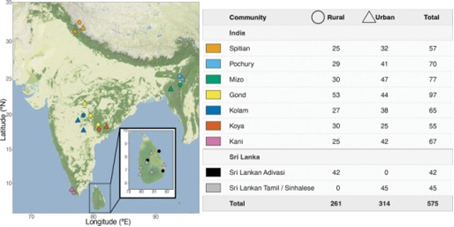
Researchers analysed Gut Microbiome data from 575 healthy adults representing 10 geographically and culturally diverse South Asian communities. Participants included people from the Indian Himalayas, Central India, South India and Northeast India, as well as communities in Sri Lanka. Rural and urban populations were examined within communities, allowing scientists to investigate how lifestyle transitions interact with existing cultural and geographical differences. 1
The research is particularly significant because much of the world’s microbiome research has historically focused on populations in Europe and North America. South Asia, despite its enormous population and exceptional diversity in food, culture, geography and lifestyles, has remained comparatively underrepresented in such research.
Gut Microbiomes Are Shaped by Culture, Diet and Geography
One of the study’s central findings is that South Asian gut microbiomes do not follow one uniform pattern.
Researchers found that geography and community identity explained more variation in gut microbiome composition than urban or rural lifestyle alone. In other words, two communities experiencing similar degrees of urbanization may still show substantially different microbial profiles because their traditional diets, environments and cultural practices differ.
This challenges the idea that urbanization automatically produces the same microbiome changes everywhere.
Instead, the research indicates that urbanization interacts with the biological and cultural characteristics of individual communities. The researchers described these as distinct “microbiome trajectories” shaped by local culture, diet, geography and lifestyle. 2
Why South Asia Is Important for Microbiome Research
South Asia is undergoing rapid urbanization while simultaneously experiencing increasing rates of obesity, type 2 diabetes and other cardiometabolic disorders. These changes have created an urgent need to understand how modern lifestyles influence human biology.
Urbanization can involve major changes in food consumption, physical activity, work patterns, environmental exposures and access to healthcare. Such changes can also affect the microorganisms living in the digestive tract.
The gut microbiome consists of trillions of microorganisms that interact with food, metabolism and the host’s biological systems. Scientists are increasingly investigating associations between microbial communities and conditions involving metabolism and immune function.
However, findings generated predominantly from Western populations cannot automatically be assumed to apply equally to highly diverse South Asian communities.
What Is the SAMBAR Study?
The South Asian MicroBiome ARray, or SAMBAR, was developed to provide a more representative picture of gut microbial diversity across the region.
The international research team included scientists from the Birbal Sahni Institute of Palaeosciences (BSIP), an autonomous institution under India’s Department of Science and Technology, the University of Chicago and collaborating institutions in India, Sri Lanka and the United States. 3
Researchers collected stool samples along with information about participants’ diets, lifestyles and health. The gut microbiome was then characterised using high-throughput sequencing of bacterial 16S rRNA genes, followed by computational and bioinformatic analyses.
The researchers also compared the South Asian data with previously published microbiome datasets from other regions of the world.
South Asian Microbiomes Occupy a Distinct Global Position
When compared with global datasets, the microbiomes of the South Asian communities studied occupied a distinct compositional space.
This does not mean that all South Asians have the same gut microbiome. In fact, the study highlights the opposite: considerable variation exists within South Asia itself.
The important finding is that South Asian populations collectively add microbial diversity that has been missing from many global datasets. This makes the SAMBAR resource potentially valuable for researchers trying to understand how diet, geography and lifestyle interact with human biology.
The researchers argue that future microbiome-based diagnostics and therapies should be informed by population diversity rather than relying predominantly on data from historically well-studied populations. 4
Urbanization Changes the Gut Microbiome, But Not in the Same Way Everywhere
The study found that urbanization was consistently associated with changes in the gut microbiome, but the magnitude and nature of those changes differed between communities.
This is an important distinction. Urbanization is not a single biological exposure. Moving from a rural environment to a city can involve changes in diet, occupation, physical activity, sanitation, food availability, healthcare access and environmental exposures simultaneously.
Those changes may affect different communities in different ways depending on what their traditional lifestyles looked like before urbanization.
The research therefore supports a more nuanced approach to studying the health consequences of modernization.
Gut Microbiome Diversity Declined in Several Urban Groups
Across multiple communities, researchers observed a decrease in microbiome diversity among urban cohorts. They also identified an increase in the abundance of Megamonas in several urban populations.
Megamonas has been associated with fat metabolism and metabolic outcomes, including obesity. The study also identified associations between this microbial signal, increased blood glucose and lower gut microbiome diversity. 5
Importantly, these findings are associations rather than proof that a particular bacterium causes diabetes or obesity. The study provides clues about relationships between lifestyle transition, microbial composition and metabolic health, but further research is needed to establish causal mechanisms.
Diet Leaves a Microbial Signature
The research also demonstrated how strongly food traditions can influence gut bacteria.
For example, Bifidobacterium was associated with wheat and yogurt consumption. In certain communities with long-standing traditions of pastoralism and dairy consumption, Bifidobacterium was abundant in both rural and urban groups. In other populations, it was more abundant among urban participants, where dairy consumption had increased.
These findings illustrate why simply classifying people as “urban” or “rural” can miss important information. The foods people eat within those environments can have a substantial relationship with their microbial communities.
Traditional Fermented Foods May Shape Local Microbial Profiles
One particularly striking example involved the Pochury community in Northeast India.
Researchers found a significantly higher abundance of the genus Bacillus among Pochury participants. The finding was associated with the community’s regular consumption of axone, a fermented soybean condiment traditionally consumed in the region.
The observation demonstrates how culturally specific foods can potentially leave identifiable signatures in the gut microbiome.
It also highlights the importance of documenting traditional food practices before they are lost or substantially altered by dietary transitions associated with urbanization.
Why Traditional Diets Matter in Precision Nutrition
Precision nutrition aims to move beyond the assumption that the same dietary intervention will produce identical effects in everyone.
The SAMBAR findings support the idea that dietary recommendations may eventually need to account for differences in microbiome composition, cultural food patterns and metabolic characteristics.
However, the study does not mean that personalised microbiome-based diets are already ready for routine clinical use. Considerable research remains necessary to determine which microbial patterns are causal, which are simply markers of diet or lifestyle, and whether deliberately changing the microbiome produces meaningful improvements in health outcomes.
Could the Findings Help Explain South Asia’s Metabolic Disease Burden?
South Asia has experienced rapid changes in food systems, urban living and daily activity patterns alongside a growing burden of metabolic disease.
The new findings provide one potential area for deeper investigation. If urbanization-associated lifestyle changes repeatedly correspond with alterations in microbial diversity or specific microbial groups, researchers can begin asking whether those changes are connected to metabolic risk.
But the relationship is complex. Obesity and diabetes are influenced by genetics, diet, physical activity, sleep, socioeconomic conditions, medications, environmental exposures and many other factors.
The gut microbiome should therefore be viewed as one component of a much larger biological system, rather than as a single explanation for rising rates of lifestyle-related disease.
Why Global Microbiome Databases Need More South Asian Data
The study highlights a broader issue in biomedical research: scientific databases can become less representative when particular populations are studied far more extensively than others.
If microbiome-based tests are developed primarily from European or North American populations, their accuracy and relevance for other populations may not always be guaranteed.
South Asia’s diversity makes this particularly important. Dietary practices can vary dramatically between regions and communities, as can altitude, climate, agricultural traditions, fermented foods, animal-product consumption and patterns of urbanization.
A larger and more diverse South Asian microbiome database could help researchers distinguish universal biological patterns from population-specific ones.
From Microbiome Research to Future Healthcare
The researchers hope SAMBAR will serve as a foundation for future studies examining how changing diets, environments and lifestyles affect gut microbes and health across South Asia.
Potential long-term applications include microbiome-based diagnostics, personalised nutrition and precision healthcare. Researchers could eventually investigate whether microbial signatures help identify people at increased risk of particular metabolic conditions or predict responses to dietary or medical interventions.
However, these applications remain an area for continued research. A microbial association identified in a population study does not automatically become a clinical diagnostic tool.
A Community-Engaged Approach to Microbiome Science
An important feature of the project was its engagement with participating communities.
Researchers worked with local authorities and community representatives during recruitment and sampling, and findings were also shared back with participating communities. This approach can help build trust and ensures that communities are not treated simply as sources of biological samples.
Such collaboration is particularly valuable for microbiome research because understanding dietary practices, cultural traditions and local environments requires more than laboratory analysis alone.
What the Study Means for South Asian Health Research
The significance of the research extends beyond identifying which bacteria are more common in particular communities.
It demonstrates that human microbiome research needs to account for cultural and geographical diversity. A population undergoing urbanization does not necessarily follow the same biological trajectory as another population experiencing a similar transition.
For South Asia, that insight could be particularly important as cities expand, food systems change and traditional lifestyles evolve.
Future studies will need to determine which microbiome changes are temporary responses to lifestyle, which persist over generations, and which may contribute to disease risk or resilience.
South Asian Gut Microbiome Study: Key Takeaways
- 575 adults from 10 culturally and geographically diverse South Asian communities were included in the SAMBAR study.
- The communities were located across India and Sri Lanka.
- South Asian gut microbiomes occupied a distinct position compared with global datasets.
- Geography and community identity explained substantial variation in microbiome composition.
- Urbanization was associated with microbiome changes, but those changes differed among communities.
- Several urban groups showed reduced microbiome diversity and increased Megamonas.
- Dietary traditions, including wheat, dairy and fermented soybean consumption, were associated with specific microbial patterns.
- The findings could support future research into personalized nutrition, microbiome diagnostics and precision healthcare.
Bottom Line
The new South Asian gut microbiome research offers a more detailed picture of how modernization interacts with human biology. Rather than producing one universal “urban microbiome,” urbanization appears to set different communities on distinct microbial trajectories shaped by their history, geography, food traditions and lifestyle.
For a region experiencing rapid urbanization alongside rising metabolic disease, building a stronger population-specific microbiome evidence base could prove valuable. The SAMBAR resource represents an important step toward that goal, while also highlighting the need for larger, longitudinal studies that can determine whether microbial changes merely accompany lifestyle transitions or actively influence future disease risk.
The broader message is clear: understanding South Asian health may require studying South Asian biology on its own terms, rather than assuming that findings from other populations apply universally.
For breaking news and live news updates, like us on Facebook or follow us on Twitter and Instagram. Read more on Latest Lifestyle on thefoxdaily.com.






COMMENTS 0