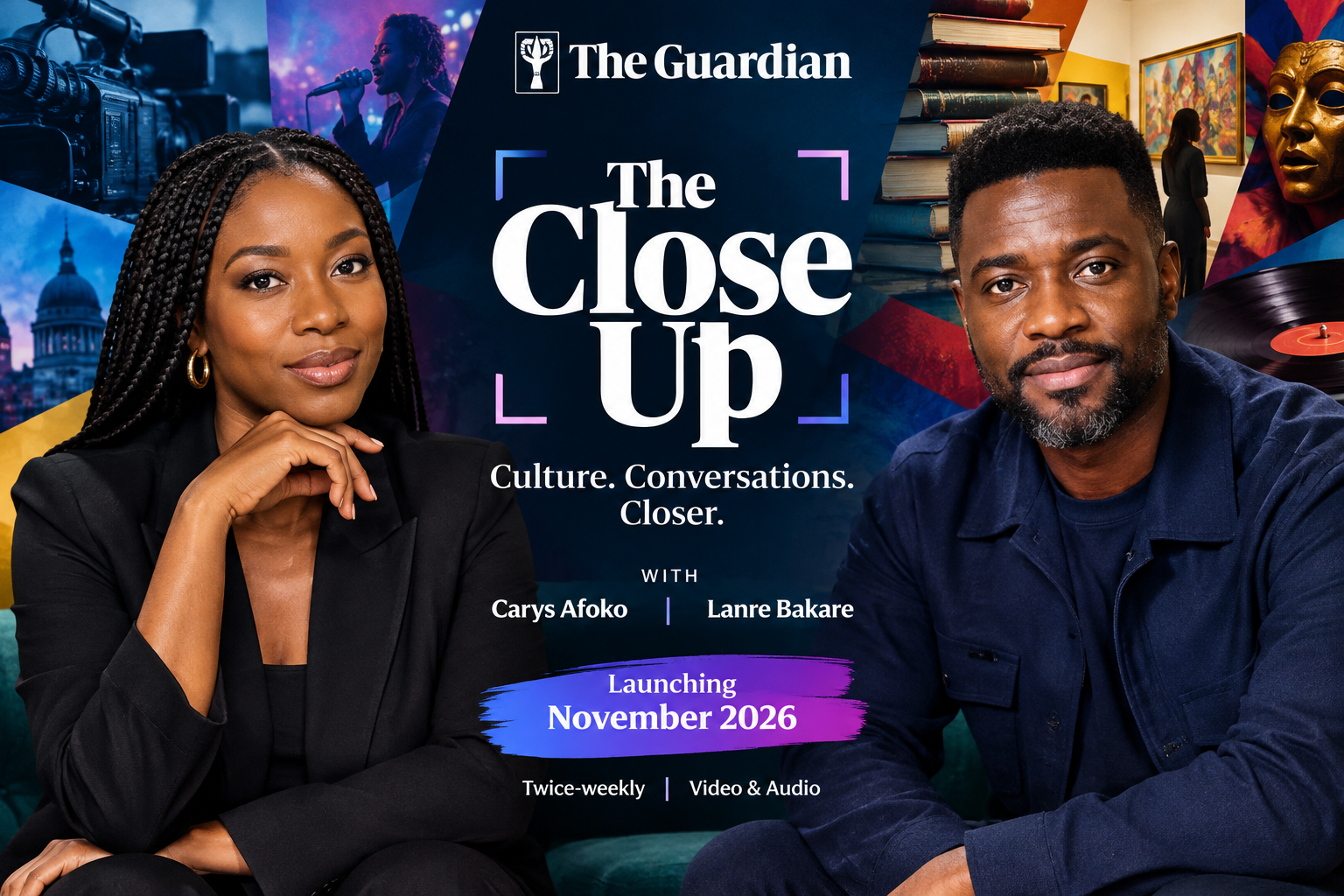
The Guardian is expanding its digital video and audio offerings with The Close Up, a new culture-focused show hosted by journalist Carys Afoko and Guardian senior culture writer Lanre Bakare. Scheduled to launch in November 2026, the series will explore major cultural conversations, from books and film to celebrity controversies, television, art and the entertainment industry’s biggest events.
Announced on Friday, October 16, The Close Up marks the first programme from Guardian Studios, the publication’s new creative hub for video-first, personality-led journalism. The series is designed to bring audiences closer to the cultural stories shaping public conversations through expert analysis, celebrity interviews, behind-the-scenes insights and discussions led by two experienced journalists.
With new episodes planned twice a week across video and audio platforms, the show represents a significant addition to the Guardian’s digital content strategy. It also reflects the growing importance of presenter-led formats that combine journalistic expertise with accessible conversations about entertainment, art and contemporary culture.
What Is The Close Up? Inside the Guardian’s New Culture Show
The Close Up is a new culture programme that aims to examine the stories, personalities and debates influencing the cultural landscape. Rather than focusing exclusively on entertainment news, the show will explore the wider questions behind cultural moments and explain why they matter to audiences.
The programme will cover a broad range of subjects, including major literary awards, reality television, fashion events, film campaigns, comedy and developments in the art world. Its editorial approach will combine current cultural news with deeper discussions about the forces shaping entertainment and creative industries.
Viewers can expect conversations about subjects ranging from the Booker Prize and the Met Gala to the Oscars, sketches from Saturday Night Live and controversies surrounding television personalities or artistic institutions.
The show’s format will also include new releases, prominent cultural stories and segments built around sharing recommendations and discoveries. These elements are intended to make the programme both informative and engaging, offering audiences different ways to explore the week’s cultural developments.
According to the Guardian’s announcement, the series will bring together the hosts’ knowledge of culture with contributions from industry experts and celebrity guests. These conversations will provide opportunities to examine developments from multiple perspectives and offer insight into the creative decisions, personalities and institutions behind major cultural events.
When Will The Close Up Launch?
The Close Up is scheduled to launch in November 2026 as an ongoing series, with new episodes released twice a week. The programme will be available in both video and audio formats, allowing audiences to watch or listen according to their preferences.
The Guardian plans to distribute episodes through its own website and digital platforms, including YouTube and Spotify. This multi-platform strategy will make the programme accessible to audiences who consume journalism through traditional publisher websites as well as video-sharing and audio-streaming services.
The twice-weekly release schedule suggests that the show is intended to remain closely connected to the cultural news cycle. Rather than functioning as an occasional special programme, it will provide recurring opportunities to discuss major developments, respond to new releases and revisit conversations that continue to evolve throughout the week.
The combination of video and audio distribution also gives the Guardian flexibility in how audiences engage with the content. Viewers may prefer the visual elements of interviews and discussions, while listeners can follow the same conversations through an audio format.
The announcement did not specify the exact launch date in November, the duration of individual episodes or the complete publishing schedule. Those details may become available closer to the programme’s debut.
Who Are the Hosts of The Close Up?
The programme will be presented by Carys Afoko and Lanre Bakare, two journalists whose professional experience spans culture, current affairs, broadcasting and commentary.
The pairing is central to the show’s concept. By bringing together different areas of expertise and perspectives, the programme aims to create conversations that are informed without becoming inaccessible to audiences who want to understand cultural developments beyond the headlines.
Carys Afoko: Journalist, Broadcaster and Communications Strategist
Carys Afoko is a journalist, broadcaster and communications strategist who writes regularly for publications including the Guardian, Prospect and Zeteo. She also co-hosts the award-winning current affairs podcast Over The Top Under The Radar.
Her experience across journalism, broadcasting and communications provides a foundation for a format that combines cultural discussion with wider questions about society and public life.
Afoko said culture influences how people understand themselves and the world around them. She described The Close Up as an opportunity to take cultural subjects seriously while maintaining a relaxed and engaging approach to discussion.
“Culture shapes how we understand ourselves and the world around us. The Close Up will take a serious look at culture without taking ourselves too seriously.”
She also expressed enthusiasm about working with Bakare and the Guardian Studios team on the new programme.
Lanre Bakare: Guardian Culture Writer With Extensive Experience
Lanre Bakare is a senior culture writer at the Guardian whose reporting examines the intersection of art, race and culture across different disciplines. His work has covered a range of subjects within the creative industries, making him a natural fit for a programme focused on cultural developments and the debates surrounding them.
Bakare has worked at the Guardian for 15 years, contributing across print, digital journalism and podcasts. His experience gives him a long-standing perspective on how cultural coverage has evolved and how audiences engage with stories about art, entertainment and society.
His debut nonfiction book, We Were There, was published by The Bodley Head in 2025. The book was selected as a book of the year by GQ, Esquire and The Observer. Bakare is currently working on his second book and is part of the judging panel for the Gordon Burn Prize 2027.
Speaking about the new series, Bakare said that the project represents the next step in his work at the Guardian. He also highlighted the opportunity to develop the publication’s culture coverage at a time when audiences are looking for new ways to understand the world.
“The Close Up is the perfect next step in the Guardian’s culture coverage at a time when audiences are looking for new ways to learn about the world.”
Bakare added that he was looking forward to audiences seeing what the team had been developing.
What Topics Will The Close Up Cover?
The Guardian describes The Close Up as a programme built around the biggest cultural questions of the week. Its editorial range is expected to extend across several interconnected areas of entertainment and creative life.
Books and Literary Awards
Literature will be among the subjects explored by the programme, including major awards such as the Booker Prize. Discussions could examine notable books, literary trends, the significance of award nominations and the conversations that develop around authors and publishing.
By looking beyond the announcement of winners or shortlisted titles, a culture show can explore why certain books attract attention and how literary recognition reflects wider debates about storytelling, identity and society.
Film, Hollywood and the Oscars
Film coverage will include the campaigns and conversations surrounding the Oscars. Awards season often involves more than the films themselves, with public relations strategies, performances, industry decisions and changing audience expectations contributing to the wider story.
The Close Up is expected to examine these developments as part of its broader approach to understanding the cultural forces behind major entertainment events.
Reality Television and Popular Entertainment
Reality television is another subject named in the announcement. The genre frequently generates discussions about celebrity, public behaviour, representation and the relationship between entertainment and social media.
By examining reality television alongside other cultural forms, the show can explore how popular entertainment shapes public conversation and why certain programmes or personalities become major talking points.
Fashion, Celebrity and the Met Gala
The Met Gala and the controversies surrounding it will also feature within the programme’s broad editorial scope. Major fashion events combine design, celebrity, image-making and cultural symbolism, often generating debate about artistic choices and public expectations.
Coverage of these events can extend beyond clothing and celebrity appearances to consider the ideas, institutions and social conversations that influence how they are received.
Comedy, Television and Art-World Controversies
The programme will also examine comedy, including sketches from Saturday Night Live, as well as stories from the art world. These subjects provide opportunities to discuss creative experimentation, satire, cultural criticism and disputes over artistic expression.
The inclusion of such varied topics suggests that The Close Up will not be limited to a single entertainment category. Instead, it will move between different cultural disciplines, connecting individual stories with broader questions about the creative industries and contemporary life.
Guardian Studios: A New Direction for Digital Journalism
The Close Up is the first release from Guardian Studios, a creative hub announced earlier in 2026. The initiative is intended to develop video-first, personality-led journalism and present the Guardian’s reporting through new visual formats.
The studio forms part of the Guardian’s multi-year transformation programme, which aims to bring its journalism to audiences in different ways, reach new groups of readers and viewers, and develop on-screen talent.
The launch indicates an emphasis on programmes built around recognisable presenters and recurring editorial formats. Rather than simply adapting written articles for video, personality-led shows can create a distinct identity through conversations, interviews, expert contributions and the relationship between hosts and audiences.
For a publication with an established culture desk, this approach creates opportunities to explore subjects in more depth while offering audiences a different experience from reading a conventional article.
Guardian Studios will be led by the ambition to combine the publication’s established journalistic approach with formats designed for digital distribution. The success of its first programme may help demonstrate how the wider initiative can develop its presence across video and audio platforms.
Why the Guardian Is Investing in Video and Audio Formats
The launch of The Close Up reflects a wider change in how audiences encounter journalism. News and cultural commentary are no longer consumed only through printed publications or website articles. Many people also discover stories through video platforms, podcasts and other digital channels.
Producing content for multiple formats allows publishers to meet audiences where they already spend time. A programme distributed through a publisher’s website, YouTube and Spotify can reach people who might prefer watching a discussion, listening during a commute or exploring a story through a combination of formats.
Video can also provide a more immediate sense of a conversation through facial expressions, reactions and visual references. Audio, meanwhile, allows audiences to follow extended discussions without needing to remain in front of a screen.
For culture journalism, both formats offer particular advantages. Conversations about film, television, fashion, books and art often benefit from interviews, demonstrations, critical exchanges and discussion of the creative choices behind a work.
A recurring show can also give cultural coverage a consistent identity. Regular hosts can build familiarity with audiences over time, while recurring segments and expert guests can help establish an editorial rhythm that viewers and listeners recognise.
However, audience growth and engagement will depend on execution, consistency and the quality of the conversations. A multi-platform launch provides distribution opportunities, but the programme will still need to offer distinctive analysis and a clear reason for audiences to return.
What Guardian Studios Leadership Says About the Show
Leah Green, head of Guardian Studios, described the launch as an opportunity to bring audiences closer to the cultural stories shaping their lives.
She said the programme would combine the Guardian’s emphasis on thoughtful analysis, curiosity and expertise with a hosting partnership built around chemistry and charisma.
“The show will bring audiences closer to the cultural stories shaping our lives, combining the thoughtful analysis, curiosity and expertise they expect from the Guardian.”
Green also expressed enthusiasm about The Close Up becoming the first show released by Guardian Studios. She highlighted the hosts’ on-screen partnership and the programme’s format as central elements of the new initiative.
Her comments underline the importance the studio places on both editorial substance and presentation. The programme is intended to make cultural journalism accessible and engaging without abandoning the expertise and analysis associated with the Guardian’s reporting.
How The Close Up Could Stand Out in Culture Journalism
The cultural media landscape includes reviews, interviews, podcasts, video essays, entertainment news programmes and social media commentary. In such an environment, a new show needs a clear editorial identity to distinguish itself from the large volume of content already available.
The Close Up is positioning itself around the idea that cultural stories deserve both serious analysis and an approachable presentation. Its range of subjects may help it connect developments that are often discussed separately, such as literature, fashion, film, television and contemporary art.
The involvement of experienced journalists could also help the programme move beyond immediate reactions. Cultural events frequently produce fast-moving online debates, but a journalist-led discussion can provide context, explain competing interpretations and examine why a particular story has attracted attention.
The announced inclusion of industry experts and celebrity guests may add further perspectives. Guests can offer professional insight into creative processes, while the hosts can place those contributions within broader cultural conversations.
The show’s twice-weekly schedule could allow it to respond to major developments while maintaining recurring segments and longer-running discussions. Its eventual impact, however, will depend on how effectively it balances timely commentary with deeper reporting and analysis.
About the Guardian
Guardian Media Group publishes the Guardian, theguardian.com and the Guardian app. Founded more than 200 years ago, the Guardian serves audiences through five editions: Australia, Europe, International, UK and US.
The publication is known for investigative journalism, reporting that holds powerful institutions accountable and coverage of stories that may receive limited attention elsewhere. Its ownership structure does not involve a billionaire owner, and the organisation says its independence helps protect its journalism from political and commercial influence.
According to the announcement, millions of people worldwide read or engage with the Guardian’s journalism each day, while more than two million readers across 180 countries have supported its work.
Its digital portfolio includes podcasts, documentaries, a live news app and Feast, its recipe app. The launch of Guardian Studios adds another element to this portfolio, with an emphasis on video-first journalism and programmes built around presenters.
Frequently Asked Questions
What is The Close Up?
The Close Up is a new culture show from Guardian Studios, hosted by Carys Afoko and Guardian senior culture writer Lanre Bakare. It will explore major cultural stories and questions across books, film, television, fashion, comedy and art.
When will The Close Up launch?
The programme is scheduled to launch in November 2026. The Guardian has not specified an exact launch date in its announcement.
How often will new episodes be released?
New episodes are planned twice a week as part of an ongoing series.
Where can audiences watch or listen to The Close Up?
The show will be available in video and audio formats on the Guardian’s website and platforms including YouTube and Spotify.
Who hosts The Close Up?
The programme is hosted by Carys Afoko, a journalist, broadcaster and communications strategist, and Lanre Bakare, a Guardian senior culture writer whose work focuses on art, race and culture.
What is Guardian Studios?
Guardian Studios is the Guardian’s creative hub for video-first, personality-led journalism. It forms part of the publication’s multi-year transformation programme and aims to present its journalism through new visual formats, reach new audiences and develop on-screen talent.
Conclusion
The launch of The Close Up marks a new chapter in the Guardian’s approach to culture journalism and digital storytelling. Hosted by Carys Afoko and Lanre Bakare, the programme will bring together discussions about books, film, fashion, television, comedy and art, with contributions from experts and celebrity guests.
Launching in November 2026, the twice-weekly series will be available in video and audio formats through the Guardian’s website, YouTube and Spotify. As the first programme from Guardian Studios, it will also provide an early look at the publication’s ambitions for personality-led, video-first journalism.
The show’s combination of cultural expertise, topical conversations and multi-platform distribution is designed to offer audiences a new way to engage with the stories shaping contemporary culture. Its launch will be an important first step in the Guardian’s effort to expand its digital formats while continuing to draw on its established journalistic strengths.
For breaking news and live news updates, like us on Facebook or follow us on Twitter and Instagram. Read more on Latest Lifestyle on thefoxdaily.com.

COMMENTS 0