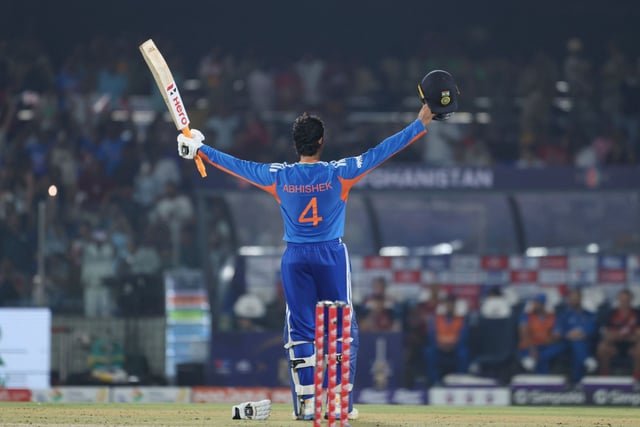
Abhishek Sharma produced one of the most explosive batting performances of his career in the third T20I against Afghanistan, and former India batter Mohammad Kaif believes the young left-hander is a rare talent who needs to be protected and backed.
India completed a 3-0 series sweep with a dominant 127-run victory in the final T20I. The match, however, belonged largely to Abhishek, who transformed the contest with an extraordinary 108 from only 34 deliveries.
The innings included nine fours and 11 sixes, with Abhishek reaching his century from just 30 balls. The performance gave him the fastest T20I hundred by an Indian batter and earned him the Player of the Match award.
Kaif was particularly impressed by the way Abhishek has developed his approach. According to the former India batter, the opener is now showing greater awareness about when to attack rather than simply attempting big shots from the beginning of his innings.
Mohammad Kaif Calls Abhishek Sharma a Rare Talent
Kaif’s praise came after Abhishek’s spectacular performance in the deciding T20I. He pointed out that the batter has worked on his game and is beginning to show more control alongside his natural attacking ability.
The former India batter specifically highlighted a change in Abhishek’s approach compared with some of his earlier performances. Instead of immediately searching for a boundary from the first delivery, Abhishek is increasingly giving himself a few balls to understand the conditions before launching his attack.
That adjustment was evident during his record-breaking innings. Once settled, Abhishek attacked Afghanistan’s bowlers with extraordinary power and maintained an exceptionally high scoring rate throughout his stay at the crease.
Kaif also stressed that a few low scores should not automatically change the perception of a batter’s ability. His argument was that players need backing, particularly when they possess the kind of match-winning ability Abhishek demonstrated in Delhi.
Abhishek Sharma Answers Pressure With a Stunning Century
Abhishek entered the Afghanistan series with pressure surrounding his place and recent form. Before the three-match series, he had gone seven innings without registering a half-century.
His scores across those seven innings were 43, 10, 16, 3, 1, 8 and 2. While the sequence included a 43, he had not converted any of those opportunities into a fifty-plus score.
For an aggressive opening batter competing for a place in India’s limited-overs setup, such a run can create significant scrutiny.
The competition for batting positions is also intense. Kaif mentioned Vaibhav Suryavanshi as another young batter waiting for an opportunity, adding context to the pressure surrounding India’s T20I selection.
Abhishek responded by playing aggressively throughout the Afghanistan series rather than allowing his previous scores to affect his intent.
His Third T20I Innings Was on Another Level
India finished on 221/7 in 20 overs after being asked to build a strong total. Abhishek provided the foundation and then accelerated at an extraordinary rate.
He scored 108 runs from 34 balls, striking nine fours and 11 sixes. His strike rate reached 317.65, illustrating just how quickly he turned his innings into a major scoring burst.
His century came from only 30 deliveries. That made it the fastest T20I century by an Indian batter, according to the supplied report.
Abhishek’s innings was not simply a collection of boundaries. It came after he had faced pressure heading into the series, making the timing of the performance particularly significant for his confidence and standing within the team.
His aggressive approach also gave India the platform to post a total that Afghanistan could not chase.
India Complete a 3-0 Whitewash Against Afghanistan
Afghanistan struggled to respond to India’s imposing total. The visitors were dismissed for 94 in 14.1 overs, giving India a 127-run victory.
The result completed a 3-0 series sweep for the Men in Blue.
India’s commanding win meant Abhishek’s individual performance came within a broader team success. His century established the platform, while India’s bowling attack then restricted Afghanistan to a modest total.
For Abhishek, the final match was also the perfect way to close a series in which he finished as India’s leading run-scorer.
Abhishek Sharma’s Numbers Across the T20I Series
Abhishek finished the three-match series with 229 runs at an average of 76.33. His strike rate was an extraordinary 269.41.
| Statistic | Abhishek Sharma |
|---|---|
| Series runs | 229 |
| Average | 76.33 |
| Strike rate | 269.41 |
| Centuries | 1 |
| Half-centuries | 1 |
| Sixes in series | 22 |
| Series award | Player of the Series |
Those numbers underline the extent of Abhishek’s contribution. He combined a high average with an exceptional scoring rate and finished the series with both a century and a half-century.
His 22 sixes across the three matches were another clear indication of his power-hitting ability.
Abhishek Changed His Approach During the Series
One of the most interesting aspects of Kaif’s assessment was his observation that Abhishek is learning to balance aggression with a small amount of initial patience.
That does not mean Abhishek has abandoned his attacking style. Instead, his approach appears to involve giving himself a few deliveries before taking greater risks.
For a batter whose greatest strength is power hitting, that small adjustment can create additional opportunities. Getting through the initial phase of an innings can allow an aggressive opener to better assess the bowler, pitch and field before launching into high-risk shots.
Kaif’s comments suggest that he sees this development as an important part of Abhishek’s progress.
The third T20I provided a strong example of what can happen when that approach works. Abhishek survived the early phase and then attacked with enough consistency to reach a record-breaking hundred.
22 Sixes Show Abhishek’s Power-Hitting Ability
Abhishek’s six-hitting was one of the defining features of India’s series victory. He struck 22 sixes across the three matches, showing why he has become such an exciting T20 batter.
His ability to clear the boundary regularly can change the momentum of an innings within a few overs. That was particularly clear in the third T20I, when his 11 sixes helped him reach 108 from just 34 balls.
The sixes were not simply useful for the final score. They also forced Afghanistan’s bowlers to respond to a batter capable of generating significant power from the crease.
For India, that type of batting provides a different route to building large T20 totals.
Kaif Says Poor Scores Do Not Make a Batter Bad
Kaif’s comments also focused on the importance of supporting players during periods of poor form.
Abhishek’s seven innings without a fifty had created pressure, especially because India’s T20I batting pool contains several talented options.
However, Kaif argued that a batter’s ability should not be judged solely through a short sequence of low scores. Abhishek’s response against Afghanistan provided a strong example of why form can change quickly in T20 cricket.
A player can struggle for several matches and then produce a match-defining innings. In Abhishek’s case, the turnaround was particularly dramatic because his response was not just a fifty or a century—it was a record-breaking hundred at an extraordinary strike rate.
Competition Adds Context to Abhishek’s Comeback
The pressure on Abhishek was also connected to the depth of India’s batting options.
Kaif specifically referred to Vaibhav Suryavanshi as a player waiting for an opportunity. The presence of emerging batters means established or developing players have limited room for prolonged periods of poor returns.
That competitive environment makes Abhishek’s response against Afghanistan even more notable from a performance perspective.
Instead of allowing recent scores to change his aggressive approach, he produced three strong performances across the series and finished as the leading run-scorer.
His performances therefore provided an immediate answer on the field while also giving India’s team management another strong display of his potential as an attacking opener.
Abhishek Wins Player of the Series
After three matches, Abhishek was named Player of the Series for his contribution with the bat.
His 229 runs at an average of 76.33 made him India’s leading run-scorer, while his strike rate of 269.41 demonstrated the extraordinary speed at which those runs came.
The combination of consistency and explosive scoring was particularly impressive. Abhishek did not rely on one isolated performance to dominate the series statistics; he contributed throughout the three matches and then produced his biggest innings in the finale.
That progression made the third T20I century an appropriate conclusion to his series.
What Abhishek Sharma’s Performance Means for India
India’s T20 setup benefits from having batters capable of changing games quickly at the top of the order. Abhishek’s performances against Afghanistan demonstrated precisely that quality.
His left-handed batting provides another dimension to the opening combination, while his ability to hit sixes at a high frequency allows India to score rapidly during the powerplay and middle overs.
At the same time, the comments from Kaif highlight an important part of Abhishek’s development: learning when to attack rather than simply attacking every delivery.
If that balance continues to develop, it could become an important part of his evolution as an international batter. His Afghanistan series showed the potential of that approach without requiring him to move away from the aggressive style that defines his game.
Abhishek Sharma’s Record-Breaking T20I Hundred
The third T20I century now stands as the headline moment of the series. Abhishek reached three figures from 30 balls, setting a new mark for the fastest T20I hundred by an Indian batter.
He eventually finished with 108 from 34 deliveries, meaning he maintained his extraordinary scoring rate even after reaching the milestone.
The innings included 20 boundary hits in total: nine fours and 11 sixes. Those numbers explain how quickly he accumulated his runs and why Afghanistan struggled to contain India’s opening batter.
His Player of the Match award followed naturally from the scale of his contribution.
Final Verdict
Abhishek Sharma’s Afghanistan series was a major response to the pressure surrounding his recent form. After seven innings without a half-century, the left-hander finished the three-match series with 229 runs, including a century and a half-century.
His 108 from 34 balls in the third T20I was the defining performance. Reaching his hundred from 30 deliveries, hitting 11 sixes and finishing with a strike rate of 317.65, Abhishek helped India secure a 127-run victory and complete a 3-0 series sweep.
Mohammad Kaif’s praise focused not only on the result but also on the batter’s developing approach. The former India player highlighted Abhishek’s ability to give himself a few deliveries before launching his attack and stressed the importance of backing a player despite occasional low scores.
With 22 sixes across the series and the Player of the Series award to his name, Abhishek leaves the Afghanistan series having provided a powerful demonstration of his T20 batting ability and his capacity to respond strongly after a difficult run of scores.
For breaking news and live news updates, like us on Facebook or follow us on Twitter and Instagram. Read more on Latest Cricket on thefoxdaily.com.






COMMENTS 0