Argentina’s thrilling 2-1 comeback victory over England was supposed to be remembered primarily for Lionel Messi’s brilliance, Lautaro Martinez’s late winner, and another remarkable chapter in one of football’s greatest rivalries.
Instead, the celebrations that followed have generated a new talking point that extends far beyond football.
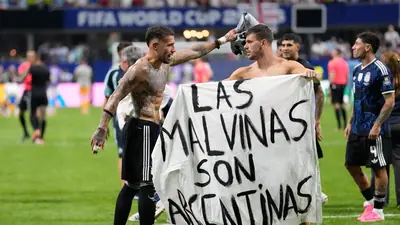
Following the final whistle, Argentine players Giovani Lo Celso and Nicolas Otamendi were photographed displaying a banner reading “Las Malvinas son Argentinas” (“The Malvinas are Argentine”), referencing the disputed Falkland Islands territory. The incident immediately attracted global attention because of the long-standing political sensitivity surrounding the issue.
With Argentina preparing to face Spain in the FIFA World Cup 2026 final, attention has now shifted from the football pitch to a complex debate involving politics, history, international relations, and FIFA’s strict regulations regarding political messaging.
Why the Falklands Banner Has Become a Global Story
Football and politics have often intersected throughout history, but FIFA has consistently attempted to keep political messages away from its tournaments.
The banner displayed by Argentine players touches on one of the most emotionally charged issues in Argentine national identity.
The Falkland Islands, known in Argentina as the Malvinas, have been the subject of a sovereignty dispute between Argentina and the United Kingdom for generations.
Because the issue remains politically sensitive, any public statement made during a major international sporting event inevitably attracts scrutiny.
In this case, the timing amplified the controversy. The message appeared immediately after Argentina defeated England, a country directly connected to the dispute, in a World Cup semi-final watched by millions worldwide.
What Does “Las Malvinas Son Argentinas” Mean?
The phrase translates to “The Malvinas are Argentine.”
In Argentina, the slogan is widely recognized and frequently used to express the country’s claim over the Falkland Islands.
For many Argentines, the issue goes beyond politics and is viewed as part of national history and identity.
The phrase regularly appears in schools, public events, political speeches, and cultural discussions throughout the country.
However, in international settings, especially at sporting competitions governed by strict neutrality rules, the slogan can be interpreted as a political statement.
The Historical Background Behind the Falklands Dispute
Understanding why the banner generated such strong reactions requires examining the historical context.
The Falkland Islands dispute predates modern football by more than a century. Both Argentina and the United Kingdom have maintained competing claims over the territory.
The issue reached its most dramatic point in 1982 when the Falklands War broke out.
| Key Falklands Timeline | Event |
|---|---|
| 1833 | Britain established control over the islands |
| 1960s-1970s | Diplomatic discussions intensified |
| 1982 | Falklands War between Argentina and the United Kingdom |
| 74 Days | Duration of the conflict |
| Post-1982 | Britain retained control of the islands |
| Present Day | Sovereignty dispute remains unresolved |
The conflict resulted in significant casualties and left lasting emotional scars in both countries. Decades later, the issue remains sensitive and occasionally resurfaces in sporting contexts.
Why Argentina vs England Is Different From Other Football Rivalries
Most football rivalries are built purely on sporting competition.
England versus Argentina carries additional historical and political dimensions.
The rivalry has produced some of the most famous moments in World Cup history, including Diego Maradona’s “Hand of God” goal in 1986 and numerous dramatic encounters in subsequent tournaments.
Because of the wider historical backdrop, matches between the two nations often attract attention beyond football itself.
The World Cup 2026 semi-final already carried enormous emotional significance before kickoff. The banner display ensured discussions continued long after the match ended.
Could FIFA Take Disciplinary Action?
The most important question now concerns FIFA’s response.
FIFA generally prohibits political, religious, and ideological messages during official competitions. The organization has repeatedly emphasized its commitment to maintaining neutrality during global tournaments.
If FIFA determines that the banner constituted a political statement, disciplinary proceedings could theoretically follow.
Potential consequences in previous football-related disciplinary cases have included:
- Formal warnings.
- Financial penalties.
- Disciplinary investigations.
- Sanctions against football associations.
- Restrictions regarding future displays.
However, every case is assessed individually, and the context surrounding the display would likely play a significant role in any investigation.
Why the Incident Creates a Challenge for FIFA
The controversy highlights one of FIFA’s most difficult balancing acts.
Football players do not operate in a vacuum. They represent nations, cultures, and identities that often carry historical and political significance.
At the same time, FIFA seeks to prevent major tournaments from becoming platforms for political disputes.
This creates a recurring challenge.
Where exactly should governing bodies draw the line between expressions of national identity and political messaging?
The Argentina banner incident places that question back in the spotlight.
The Timing Makes the Situation More Sensitive
Had the banner appeared during a friendly match or domestic celebration, it might have attracted less international attention.
Instead, it emerged immediately after a World Cup semi-final against England.
The symbolism of the moment amplified its impact.
Millions of viewers watched Argentina eliminate England from the tournament. The subsequent display inevitably connected the football result with a much broader historical issue.
That connection explains why the incident rapidly became one of the most discussed stories of the tournament.
Argentina’s World Cup Journey Continues Amid the Controversy
While the political debate dominates headlines, Argentina still has a World Cup final to prepare for.
The defending champions have once again demonstrated remarkable resilience throughout the tournament.
The semi-final victory highlighted several characteristics that have defined their campaign:
- Strong team unity.
- Mental toughness under pressure.
- Ability to recover from difficult situations.
- Leadership from experienced players.
- Decisive contributions from Lionel Messi.
Those qualities have carried Argentina to another World Cup final and placed them within one victory of successfully defending their title.
How Lionel Messi’s Achievement Risks Being Overshadowed
One unintended consequence of the controversy is that it has diverted attention away from another remarkable Messi performance.
The Argentina captain produced two assists in the closing stages against England, orchestrating one of the tournament’s most dramatic comebacks.
For much of the football world, the semi-final should have been remembered primarily as another example of Messi’s enduring brilliance.
Instead, post-match discussions quickly shifted toward the banner incident and its potential implications.
This demonstrates how off-field controversies can sometimes dominate narratives even after historic sporting achievements.
What Happens Next?
Several developments could follow in the coming days.
FIFA could decide to review the incident and determine whether any regulations were breached.
Argentina’s football authorities could potentially be asked to provide explanations regarding the display.
Alternatively, FIFA may conclude that no further action is necessary.
Until an official decision is made, speculation will continue surrounding the governing body’s next move.
| Possible Outcomes | Likelihood Depends On FIFA Review |
|---|---|
| No Action | If no rule violation is determined |
| Formal Warning | If message is deemed inappropriate but minor |
| Financial Fine | If regulations are considered breached |
| Disciplinary Investigation | If FIFA pursues a deeper review |
A Bigger Question About Modern Football
Beyond disciplinary questions, the incident raises a broader issue facing modern football.
International tournaments are no longer purely sporting events. They are global cultural occasions watched by billions of people.
Players increasingly recognize the visibility these platforms provide.
As a result, football authorities continue facing pressure to define what forms of expression should be permitted and what should remain outside the game.
The Argentina banner controversy is unlikely to be the last example of that challenge.
What It Means for the World Cup Final
From a football perspective, Argentina’s focus must quickly return to the task ahead.
Spain awaits in the World Cup final, presenting a completely different challenge from England.
The Spanish side has impressed throughout the tournament with its possession-based style, tactical discipline, and defensive organization.
Argentina will need complete concentration if it hopes to retain the trophy.
Any prolonged distraction surrounding the banner controversy could become an unwanted complication during preparations.
Conclusion
Argentina’s dramatic semi-final victory over England should have been remembered solely as a football spectacle defined by Lionel Messi’s brilliance and another remarkable comeback.
Instead, the post-match display of a Falklands-related banner has created a significant controversy that now threatens to overshadow one of the tournament’s biggest matches.
The incident highlights the complex relationship between football, national identity, and politics in the modern era. It also places FIFA in a difficult position as the governing body balances its commitment to neutrality with the realities of international competition.
Whether disciplinary action follows remains uncertain. What is certain is that the debate has added another layer of intrigue to Argentina’s World Cup journey.
As the defending champions prepare to face Spain in the final, the football world will be watching not only what happens on the pitch but also how FIFA responds to one of the tournament’s most controversial moments.
For breaking news and live news updates, like us on Facebook or follow us on Twitter and Instagram. Read more on Latest Sports on thefoxdaily.com.






COMMENTS 0