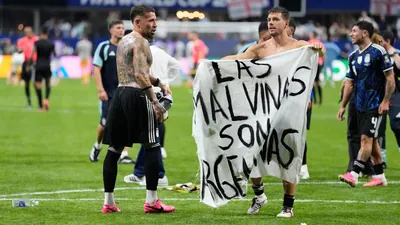
Football and politics have shared a complicated relationship for decades, but few issues carry the emotional, historical, and diplomatic weight of the Falkland Islands dispute between Argentina and the United Kingdom. That reality came sharply into focus following Argentina’s FIFA World Cup 2026 semi-final victory over England, when a post-match celebration quickly evolved into an international controversy.
FIFA has opened an investigation after Argentina players displayed a banner reading “Las Malvinas son Argentinas” (“The Falklands are Argentine”) during celebrations following their victory. What may have been viewed by some supporters as a patriotic gesture has instead triggered scrutiny from football’s governing body, reactions from political leaders, and renewed debate about whether political messages belong on football’s biggest stage.
The incident arrives at a time when FIFA has been working aggressively to keep political disputes away from international tournaments. However, the controversy demonstrates how difficult that objective can be when national identity, historical grievances, and global sporting rivalries intersect in front of billions of viewers.
What Happened After Argentina’s Victory Over England?
The controversy emerged immediately after Argentina secured its place in the FIFA World Cup 2026 final.
During the on-field celebrations, members of the Argentine squad displayed a banner carrying the message “Las Malvinas son Argentinas.” The phrase refers to Argentina’s claim over the Falkland Islands, known in Argentina as the Malvinas Islands.
The timing of the display amplified its significance. The banner appeared following a high-profile World Cup match against England, the country with which Argentina has disputed sovereignty over the islands for generations.
What might have been a routine celebration suddenly became an issue extending far beyond football, drawing attention from governments, diplomats, football authorities, and international media outlets.
Why FIFA Has Opened an Investigation
FIFA’s disciplinary regulations generally prohibit political, ideological, and non-sporting messages during official competitions.
The organization has consistently maintained that football tournaments should remain politically neutral environments, particularly during World Cup events where participating nations often bring complex historical and geopolitical disputes with them.
The investigation will likely focus on several key questions:
- Whether the banner constituted a political statement under FIFA regulations.
- Whether players violated tournament conduct rules.
- Whether the display was pre-planned or spontaneous.
- Whether disciplinary action is warranted.
The outcome could influence how FIFA handles similar incidents in future tournaments and may establish an important precedent for political expressions during international sporting events.
Understanding the Falklands-Malvinas Dispute
To understand why the banner generated such intense reactions, it is important to understand the history behind the dispute.
The Falkland Islands are a British Overseas Territory located in the South Atlantic Ocean. Argentina refers to the territory as the Malvinas Islands and has long maintained that the islands rightfully belong to Argentina.
The disagreement stretches back nearly two centuries and remains one of the most enduring sovereignty disputes in modern international relations.
| Issue | Argentina’s Position | United Kingdom’s Position |
|---|---|---|
| Sovereignty | Claims islands were historically Argentine territory | Claims continuous British sovereignty |
| Name | Malvinas Islands | Falkland Islands |
| Population Rights | Focuses on territorial claim | Emphasizes islanders’ right to self-determination |
| 1982 Conflict | National historical cause | Defense of British territory |
While the dispute is political in nature, it remains deeply emotional in both countries, particularly due to the 1982 Falklands War.
Why the Falklands Issue Remains So Emotional in Argentina
In Argentina, the Malvinas issue extends beyond politics and is often viewed as a matter of national identity.
Generations of Argentinians have grown up learning about the islands as part of the nation’s historical territory. The subject is frequently discussed in schools, politics, and public life.
As a result, references to the Malvinas often generate strong patriotic feelings regardless of political affiliation.
This context helps explain why some Argentine politicians and supporters defended the players’ actions following the semi-final victory.
For many Argentinians, expressions supporting the Malvinas claim are viewed as acts of national pride rather than political activism.
Why Britain Responded So Strongly
The British reaction was equally predictable given the historical sensitivity surrounding the islands.
The United Kingdom maintains that the Falkland Islands are British territory and emphasizes the right of island residents to determine their own political future.
British officials have consistently argued that the wishes of the islanders should remain the primary factor in any discussion regarding sovereignty.
Because the banner appeared after a match between Argentina and England, many observers interpreted it as a symbolic political statement directed at Britain.
That perception contributed significantly to calls for FIFA to investigate the incident.
The Historical Link Between Football and the Falklands Conflict
This is not the first time football and the Falklands dispute have intersected.
Few sporting rivalries carry as much historical baggage as Argentina versus England.
The relationship between the two nations in football became particularly intense following the 1982 war.
The most famous example came during the 1986 FIFA World Cup when Diego Maradona scored the controversial “Hand of God” goal and later produced the “Goal of the Century” in the same match against England.
That game became far more than a football match. For many supporters, it carried emotional significance linked to recent historical events.
Even decades later, matches between Argentina and England often attract attention that extends beyond sport.
FIFA’s Long Battle Against Political Messages
The current controversy highlights a challenge FIFA has faced repeatedly over the years.
Football’s global popularity means players frequently become symbols of national identity, social causes, and political movements.
FIFA has attempted to maintain neutrality by restricting political statements during tournaments.
However, enforcing that principle consistently has proven difficult.
Players, federations, and supporters often argue that certain issues transcend politics and instead represent human rights, historical memory, or national pride.
The result is a constant tension between freedom of expression and FIFA’s desire to keep football focused solely on sport.
What Punishments Could FIFA Consider?
If FIFA determines that disciplinary rules were violated, several outcomes are possible.
- Formal warnings
- Financial penalties
- Disciplinary sanctions against individuals
- Action against the national federation
- No punishment if mitigating circumstances are accepted
Historically, FIFA has often preferred financial penalties in cases involving unauthorized banners or political messages.
However, every disciplinary case is assessed individually, making predictions difficult.
The Bigger Issue: Can Football Ever Truly Be Separate From Politics?
The controversy raises a broader question that extends beyond Argentina, England, or FIFA.
Can global sport realistically remain separate from politics?
Throughout history, major sporting events have reflected international tensions, social movements, and national narratives.
From Olympic boycotts to political protests and diplomatic disputes, sport has frequently served as a platform where larger global issues become visible.
Football may strive for neutrality, but players represent nations, cultures, and histories that cannot simply be left outside the stadium.
The Argentina banner controversy illustrates this reality perfectly.
A celebration lasting only a few moments became global news because it touched on issues far deeper than football itself.
How This Could Impact Argentina Ahead of the World Cup Final
From a sporting perspective, Argentina will want to avoid distractions as it prepares for the World Cup final.
Teams reaching this stage of the tournament typically focus entirely on tactical preparation, fitness management, and mental readiness.
Media attention surrounding disciplinary investigations can create unnecessary noise during a crucial period.
Whether the controversy affects the players psychologically remains uncertain, but coaching staff will likely be eager to keep attention focused on football rather than off-field debates.
The Unique Insight Many Analysts Are Missing
Much of the discussion has focused on whether the banner violated FIFA regulations.
However, a deeper issue is emerging.
The incident demonstrates how modern sporting events have become global communication platforms.
Today, a message displayed for a few seconds inside a stadium can instantly reach hundreds of millions of people worldwide through television broadcasts, social media clips, and digital news coverage.
That reality increases both the influence and responsibility of athletes.
Players are no longer communicating solely with supporters inside the venue. They are communicating with a global audience.
As a result, every gesture carries potential consequences far beyond the field of play.
What Happens Next?
FIFA’s disciplinary process will determine whether any action is taken against the players or the Argentine Football Association.
The investigation will likely examine match reports, video evidence, and relevant tournament regulations before reaching a conclusion.
Meanwhile, political debate surrounding the incident is likely to continue regardless of FIFA’s eventual decision.
The controversy has already reignited international discussion about sovereignty, national identity, and the role of political expression in sport.
Conclusion: A Football Celebration That Became a Global Story
What began as a post-match celebration following Argentina’s victory over England has evolved into one of the most significant off-field controversies of the FIFA World Cup 2026.
At its core, the incident highlights the complex relationship between football, politics, and national identity. FIFA now faces the difficult task of enforcing its regulations while navigating an issue that carries profound historical and emotional significance for multiple nations.
Regardless of the disciplinary outcome, the controversy serves as another reminder that football’s biggest moments often resonate far beyond the sport itself. In the modern era, a banner displayed for a few seconds can reopen decades-old debates, attract worldwide attention, and become part of a much larger global conversation.
For breaking news and live news updates, like us on Facebook or follow us on Twitter and Instagram. Read more on Latest Sports on thefoxdaily.com.






COMMENTS 0