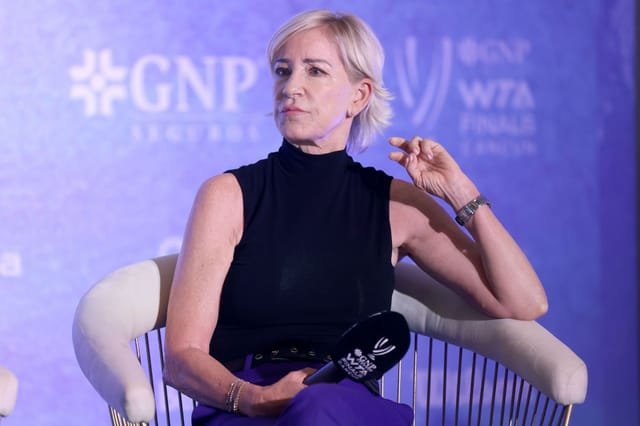
Chris Evert has shown public support for Sophie Cunningham as the Indiana Fever guard continues to face criticism over her position on transgender participation in womenâs sports. Evert’s response was only three words, but the identity of the person delivering that message gave the moment added significance.
The development came after a video showing Cunningham being heavily booed during an Indiana Fever road game against Portland Fire was shared on X on August 21. The footage recalled a late-July contest in which Cunningham came off the bench and scored 13 points as Indiana secured a 112-98 victory.
After seeing the video, Evert responded with the message “You go girl!” The former World No. 1 is one of the most accomplished players in tennis history, having won 18 Grand Slam singles titles during her career.
Evert’s message did not attempt to resolve the wider debate surrounding transgender participation in women’s sports. Instead, it offered encouragement to Cunningham at a moment when the basketball player was facing intense public criticism.
The episode also underlines how discussions about sports eligibility increasingly extend beyond individual competitions. Athletes are now frequently expected to navigate questions involving fairness, inclusion, identity, league policies and freedom of expression at the same time.
Why Chris Evert’s support carries extra weight
Chris Evert is not simply a retired tennis champion commenting on another sport. She is one of the most influential figures in the history of women’s tennis, with a career that helped define professional women’s sport during the 1970s and 1980s.
That background gives her comments additional relevance whenever the conversation turns toward competitive opportunities in women’s athletics.
Evert’s response to the Cunningham video was also notable because of its simplicity. Rather than publishing a long statement, she directly encouraged the Fever player. The short response quickly became part of the broader online conversation surrounding Cunningham.
Social media has changed how sports controversies develop. In the past, an athlete’s comments might have remained primarily within newspapers or television coverage. Today, a single post can be shared thousands of times and attract responses from athletes across completely different sports.
Cunningham’s situation illustrates that shift particularly well. A WNBA player’s position on a sensitive policy question has now drawn visible reactions from major figures in tennis, demonstrating how interconnected modern sports conversations have become.
Sophie Cunningham’s position has triggered a wider debate
Cunningham has faced criticism after publicly expressing her view that transgender women should not compete in women’s sports. Critics have characterized her position as transphobic, while supporters argue that discussions about eligibility should focus on competitive fairness.
The disagreement is part of a much larger international debate. Sports organizations have spent years considering how eligibility policies should address transgender participation while balancing competitive considerations and inclusion.
Different sports have also approached the issue in different ways. Athletic performance can depend heavily on factors such as strength, endurance, speed, body composition and technical skill, meaning policies created for one sport do not automatically translate perfectly to another.
That is one reason the issue remains difficult for governing bodies. A policy designed around one competitive environment may produce very different practical consequences in another.
The Cunningham controversy has therefore become bigger than a disagreement between one athlete and her critics. It reflects a continuing challenge for sports administrators: creating rules that athletes and governing bodies consider clear, fair and workable.
The importance of separating disagreement from harassment
One of the most important aspects of the Cunningham episode is the reaction she has received from sections of the public.
Athletes are entitled to face disagreement over public statements, particularly when those statements concern controversial issues. However, disagreement and personal harassment are not the same thing.
The video that prompted Evert’s message showed Cunningham being booed during a game. Booing is a familiar part of professional sports culture, but online conversations can become considerably more personal once criticism moves away from the playing field.
The distinction matters because athletes increasingly have to manage public scrutiny while simultaneously performing under competitive pressure.
For Cunningham, the challenge is particularly visible. She is expected to contribute on the court, represent her team professionally and respond to a highly sensitive public issue that extends far beyond basketball.
Martina Navratilova has also defended Cunningham
Evert is not the only major tennis figure to support Cunningham. Martina Navratilova, Evert’s former rival and later close friend, has also publicly defended the Fever guard.
The relationship between Evert and Navratilova adds an interesting historical dimension to the story. During their playing careers, the two were among the biggest rivals in women’s tennis. Their matches became defining moments in the sport, but their relationship eventually developed into a close friendship.
Navratilova has been particularly vocal when Cunningham has been subjected to personal attacks.
Earlier in August, Navratilova responded to an image of a man holding a sign targeting Cunningham with the phrase “biological loser.” Rather than focusing on Cunningham’s sporting position, Navratilova criticized the person carrying the sign.
“The only loser here is the guy holding the sign”
Her response illustrates an important difference between debating an athlete’s position and attacking the athlete personally.
It also demonstrates why Cunningham has attracted support from some established sports figures even though her views remain highly controversial.
Evert and Navratilova bring decades of women’s sports experience
The involvement of Evert and Navratilova is particularly noteworthy because both built their reputations in an era when women’s professional tennis was fighting for greater recognition, opportunities and competitive legitimacy.
Their careers are therefore closely connected with the history of women’s sport itself.
That does not automatically settle the modern debate over transgender participation. However, their involvement shows how questions about the future of women’s sports can resonate with athletes whose careers helped shape the professional landscape in the first place.
Why the debate is bigger than Sophie Cunningham
The most important takeaway from the controversy is that Cunningham has become one individual figure within a much larger discussion.
The debate involves several competing considerations. Supporters of restrictions on transgender participation generally emphasize competitive fairness and the protection of women’s categories. Advocates for inclusion emphasize equal opportunity and the importance of allowing transgender athletes to participate in organized sport.
Sports governing bodies are ultimately responsible for establishing eligibility rules. Those rules can differ between leagues, sports and governing organizations, which makes broad claims about all women’s sports difficult to apply universally.
This is where the discussion needs more nuance. Basketball, tennis, swimming, athletics and contact sports have different competitive demands. A policy question that appears straightforward in one discipline may become considerably more complicated in another.
Comparison: Social-media debate versus sporting policy
| Issue | Social-media discussion | Sports-policy approach |
|---|---|---|
| Primary focus | Individual opinions and reactions | Eligibility and competition rules |
| Decision-making | Public debate | Leagues and governing bodies |
| Speed of discussion | Immediate | Usually slower and evidence-based |
| Scope | Often broad and emotional | Usually sport-specific |
| Impact on athletes | Public pressure and criticism | Direct effect on participation |
The comparison explains why social-media arguments rarely provide a complete answer to complicated eligibility questions. Online discussions can highlight genuine concerns, but formal sporting policies require definitions, evidence, enforcement mechanisms and consistent application.
What could happen next for Sophie Cunningham?
The immediate attention surrounding Cunningham is unlikely to disappear simply because Evert offered encouragement. Her position has already become part of her public identity, meaning future comments or incidents could generate renewed discussion.
At the same time, the focus could eventually return to what happens on the basketball court. Professional athletes are ultimately judged by their performances, and Cunningham’s contribution in the Fever’s 112-98 victory showed how quickly sporting achievements can become part of the same conversation.
The bigger question is whether the controversy changes Cunningham’s relationship with fans or teammates. That will depend on how the discussion develops and whether future disagreements remain focused on sporting policy rather than personal attacks.
The wider future of transgender participation in sports
The transgender sports debate is likely to remain an important issue for international sporting organizations. As more leagues and governing bodies review their policies, athletes and fans will continue to encounter different eligibility standards across different competitions.
The most sustainable approach will likely require clarity. Athletes need to understand the rules before competing, governing bodies need policies that can be consistently applied, and fans need to recognize that individual athletes do not create league eligibility rules on their own.
That is particularly relevant in Cunningham’s case. Her public position may influence the conversation, but the final rules governing professional competitions remain the responsibility of the relevant sporting authorities.
Chris Evert’s message adds another chapter to the controversy
Chris Evert’s three-word message may have been simple, but its impact comes from the context surrounding it. Cunningham is at the center of a highly divisive debate, while Evert is one of the most recognizable champions in women’s tennis history.
Martina Navratilova’s previous defense of Cunningham has made the involvement of the two tennis legends even more notable. Their support does not end the disagreement, nor does it provide a universal answer to questions about transgender participation.
What it does demonstrate is how deeply the issue has entered mainstream sports culture.
Conclusion
Chris Evert’s support for Sophie Cunningham has added a high-profile tennis voice to an already contentious WNBA controversy. Evert’s “You go girl!” message came after Cunningham was shown receiving heavy boos during a game, while Martina Navratilova has separately defended the basketball player against personal attacks.
The larger story extends beyond one athlete or one social-media exchange. The debate over transgender participation in women’s sports involves competitive fairness, inclusion, athlete expression, league policies and the responsibilities of sports organizations.
Cunningham’s comments will likely continue to attract strong reactions, but the long-term direction of the issue will ultimately depend less on social-media exchanges and more on how individual sports establish and enforce their eligibility policies.
For now, Evert’s message has made one thing clear: the Cunningham controversy has reached well beyond the WNBA, drawing attention from some of the most recognizable figures in women’s sporting history.
For breaking news and live news updates, like us on Facebook or follow us on Twitter and Instagram. Read more on Latest Sports on thefoxdaily.com.






COMMENTS 0