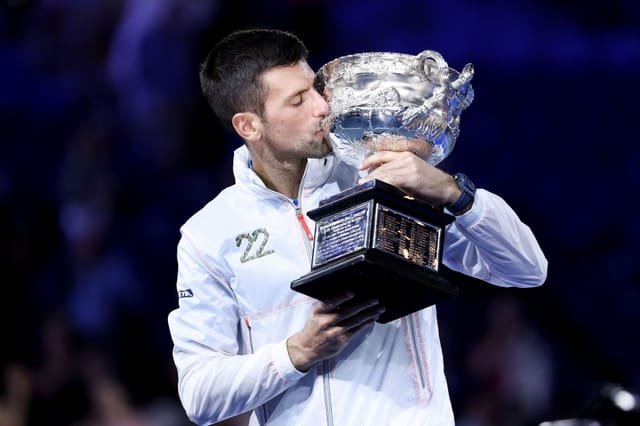
Novak Djokovic Australian Open statue discussions have gained fresh momentum after Tennis legend Chris Evert publicly backed the idea of honoring the Serbian great with a statue at Melbourne Park. Evert’s response came as debate intensified among tennis fans over whether Djokovic’s unprecedented success at the Australian Open has reached the level deserving of a permanent monument.
The conversation emerged on social media after a tennis fan page posted an AI-generated image imagining a Djokovic statue alongside a question asking whether the 24-time Grand Slam champion deserved such an honor. Evert, an 18-time Grand Slam singles champion and former World No. 1, responded simply: “Yes.”
Although the response was only one word, its significance is difficult to ignore. Evert is one of the most accomplished players in tennis history, and her opinion carries particular weight when discussing the legacy of an athlete whose career has reshaped the sport’s record books.
Djokovic’s connection with Melbourne is unlike that of almost any other active player. He has won the Australian Open 10 times, more than any other man in tournament history, and captured his first Grand Slam title at the venue in 2008. His Melbourne record has also been defined by longevity, historic rivalries and performances that have become part of Australian Open folklore.
Why Novak Djokovic’s Australian Open Legacy Is Different
The strongest argument for a statue begins with one simple fact: Djokovic has dominated the Australian Open for more than a decade and a half.
His 10 Melbourne titles came in 2008, 2011, 2012, 2013, 2015, 2016, 2019, 2020, 2021 and 2023. That collection of championships is not merely an impressive statistic. It represents sustained excellence across different generations of opponents, playing conditions and stages of Djokovic’s career.
Winning one Grand Slam repeatedly is difficult. Maintaining that level of dominance while the sport changes around you is something else entirely.
Djokovic’s first Australian Open triumph arrived when he was still establishing himself among the world’s best players. His later victories came when he had already become a global superstar and was competing against generations of players who had grown up watching him.
That longevity is one reason the statue argument has continued to attract attention.
Djokovic’s Australian Open Timeline Shows the Scale of His Achievement
| Year | Australian Open result | Why it mattered |
|---|---|---|
| 2008 | Champion | Djokovic won his first Grand Slam singles title in Melbourne. |
| 2011 | Champion | Returned to the top of the Australian Open after a three-year gap. |
| 2012 | Champion | Defeated Rafael Nadal in a historic five-set final. |
| 2013 | Champion | Successfully defended his Melbourne crown. |
| 2015 | Champion | Added another title during the peak of his rivalry with Andy Murray. |
| 2016 | Champion | Won his sixth Australian Open title. |
| 2019 | Champion | Returned to the top after a difficult period earlier in his career. |
| 2020 | Champion | Claimed another Melbourne crown just before the global pandemic transformed sport. |
| 2021 | Champion | Won a third consecutive Australian Open title. |
| 2023 | Champion | Returned to the summit and secured his 10th Australian Open title. |
The 2012 Final May Be the Best Argument for a Statue
If Djokovic’s 10 championships provide the statistical case, the 2012 Australian Open final provides the emotional one.
Djokovic faced Rafael Nadal in a final that lasted five hours and 53 minutes. The Serbian eventually prevailed 5-7, 6-4, 6-2, 6-7(5), 7-5 in one of the most physically demanding matches ever played at a Grand Slam.
The significance of that match extends beyond its duration.
Djokovic and Nadal were already developing one of the defining rivalries in tennis history, and the Melbourne final captured nearly everything that made their contests so compelling: physical endurance, tactical adjustments, defensive brilliance and extraordinary resilience.
For Australian Open history, the match is almost impossible to separate from Djokovic’s identity at the tournament.
A statue would therefore not simply represent a player holding a trophy. It could symbolize an entire era of Australian Open tennis.
Chris Evert’s Support Adds Weight to the Debate
Evert’s endorsement is noteworthy because she understands exactly what it means for a player to build a lasting Grand Slam legacy.
The American won 18 major singles titles and spent years competing at the highest level of women’s tennis. Her own career is deeply connected to the history of Grand Slam competition, making her assessment of Djokovic’s achievements particularly meaningful.
Her response also highlights an important distinction in the statue debate: recognition does not necessarily have to wait until a player’s career is officially over.
Djokovic is still competing at 39. That makes any permanent tribute more complicated because his career record could continue to evolve.
However, his Australian Open legacy is already established. Even if he never wins another match in Melbourne, his 10 titles will remain a defining part of the tournament’s history.
Djokovic’s 2026 Australian Open Run Complicated the Story
The most recent Australian Open added another fascinating chapter to Djokovic’s relationship with Melbourne.
After semifinal appearances in 2024 and 2025, Djokovic returned in 2026 with another opportunity to challenge for the title. He defeated two-time defending champion Jannik Sinner in a dramatic five-set semifinal, showing that even at 38 he could still defeat one of the leading players of the next generation on one of tennis’s biggest stages.
That victory placed Djokovic in the final against Carlos Alcaraz.
Djokovic won the opening set by playing aggressively, but the physical demands of the semifinal appeared to become increasingly difficult to overcome. Alcaraz used his variety, movement and shot-making to turn the match around and eventually won in four sets.
The result denied Djokovic an 11th Australian Open championship while giving Alcaraz his first title in Melbourne and completing his career Grand Slam.
His Emotional Comments Made the 2026 Final More Significant
What happened after the final may ultimately become one of the most memorable parts of Djokovic’s Australian Open story.
While speaking to the crowd, Djokovic acknowledged the uncertainty surrounding his future and suggested that he could potentially have played his last Australian Open.
That statement does not confirm retirement. Djokovic has repeatedly demonstrated that predictions about the final stage of his career are difficult to make.
But it did underline the reality that his Melbourne career is moving toward its final chapter.
That makes the statue discussion more timely. The question is no longer only about what Djokovic might achieve in Australia. It is increasingly about how the tournament will eventually commemorate what he has already accomplished.
Does a Statue Have to Mean Djokovic Is Retired?
This is perhaps the most important question missing from much of the social-media debate.
A statue is normally associated with a completed legacy. Athletes are often honored after retirement because their careers can be evaluated with historical distance.
Djokovic’s case is different.
His Australian Open record has already reached a level that cannot be erased by what happens next. His 10 championships remain 10 championships, regardless of whether he eventually adds an 11th.
That creates a reasonable argument for beginning the conversation now while recognizing that an official tribute could be considered later.
In other words, debating a statue does not have to mean declaring Djokovic’s career finished.
How Djokovic Compares With Other Australian Open Greats
Djokovic’s case becomes even stronger when his Melbourne record is viewed specifically through the lens of tournament dominance.
Many legendary players have enjoyed remarkable Australian Open careers, but Djokovic has combined title volume with longevity in a way that is extremely difficult to match.
His 10 championships place him at the top of the men’s singles title list at the event. More importantly, his victories have been spread across multiple stages of his career rather than concentrated into one short period.
That distinction separates a great tournament record from a historically dominant one.
His Legacy Extends Beyond the Number of Trophies
Another reason the statue debate has staying power is that Djokovic’s Australian Open legacy is about more than titles.
Melbourne became one of the most important stages in his development from Grand Slam champion to one of the greatest players in tennis history.
The tournament witnessed his first major triumph, multiple victories over his greatest rivals and several comebacks that defined different phases of his career.
It also became a venue where Djokovic repeatedly demonstrated his ability to handle pressure. The expectations surrounding him increased with every title, yet he continued returning to Melbourne as one of the players everyone else had to defeat.
That psychological element is difficult to quantify, but it is central to understanding his legacy.
His 2026 Cincinnati Defeat Shows Why the Endgame Is Uncertain
Djokovic’s most recent competitive appearance before the US Open came at the 2026 Cincinnati Open, where he suffered a surprising second-round defeat to Argentina’s Thiago Agustin Tirante.
Physical difficulties related to heat and humidity were part of the circumstances surrounding the loss.
The defeat also illustrates why predicting Djokovic’s remaining career is so difficult. A player capable of reaching a Grand Slam final earlier in the year can still encounter unexpected physical challenges at another tournament.
At 39, managing the demands of a full tennis season becomes increasingly important. Djokovic’s future at the Australian Open may therefore depend as much on scheduling, physical preparation and recovery as it does on his motivation.
What a Djokovic Statue Could Represent
- Historic dominance: His 10 Australian Open men’s singles titles are the clearest statistical argument.
- Longevity: His Melbourne success spans different eras of men’s tennis.
- Rivalries: His matches against Nadal and other great players helped define the tournament’s modern history.
- Global influence: Djokovic became one of the central figures of modern tennis while repeatedly succeeding in Melbourne.
- First Grand Slam breakthrough: The Australian Open was the tournament where he began his 24-major journey.
The Strongest Argument Against It
There is still a legitimate counterargument.
Djokovic is an active player, and his career is not officially complete. He could potentially return to Melbourne and add another title, which would change the exact way his legacy is remembered.
There is also a broader question about how Melbourne Park should decide which players deserve permanent physical recognition. If statues become too common, their symbolic value could decline.
That means the decision should be based on more than popularity. It should reflect historical significance, contribution to the tournament and an achievement that stands apart from ordinary greatness.
Prediction: The Statue Debate Is Unlikely to Disappear
Even if Melbourne Park does not immediately announce plans for a statue, the discussion is unlikely to disappear.
Djokovic’s career is already approaching its final stage, and every Australian Open appearance now carries additional historical significance. If he returns to Melbourne in the future, the question will become even more interesting: is he chasing an 11th title, or is he completing the final pages of one of the tournament’s greatest careers?
If he ultimately retires without another Australian Open championship, the case for a permanent tribute will arguably become easier to evaluate because his Melbourne record will be complete.
Conclusion: Has Djokovic Earned a Statue in Melbourne?
Chris Evert’s answer was simple: yes.
The reasoning behind that answer is considerably more complicated, but Djokovic’s Australian Open résumé makes the argument difficult to dismiss.
He has won 10 Australian Open titles, captured his first Grand Slam in Melbourne, produced one of the tournament’s most famous finals against Rafael Nadal and remained a central figure at the event across multiple generations of tennis.
The 2026 final against Carlos Alcaraz may have marked the beginning of a different phase of his Melbourne story, particularly after Djokovic openly acknowledged the possibility that his Australian Open career could be nearing its conclusion.
Whether Melbourne Park eventually chooses to honor him with a statue is ultimately an institutional decision. But the debate itself reflects the scale of Djokovic’s achievement.
For most players, one Australian Open title can define a career. For Djokovic, Melbourne became a stage on which he repeatedly demonstrated greatness for nearly two decades.
That is why the statue conversation is not simply about celebrating a famous athlete. It is about deciding how a tournament should preserve the memory of one of the most dominant champions it has ever produced.
For breaking news and live news updates, like us on Facebook or follow us on Twitter and Instagram. Read more on Latest Sports on thefoxdaily.com.






COMMENTS 0