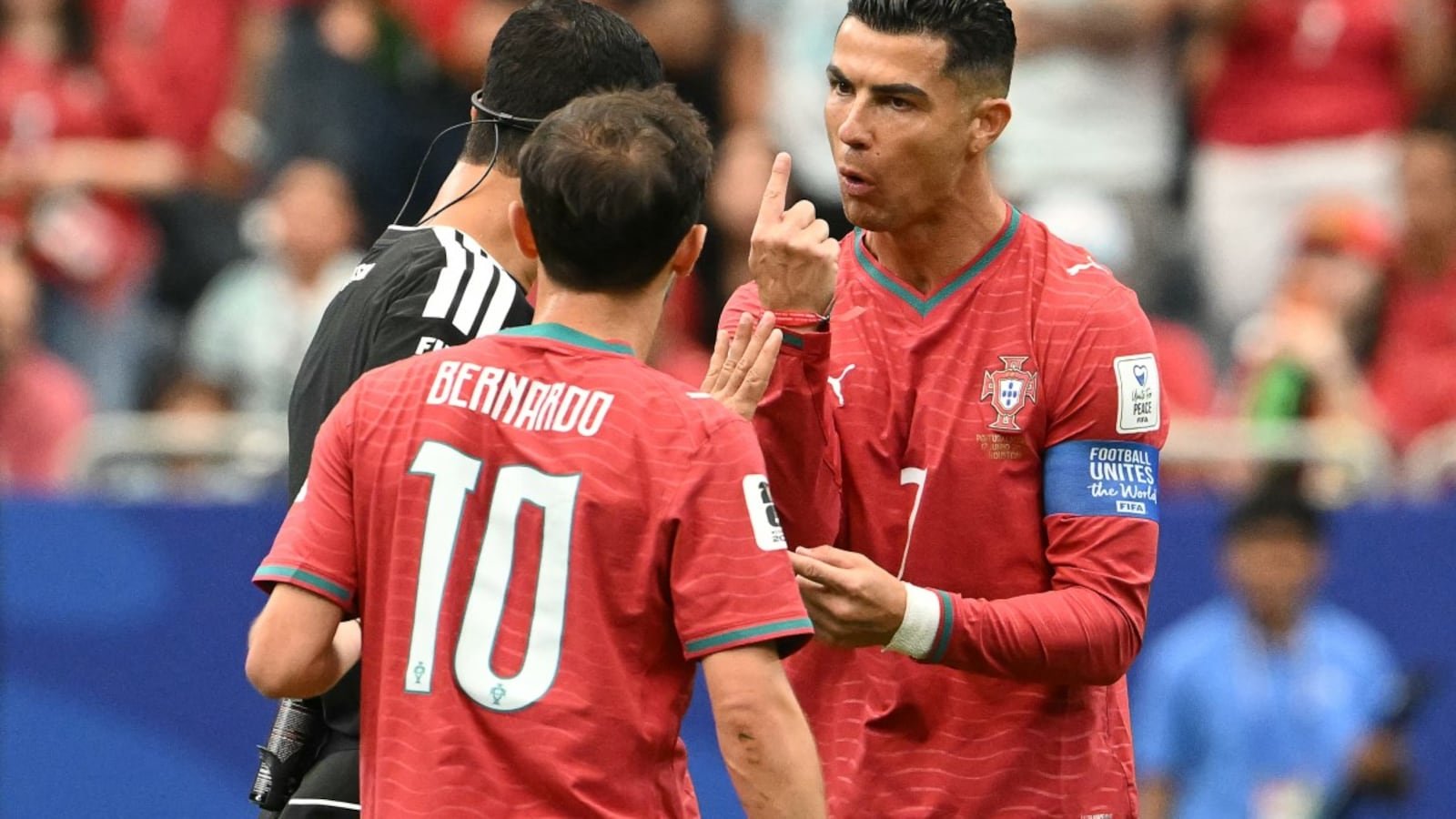
For more than two decades, Cristiano Ronaldo built a reputation that forced opponents to change their game plans before kickoff. His pace, movement, aerial dominance, and relentless goalscoring instincts made him one of football’s most feared players.
But following Portugal’s disappointing 1-1 draw against DR Congo at the 2026 FIFA World Cup, one opponent offered a brutally honest assessment that underlined a difficult truth about elite sport: even the greatest players are eventually challenged by time.
DR Congo midfielder Ngal’ayel Mukau did not hold back when discussing Portugal’s captain after the match.
“We know that Ronaldo isn’t the same as before. So we know that he runs less, less efforts. It was up to our defence to stop him, and they did a great job.”
The statement quickly became one of the most talked-about reactions from the opening round of World Cup fixtures because it reflected what millions watching around the world had already noticed.
Ronaldo’s aura remains intact, but his game has changed dramatically.
A Historic Night Overshadowed by an Underwhelming Performance
The match against DR Congo was significant even before kickoff.
At 41 years old, Ronaldo joined Lionel Messi as the only men’s players to appear in six FIFA World Cups, extending a career that has consistently defied conventional expectations about longevity.
However, history offered little protection from criticism after the final whistle.
Portugal entered the game as heavy favourites but failed to justify that status. Despite dominating possession, Roberto Martinez’s side struggled to create clear-cut opportunities and were held to a surprising draw.
Ronaldo’s individual numbers highlighted his limited influence.
| Cristiano Ronaldo vs DR Congo | Statistic |
|---|---|
| Minutes Played | 90 |
| Goals | 0 |
| Assists | 0 |
| Touches | 25 |
| Shots on Target | 0 |
| World Cup Appearances | 6 |
He missed two promising opportunities in the second half and struggled to impose himself against a disciplined DR Congo defence.
For a player who built his legacy on delivering in decisive moments, it was a difficult evening.
How Ronaldo’s Role Has Changed Over the Years
The version of Ronaldo that terrified defenders during his early years at Manchester United and Real Madrid was a completely different player.
He regularly attacked defenders one-on-one, made explosive runs from wide areas, and contributed heavily during transitional phases.
Today, his game revolves around efficiency inside the penalty area.
As his physical profile has evolved, Ronaldo has transformed into a traditional central striker who relies more heavily on service from teammates.
That evolution is natural. Few players maintain elite athleticism into their forties.
The challenge for Portugal is ensuring their tactical structure reflects that reality.
Against DR Congo, Ronaldo rarely dropped deep to participate in build-up play, leaving him isolated when Portugal struggled to progress the ball into dangerous areas.
Portugal’s Bigger Problem Extends Beyond Ronaldo
While Ronaldo’s performance attracted the headlines, Portugal’s issues ran deeper than one player.
Despite boasting one of the most technically gifted midfields in the tournament, Portugal lacked creativity and urgency in the final third.
Bruno Fernandes, Bernardo Silva, and Vitinha controlled possession but failed to consistently break through DR Congo’s compact defensive shape.
The numbers tell an uncomfortable story.
Portugal attempted just seven shots compared to DR Congo’s eight despite completing significantly more passes.
Joao Neves gave Portugal an early lead, but their attacking threat faded as the game progressed.
Too often, possession became predictable rather than purposeful.
Portugal appeared more focused on finding Ronaldo than exploiting the spaces available elsewhere on the pitch.
Why Mukau’s Comments Matter
Opposing players rarely speak so openly about legendary figures, which is why Mukau’s assessment resonated.
His comments revealed that teams no longer fear Ronaldo in the same way they once did.
Instead of adjusting defensive structures to contain his movement, opponents now view his reduced mobility as a potential advantage.
That shift in perception is significant.
Elite athletes often maintain their technical ability longer than their physical attributes, but international football leaves little room for compromise.
Every weakness is analysed, targeted, and exploited.
DR Congo’s game plan reflected that understanding.
They remained compact, denied service into dangerous areas, and trusted their defenders to handle Ronaldo without requiring extra cover.
The strategy worked perfectly.
Roberto Martinez Faces a Difficult Decision
After the match, Portugal coach Roberto Martinez defended his decision to keep Ronaldo on the pitch.
“It makes no sense to take off the greatest goalscorer in the history of football in a match where we need goals.”
The logic is understandable.
Few coaches would willingly remove one of football’s most prolific finishers during a tight game.
However, tournament football often demands difficult choices.
Former Portugal manager Fernando Santos made headlines during the 2022 World Cup when he left Ronaldo on the bench for crucial matches.
Four years later, similar questions are emerging once again.
Would Portugal benefit more from introducing Ronaldo against tired defenders in the final 30 minutes rather than starting him?
Using him as an impact substitute could maximise his goalscoring instincts while allowing Portugal’s midfield greater tactical flexibility.
Ronaldo’s Response Shows His Mindset Remains Unchanged
Although he declined to speak with reporters after the match, Ronaldo addressed supporters on social media.
“It wasn’t the start we wanted, but this is far from over. Head up and focus on the next game.”
That message reflects the mentality that has defined his career.
Ronaldo has repeatedly overcome setbacks and criticism through determination and self-belief.
Whether he can do so again at this stage of his career remains one of the most compelling storylines of the tournament.
Conclusion
Ngal’ayel Mukau’s comments may sound harsh, but they capture an uncomfortable reality facing Portugal at the 2026 FIFA World Cup.
Cristiano Ronaldo is no longer the unstoppable force he once was.
His experience, leadership, and finishing ability remain valuable assets, but Portugal can no longer rely solely on his reputation to win matches.
The challenge for Roberto Martinez is finding the right balance between respecting a legendary career and making decisions that maximise the team’s chances of success.
Because at the World Cup, history creates headlines—but performances decide tournaments.
For breaking news and live news updates, like us on Facebook or follow us on Twitter and Instagram. Read more on Latest Sports on thefoxdaily.com.






COMMENTS 0