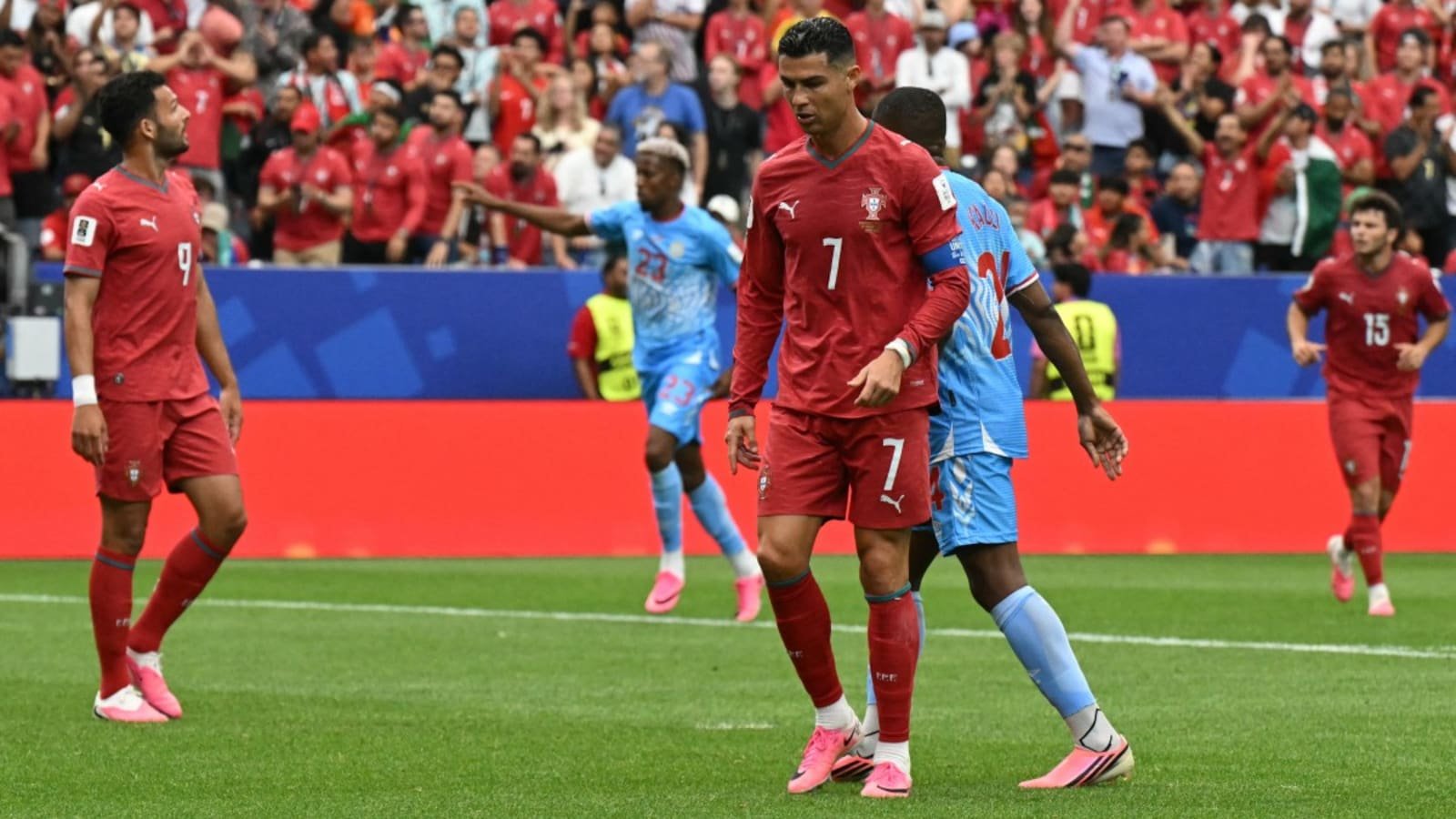
For nearly two decades, Cristiano Ronaldo built his reputation on delivering in football’s biggest moments. Whether it was the UEFA Champions League, European Championships, or FIFA World Cups, the Portuguese icon consistently found ways to influence matches through goals, leadership, and sheer determination.
However, Portugal’s opening match at the 2026 FIFA World Cup offered a stark reminder that even the greatest careers eventually encounter difficult realities.
Ronaldo, making a record-extending sixth World Cup appearance, struggled to impose himself during Portugal’s disappointing 1-1 draw against DR Congo. The 41-year-old finished the match with just 25 touches, three shots, no efforts on target, and won only one duel throughout the contest.
More significantly, it was the second-fewest touches Ronaldo has recorded in a World Cup match that he started, highlighting how effectively DR Congo neutralised one of football’s most prolific goalscorers.
Portugal Started Strongly but Failed to Capitalise
Portugal looked set for a comfortable evening when Joao Neves opened the scoring in the sixth minute.
Pedro Neto delivered an inviting cross into the penalty area, and the young midfielder powered a precise header into the far corner to give Roberto Martinez’s side an early advantage.
With Bruno Fernandes, Bernardo Silva, Vitinha, and Joao Neves controlling possession, Portugal appeared ready to dominate proceedings.
Instead, their intensity gradually faded.
Despite completing significantly more passes than their opponents, Portugal struggled to turn possession into clear-cut opportunities. The ball moved comfortably through midfield, but the final pass was often missing.
DR Congo, meanwhile, remained disciplined defensively and looked increasingly dangerous on the counterattack.
Their persistence paid off in first-half stoppage time when Arthur Masuaku delivered a dangerous cross that Yoane Wissa converted with a well-timed header.
The equaliser shifted momentum and exposed Portugal’s inability to respond effectively under pressure.
| Match Statistics | Portugal | DR Congo |
|---|---|---|
| Goals | 1 | 1 |
| Total Shots | 7 | 8 |
| Shots on Target | 1 | 2 |
| Expected Goals (xG) | 0.64 | 0.82 |
| Passes Completed | 783 | 249 |
The statistics reveal an uncomfortable truth for Portugal: they dominated possession but failed to create enough quality chances to justify their control.
Ronaldo’s Limited Influence Raises Tactical Questions
Ronaldo’s performance was defined less by missed opportunities and more by a lack of involvement.
Twenty-five touches across 90 minutes is an unusually low figure for any starting striker, particularly one who serves as the focal point of his team’s attack.
The issue was not simply individual form.
Portugal struggled to provide meaningful service into dangerous areas, leaving Ronaldo isolated against a compact and organised defence.
As his career has evolved, Ronaldo has transitioned from an explosive winger into a penalty-box specialist. He no longer drops deep regularly to initiate attacks or dribbles past multiple defenders in transition.
His effectiveness now depends heavily on the quality of service around him.
Against DR Congo, that service rarely arrived.
Bruno Fernandes failed to create a single chance during normal time, while Vitinha, despite recording more than 120 touches, produced just one key pass.
Without runners stretching the defence or midfielders breaking lines consistently, Ronaldo spent much of the match waiting for opportunities that never materialised.
A Concerning Trend in Major Tournaments
The disappointing display extended a worrying run for Portugal’s captain.
Ronaldo has now gone 10 consecutive matches without scoring in major international tournaments, including FIFA World Cup and UEFA European Championship fixtures.
For a player who built his legacy on delivering goals when they mattered most, the drought is impossible to ignore.
While his record-breaking longevity deserves admiration, elite football remains a results-driven business.
Portugal cannot rely solely on past achievements if they hope to compete for the World Cup title.
The challenge facing Roberto Martinez is determining how best to maximise Ronaldo’s strengths while minimising the limitations that naturally accompany age.
Did Portugal Become Too Predictable?
Portugal’s attacking structure appeared overly focused on finding Ronaldo in advanced areas.
While understandable given his goalscoring pedigree, that approach may have reduced the unpredictability of their attack.
DR Congo’s defenders remained compact, confident that limiting service into Ronaldo would significantly reduce Portugal’s threat.
They were proven right.
When attacks become too dependent on one player, opponents can prepare more effectively.
Portugal possess one of the most talented collections of attacking midfielders in international football, yet they struggled to create overloads, exploit wide spaces, or generate consistent movement around the penalty area.
That tactical imbalance could become a serious concern as the tournament progresses.
Should Roberto Martinez Consider a Different Approach?
One of the biggest debates surrounding Portugal heading into the World Cup was whether Ronaldo should remain an automatic starter.
The draw against DR Congo is likely to intensify that discussion.
At 41, Ronaldo remains a dangerous finisher inside the penalty area, but using him as an impact substitute against tired defences could offer Portugal greater tactical flexibility.
Starting with a more dynamic front line and introducing Ronaldo later in matches may allow Portugal’s midfield to operate with greater freedom while preserving the veteran’s energy for decisive moments.
It would be a difficult decision politically and emotionally.
However, World Cups are often defined by managers willing to prioritise team balance over individual status.
What Comes Next for Portugal?
Portugal remain among the favourites to progress from their group, but the margin for error has narrowed considerably.
Their next match will provide an immediate opportunity to respond and address the issues exposed against DR Congo.
For Ronaldo, the challenge is equally significant.
Throughout his career, criticism has often inspired some of his most memorable performances. Few players have responded to adversity as effectively as the Portuguese captain.
Yet this situation feels different because it is no longer simply about form.
It is about adaptation.
The players who extend their careers successfully are those who evolve alongside their changing abilities.
How Ronaldo adapts over the remainder of this tournament could define not only Portugal’s World Cup campaign but also the final chapter of one of football’s greatest careers.
Conclusion
Cristiano Ronaldo’s statistics against DR Congo—25 touches, zero shots on target, and no goals—paint a concerning picture, but they tell only part of the story.
Portugal’s struggles were collective rather than individual, exposing deeper tactical issues around creativity, chance creation, and attacking balance.
Still, when a team’s strategy revolves around its star player, scrutiny inevitably follows when results disappoint.
Portugal must quickly find answers, because history and reputation alone do not win World Cup matches.
Only performances do.
For breaking news and live news updates, like us on Facebook or follow us on Twitter and Instagram. Read more on Latest Sports on thefoxdaily.com.





COMMENTS 0