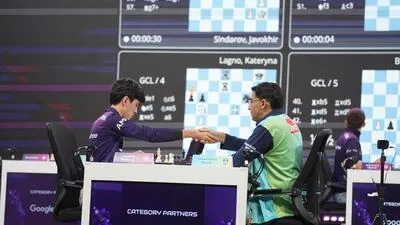
D Gukesh struggles have become one of the most closely watched stories in elite Chess as the reigning world champion prepares for another major challenge. After reaching the summit at just 18, Gukesh now faces the difficult task that follows every breakthrough victory: proving that success was not a one-time achievement.
The Indian grandmaster is preparing to defend his World Championship title against Uzbekistan’s Javokhir Sindarov. The match will arrive after a period in which Gukesh’s form has attracted considerable attention, particularly because expectations surrounding him have risen dramatically since his historic world title triumph.
Five-time world champion Viswanathan Anand understands the situation better than most. Having experienced difficult periods himself during his early career, Anand believes struggles are an unavoidable part of competing at the highest level.
Why Gukesh’s current situation is so difficult
Winning the world championship changes a chess player’s environment. Before becoming champion, the primary objective is often simple: improve, qualify, compete and win.
After becoming champion, the equation changes. Every tournament becomes connected to the title, every unexpected loss attracts attention and every dip in form can be interpreted as a warning sign.
For Gukesh, that pressure has arrived unusually early. He became world champion at 18, making him one of the youngest players ever to reach the top of classical chess.
The achievement created enormous expectations. Fans, analysts and the wider sporting audience naturally want to see the young champion continue winning, but elite chess rarely follows such a predictable path.
A player can prepare for hours every day and still experience results that do not match the quality of the preparation. That disconnect between effort and outcome is one of the most psychologically demanding aspects of professional chess.
Anand knows what a young champion goes through
Anand’s advice carries particular weight because he experienced his own difficult phases while establishing himself among the world’s strongest players.
The former world champion recalled periods in his early 20s when his classical results were not always where he wanted them to be. Rapid chess performances sometimes gave him a useful confidence boost when longer games were proving difficult.
That experience shaped an important lesson: poor form does not necessarily mean that a player has suddenly lost the ability to compete.
Chess performance is affected by confidence, preparation, decision-making, fatigue, tournament circumstances and the quality of opposition. A short sequence of disappointing results can therefore feel much bigger than it actually is.
The importance of accepting difficult periods
One of Anand’s central lessons is acceptance. Instead of fighting against the fact that results are not matching expectations, a player can acknowledge the situation and concentrate on the next available opportunity.
This approach is especially relevant to Gukesh because his current challenge is not about proving that he belongs among the world’s best. He has already done that.
The challenge is learning how to operate when the standards have changed.
A world champion cannot control every result. What the player can control is preparation, decision-making, recovery and the ability to return to the board after a disappointing game.
That distinction can help prevent one poor tournament from becoming a larger crisis of confidence.
Why one good game can change everything
Chess is unusual because a single game can dramatically influence how a player feels about an entire tournament.
A grandmaster may struggle for several rounds and then produce one brilliant performance. That victory can restore confidence, confirm that the preparation is working and change the player’s perception of the competition.
For Gukesh, an encouraging result before the world championship could therefore have importance beyond its position in a tournament table.
Anand suggested that even an unexpected positive result can provide the emotional lift required during a difficult period. In elite sport, confidence does not always return gradually; sometimes one convincing performance can change the narrative immediately.
Anand’s Moscow experience offers a valuable lesson
Anand also reflected on his 2012 world championship match against Boris Gelfand in Moscow. The match began with six consecutive draws before Anand lost the seventh game.
That setback could have changed the direction of the contest. Instead, Anand recovered and won the following game before eventually securing the match.
The broader lesson is important for Gukesh: a difficult moment inside a world championship does not determine the final result.
Long matches create opportunities for recovery. A player who loses one game still has time to adjust preparation, rethink strategy and return to the board with a fresh approach.
This is particularly important in a championship setting, where emotional control can be just as significant as opening preparation.
The burden of defending a world title
Defending a world championship can be psychologically different from winning one for the first time.
A challenger enters the contest trying to achieve something extraordinary. The champion enters with something to protect. That difference can influence expectations and the way every game is perceived.
Gukesh is also competing in a period when several former champions have followed very different paths after holding the crown.
Magnus Carlsen eventually stepped away from the classical world championship cycle, while Ding Liren’s post-championship period has been far less prominent than his rise to the title.
These examples demonstrate how demanding the world champion’s position can become. Maintaining motivation and elite consistency after reaching the highest possible achievement is a challenge in itself.
Gukesh’s age makes the challenge even more interesting
Gukesh’s age is one of the most important factors in understanding his current situation.
At only 20, he is still developing as a player. His world championship success does not mean that his chess journey has reached a finished stage.
In fact, becoming champion so young means he now has to learn many aspects of elite competition while already carrying the responsibilities associated with the highest title.
That can create an unusual learning environment. Instead of developing away from the spotlight, Gukesh is developing under constant attention.
The ability to turn that pressure into experience could ultimately become one of the defining characteristics of his career.
Why classical chess slumps can feel particularly severe
Classical chess places enormous demands on concentration. Games can last for hours, and players must maintain calculation accuracy and emotional control for extended periods.
When results decline, the problem can become mentally exhausting because every game represents a substantial investment of time and energy.
Unlike some faster formats, there are fewer opportunities to immediately move on from a disappointing performance. A difficult classical tournament can therefore create a prolonged sense of frustration.
Anand’s experience of using rapid chess as a confidence source highlights the value of maintaining perspective across different formats.
Gukesh and the need for a fresh tournament mindset
One of the most useful approaches for Gukesh may be to treat each tournament as a separate competitive chapter.
Results from one event do not automatically determine what happens at the next event. A player can lose several games in one period and still produce excellent chess shortly afterwards.
This is particularly relevant before a world championship. The preparation cycle should focus on the specific opponent, match conditions and strategic requirements rather than allowing every previous result to dominate the player’s thinking.
The ability to reset can become a major competitive advantage.
Gukesh’s final tournament before the title defence
Before his world championship match, Gukesh is scheduled to compete at the Olympiad in Samarkand later this month. That event represents another opportunity to regain rhythm and confidence.
Rather than viewing the tournament only through the lens of results, Gukesh can use it to assess his decision-making, opening preparation and ability to handle complicated positions.
A strong performance could provide confidence, while even difficult games could offer useful information about what needs to be adjusted before the championship.
The most important objective is therefore not perfection but readiness.
What Gukesh can learn from Anand’s career
Anand’s career provides a valuable example of longevity in elite chess. His experience demonstrates that even world champions experience uncertainty, difficult stretches and periods when results do not reflect their expectations.
The difference is often how players respond to those periods.
Instead of interpreting every setback as evidence of decline, elite competitors can treat it as information. A loss can expose a preparation weakness. A poor tournament can reveal a fatigue issue. A lack of confidence can highlight the need for a different training or competitive routine.
That mindset turns setbacks into part of the development process.
The biggest lesson: the champion does not need to be perfect
Perhaps the most important message from Anand’s perspective is that Gukesh does not need to eliminate every weakness before defending his title.
World championship matches are not won by players who never struggle. They are won by players who can respond effectively when things go wrong.
Gukesh has already demonstrated that he can perform under enormous pressure. His historic world title run showed extraordinary competitive ability at an exceptionally young age.
The next stage of his career is about adding another skill to that package: managing the periods when confidence and results are not moving in the same direction.
Gukesh vs Sindarov: Why the mental battle will matter
The upcoming title defence against Javokhir Sindarov will test much more than opening preparation and calculation.
Both players will enter with extensive preparation, but the ability to remain calm when a position becomes uncomfortable could prove decisive.
For Gukesh, the key may be avoiding the temptation to prove his form immediately. A world championship is a long competitive journey, and one difficult position should not be allowed to define the entire match.
For Sindarov, challenging the defending champion provides an opportunity to create pressure from the beginning. That makes Gukesh’s ability to handle expectations particularly important.
| Factor | Why It Matters for Gukesh |
|---|---|
| Young age | He is still developing while already carrying world champion expectations. |
| Recent form | Results have created additional scrutiny ahead of his title defence. |
| World champion status | Every tournament now comes with greater expectations and attention. |
| Upcoming defence | He must prepare for Javokhir Sindarov while managing the pressure of defending the crown. |
| Anand’s experience | Past lessons from another world champion offer perspective on handling difficult periods. |
Can Gukesh turn pressure into another breakthrough?
The current narrative around Gukesh is dominated by his struggles, but that does not necessarily predict what will happen in the world championship.
Chess history repeatedly shows that form can change quickly. A player who appears uncertain in one tournament can produce exceptional preparation and confidence in the next.
Gukesh also has something many challengers never receive: the experience of already winning a world championship match.
He knows what it feels like to sit across from the world’s best players with everything at stake. That experience could become valuable when the pressure rises again.
Conclusion: Gukesh’s next challenge is learning to live with the crown
D Gukesh struggles are an important part of the story surrounding the young world champion, but they should not be viewed as the final definition of his career.
At 20, Gukesh is learning how to operate in an environment that changed dramatically after his world championship victory. The expectations are higher, the scrutiny is greater and every disappointing result receives more attention.
Viswanathan Anand’s perspective offers a reminder that even champions experience periods when results fail to match effort. The crucial skill is learning to accept the difficult phase, recover confidence and treat the next tournament as a fresh opportunity.
Gukesh now has one major objective ahead: prepare for Javokhir Sindarov and arrive at the world championship ready to compete.
The pressure of the crown may be heavy, but the ability to handle that pressure could become just as important to Gukesh’s legacy as winning the title in the first place.
For breaking news and live news updates, like us on Facebook or follow us on Twitter and Instagram. Read more on Latest Sports on thefoxdaily.com.






COMMENTS 0