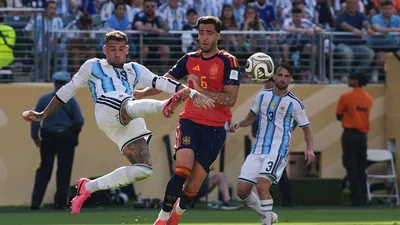
Spain’s 1-0 victory over Argentina in the FIFA World Cup 2026 Final ended weeks of debate about who was truly the best team in the competition. While La Roja completed an outstanding campaign by winning the trophy, Argentina’s journey to the final has sparked a different question: did the tournament’s two best teams actually meet in the championship match?
Reaching a World Cup final is always a remarkable achievement. However, knockout tournaments often reward teams that survive critical moments rather than those that consistently dominate opponents. The numbers from the tournament reveal a significant gap between Spain and the rest of the field.
Spain Were the Most Complete Team at the World Cup
Throughout the tournament, Spain displayed the qualities of a true champion. They controlled possession, dictated the tempo of matches, pressed aggressively, and defended with remarkable discipline.
Most impressively, Spain conceded only one goal during the entire tournament. They kept clean sheets against several strong opponents, including Portugal, France, and Argentina, showcasing their defensive excellence.
Spain’s route to the title included victories over Austria, Portugal, Belgium, France, and Argentina. Across those knockout matches, they outscored opponents 9-1 while consistently controlling games from start to finish.
Argentina Reached the Final Through Resilience and Messi’s Brilliance
Argentina entered the final after winning every previous match in the competition. Lionel Scaloni’s side scored more goals than any other team and demonstrated incredible fighting spirit throughout the tournament.
However, many of their victories came after difficult battles. Argentina required extra time against Cape Verde and Switzerland, recovered from a two-goal deficit against Egypt, and needed a dramatic late comeback against England in the semi-final.
These results highlighted Argentina’s resilience but also exposed weaknesses that were often masked by moments of individual brilliance from Lionel Messi.
Lionel Messi Carried Argentina’s Attack
The biggest story of Argentina’s campaign was once again Lionel Messi. At 39 years old, the legendary forward produced one of the greatest individual World Cup performances in history.
Messi finished the tournament with eight goals and four assists, directly contributing to nearly two-thirds of Argentina’s goals. Time and again, he provided the decisive moment when Argentina needed inspiration.
Whether it was scoring crucial goals, creating opportunities for teammates, or controlling the tempo in attacking areas, Messi remained the heartbeat of Argentina’s campaign.
His influence was so significant that Argentina’s attacking identity became heavily dependent on his creativity and decision-making.
The Final Exposed Argentina’s Biggest Weakness
Spain entered the final with a clear strategy: stop Messi and force other Argentine players to take responsibility.
The plan worked perfectly.
Argentina failed to register a single shot during regular time and struggled to create meaningful attacking opportunities. Their first attempt on goal arrived deep into extra time, illustrating how effectively Spain neutralized their biggest threat.
Without Messi finding space between the lines, Argentina lacked alternative solutions. Spain’s organized defensive structure prevented the South Americans from building attacks and ultimately controlled the match from beginning to end.
Why France Have a Strong Claim to Second Place
While Argentina reached the final, statistical analysis suggests France may have been the tournament’s second-best team overall.
Before their semi-final defeat, France ranked among the leaders in expected goals, shots on target, and attacking efficiency. Unlike Argentina, their offensive threat was spread across multiple players including Kylian Mbappe, Ousmane Dembele, Michael Olise, and Desire Doue.
France possessed a more balanced attack and stronger underlying metrics throughout the competition. Their only major obstacle was Spain, who completely outplayed them in the semi-final.
Knockout Football Does Not Always Reward the Best Teams
The beauty of World Cup football lies in its unpredictability. Unlike league competitions where consistency usually determines the champion, knockout tournaments often come down to individual moments, tactical decisions, and fine margins.
A team can dominate statistically and still be eliminated. Another side can survive difficult matches through resilience, luck, or the brilliance of a superstar.
Argentina’s journey perfectly demonstrated this reality. They found ways to win crucial matches and earned their place in the final. Yet their overall performances often relied on Messi rescuing situations that a stronger collective structure might have handled more comfortably.
Spain’s Team Strength Made the Difference
One of Spain’s greatest strengths was the distribution of responsibility across the squad. Goals, assists, defensive contributions, and playmaking duties were shared among multiple players.
Rodri controlled possession, Pedri orchestrated attacks, Mikel Oyarzabal provided goals, and Unai Simon delivered crucial saves. Even substitutes made decisive contributions throughout the tournament.
In the final, Spain once again demonstrated that collective quality often outweighs individual brilliance. While Argentina depended heavily on Messi, Spain trusted their system and were rewarded with the ultimate prize.
Final Verdict
Spain were unquestionably the best team at the FIFA World Cup 2026 and deserved their championship triumph. Their dominance in possession, defensive solidity, tactical organization, and consistency separated them from every other team in the tournament.
Argentina deserved their place in the final because they won the matches necessary to get there. However, based on overall performances, statistical indicators, and team balance, there is a strong argument that France were the tournament’s second-best side.
The final showcased the difference between a complete team and a team driven largely by one extraordinary player. For most of the tournament, Lionel Messi overcame Argentina’s shortcomings. Against Spain, even the greatest player of his generation could not find a solution.
For breaking news and live news updates, like us on Facebook or follow us on Twitter and Instagram. Read more on Latest Sports on thefoxdaily.com.





COMMENTS 0