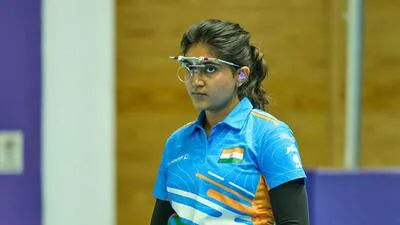
Esha Singh has established herself as one of India’s leading pistol shooters and will enter the upcoming Asian Games as one of the country’s strongest medal hopes in both the 10m and 25m events.
Three years after returning from the Hangzhou Asian Games with four medals, including one gold and three silver, Esha has continued to build an impressive senior career. Her progress has included an Olympic debut, multiple World Cup medals and a world-record score in the 25m event.
Esha Singh’s impressive run of form
Esha has enjoyed a strong period of results over the past 10 months. She has won two World Cup gold medals in the 25m event, a silver in the 10m World Cup and an individual bronze at the World Championships in the 25m event.
Her consistency has also taken her to the top of the world rankings. Esha currently sits at No.1 in the world in the 25m event and No.2 in the 10m event.
Despite those achievements, Esha remains cautious about placing too much importance on rankings and medals. She believes the sport can quickly change and that preparation remains the most important factor.
“Ultimately, it is down to training and preparation. There’s no secret sauce,” Esha said.
Why Esha Singh does not fear pressure
Shooting is a sport where extremely small margins can decide the result. Esha acknowledges that pressure is unavoidable, particularly when competing in major international events.
Interestingly, the Indian shooter does not describe herself as naturally calm during competitions. Instead, she admits that she becomes nervous and feels significant pressure when the stakes are high.
Her approach has changed, however. Rather than attempting to eliminate nervousness, Esha has learned to accept it as part of competing at the highest level.
“I am a very nervous shooter. In fact, I feel nobody feels so much pressure as me in a match. The more important the match, the more nervous I get. But rather than fighting it, I have come to embrace the pressure,” she said.
Paris Olympics changed Esha’s approach
Esha believes her experience at the Paris Olympics played an important role in changing her perspective on competitive shooting.
Although she finished 18th at the Olympics, competing against the world’s best shooters exposed her to a level of quality and intensity that helped her understand the sport differently.
Since then, Esha has become more comfortable with the uncertainty involved in shooting and has worked on separating her performance from the final result.
Her coach Ronak Pandit believes this shift has been deliberate. Instead of judging Esha’s consistency only through medals and scores, the coaching team focuses on the quality of her overall performance.
Ronak Pandit focuses on process over results
Ronak Pandit has been mentoring Esha for five years and has developed a detailed approach to improving her performance.
According to Pandit, shooting involves dozens of small factors, ranging from breathing and pistol calibration to grip, concentration and trigger control.
However, his training philosophy focuses heavily on two areas: clean triggering and adaptability when something unexpectedly changes during competition.
Clean triggering means keeping the pistol stable while pulling the trigger. This becomes particularly important in the 25m event, where the firearm produces recoil and the shooter must quickly adjust.
Training for unexpected situations
Pandit believes preparing Esha only for perfect conditions would not be enough. His training sessions therefore deliberately introduce unexpected situations to ensure she can maintain her technique when conditions change.
Training can include scenarios involving a pistol malfunction, switching to a reserve gun or suddenly changing from practice shots to simulated competition shots.
These exercises require Esha to recalibrate the weapon, adjust to its feel, establish the correct grip and regain a clean trigger release.
The objective is to ensure that she can continue performing even when the circumstances are not ideal.
Balancing the demands of 10m and 25m shooting
Esha competes in two different pistol disciplines, with the 10m air pistol requiring extreme stillness and precision while the 25m event demands speed, control and the ability to handle recoil.
Despite the differences, Pandit believes the two events share important fundamentals, including concentration, control and technical discipline.
The training programme is therefore adjusted according to the specific demands of each event while maintaining the core principles that underpin Esha’s shooting.
Competition brings out another level
Esha believes strong competition can help her discover an additional level of performance.
Her recent results against elite opposition have demonstrated her ability to perform when the pressure is high. At the Hangzhou World Cup in July, she defeated China’s Yueyue Zhang, the 2025 Asian champion, to win the 25m gold medal, while Manu Bhaker took bronze.
Earlier, Esha had also competed against leading shooters such as Olympic champion Yang Ji-in of South Korea and former world champion Doreen Vennekamp of Germany.
For Esha, facing such high-quality opponents has become an important part of her development rather than something to fear.
Esha Singh’s Asian Games medal hopes
India’s 30-member shooting squad will have several strong medal contenders at the Asian Games. Alongside Esha, the team includes shooters such as Suruchi Singh, Manu Bhaker and Rahi Sarnobat.
However, Esha enters the competition with particularly strong recent form across both of her events.
Her experience, technical development and ability to handle pressure could make her one of India’s most important medal prospects when the shooting competition begins.
Why Esha’s mindset could be crucial
Esha’s biggest strength may not simply be her ability to shoot high scores. Her willingness to accept pressure and adapt to unexpected situations could prove equally important in a major multi-sport competition.
Her coaching team has worked to ensure that she does not become overly comfortable during training. By repeatedly introducing unusual situations, the aim is to prepare her for the unpredictable nature of major competition.
For a shooter competing at the highest level, the ability to maintain technique and concentration on a difficult day can be the difference between a strong performance and a medal-winning one.
Esha’s journey from winning four medals at the Hangzhou Asian Games to becoming a world No.1-ranked 25m shooter shows how quickly her career has developed.
As she prepares for another Asian Games campaign, her approach remains simple: focus on preparation, trust the process and embrace the pressure rather than trying to eliminate it.
For breaking news and live news updates, like us on Facebook or follow us on Twitter and Instagram. Read more on Latest Sports on thefoxdaily.com.




COMMENTS 0