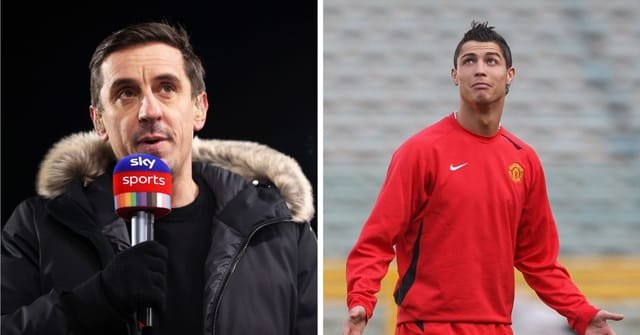
Few people are better placed to answer the question of who the greatest forward in Manchester United history is than Gary Neville. The former United captain played alongside some of the finest attackers the Premier League has ever seen, trained with them daily, watched them up close in training ground conditions that strip away any illusions a player might project on matchday, and captained them through some of the defining moments of the club’s most successful era.
His verdict, delivered during an appearance on Rio Ferdinand’s YouTube show “Rio Meets”, was unequivocal. The greatest forward he ever saw at Manchester United was not Cristiano Ronaldo. It was Wayne Rooney. And his reasoning was so detailed, so specific, and so analytically compelling that it deserves examination far beyond the headline it generated.
Neville’s Case for Rooney: A Mixture of Five United Legends in One Body
What makes Neville’s assessment so striking is that he did not simply name Rooney. He described him in a way that places the former England captain within the full context of Manchester United’s attacking history across two decades. As he told Ferdinand:
“He’s the best Wazza. If people ask me who is the best striker, I might say Van Nistelrooy or Alan Shearer. If they ask me who the best forward is that I played with at United, it’s Wayne Rooney. The best tackler, the best header, the best goalscorer, the best assist-maker, the best runner, the best fighter. He was aggressive and he played Football like he was still in the streets as a kid. He was the best forward I ever saw at Manchester United. He was a mixture of Mark Hughes, Van Nistelrooy, Eric Cantona, Paul Scholes in the half turn, Dwight Yorke. He was a mixture of all the best players that were amazing. He could do all the things that they could do. He could drop in, he could pass, he could finish, he could head, left-foot, right-foot, could sprint back and defend.”
This is a remarkable piece of player analysis. Neville is not making a vague emotional argument about Rooney being his favorite or the most memorable. He is building a specific, technical case by identifying the distinct qualities that made five different United legends exceptional and arguing that Rooney possessed all of them within a single player.
Break it down and the argument becomes even more impressive:
- Mark Hughes brought physical power, aerial presence, and the ability to hold the ball up with his back to goal under intense pressure. Hughes was one of the most physically complete centre-forwards of his generation.
- Ruud van Nistelrooy was a clinical goalscorer of almost unique efficiency. His positioning inside the box, his movement to create space, and his conversion rate were as close to perfect as any modern striker managed.
- Eric Cantona brought vision, technique, arrogance in the best possible sense, and the ability to change games through individual moments of improvised genius. He was the connective tissue between United’s early 1990s rebuild and their first title in 26 years.
- Paul Scholes in the half turn is a very specific reference. Scholes’s ability to receive the ball on the half turn, scan the field in the process, and play a pass before an opponent could close him down was among the finest technical skills in Premier League history.
- Dwight Yorke contributed creativity, movement, and a joyful unpredictability that helped United win the Treble in 1999. His partnership with Andy Cole remains one of the most celebrated in the club’s history.
Neville is saying that Rooney contained credible versions of all five of these qualities. That is not a comparison. It is a classification of Rooney as something qualitatively different from any individual one of those players.
| Player | Quality Rooney Inherited | Era at United |
|---|---|---|
| Mark Hughes | Physical power, aerial strength, back-to-goal hold-up play | 1980-1986, 1988-1995 |
| Ruud van Nistelrooy | Clinical goalscoring, box movement, conversion rate | 2001-2006 |
| Eric Cantona | Vision, creativity, game-changing individual quality | 1992-1997 |
| Paul Scholes | Half-turn receiving, passing range, technical precision | 1993-2013 |
| Dwight Yorke | Movement, creativity, unpredictability in attack | 1998-2002 |
| Wayne Rooney | All of the above | 2004-2017 |
Where Ronaldo Fits: The Best Player, But Not the Best Forward
Neville was careful and generous in his assessment of Cristiano Ronaldo. He did not dismiss the Portuguese forward. He acknowledged him, clearly and without qualification, as the best player at Manchester United during the specific period from 2006 to 2009, before Ronaldo left for Real Madrid.
That three-year window produced some of the most extraordinary individual football the Premier League had seen to that point. Ronaldo’s development from a technically gifted but inconsistent winger into a complete, dominant goalscoring forward happened at United under Sir Alex Ferguson, and the 2007-08 season in particular, when he scored 42 goals across all competitions and won the Ballon d’Or, represented a level of performance that arguably no United player before or since has matched in a single campaign.
But Neville’s distinction is important and honest: there is a difference between the best player and the best forward. The best player is the most individually impactful performer, the one whose peak performance is the highest point on the graph. The best forward is the most complete, most versatile, most comprehensively useful attacking player when evaluated across the full breadth of what the forward position demands.
Ronaldo, during his peak United years, was a spectacular individual performer who was becoming the most complete goalscorer in the world. Rooney, across his entire United career, was something harder to define and in some ways harder to replace: a player who could do almost anything that was asked of him in any attacking role, who competed with full physical commitment every time he crossed the white line, and who accumulated records at the club that nobody, including Ronaldo, came close to matching.
The Numbers Behind the Argument: Rooney’s United Record in Context
Neville’s case for Rooney is built on observation and experience, but the statistical record supports it independently. Wayne Rooney is Manchester United’s all-time top goalscorer, with 253 goals in 559 appearances. That total exceeds every other player in the club’s history, including players who spent longer at the club and players who were more celebrated during their time there.
The goals-per-game ratio is one measure. But the broader picture of what Rooney contributed across 13 years at United is more complex than any single statistic captures. He played as a centre-forward, as a support striker, as an attacking midfielder, and occasionally even deeper when the team needed his passing range and work rate in central areas. His 103 league assists across his United career place him in rare company among strikers. His defensive contribution, pressing, tracking, and recovering ground, was highlighted specifically by Neville as one of his defining qualities.
For context, Ronaldo scored 118 goals in 292 appearances during his first United spell from 2003 to 2009. That is an extraordinary record, particularly in the final three seasons. But it covers less than half the appearances and roughly half the goals of Rooney’s total contribution. The comparison is not straightforward in either direction, which is precisely why Neville’s framework of distinguishing between the best player and the best forward is so analytically useful.
Ronaldo’s Demanding Standards: The “Third Goal” Story
The second significant revelation from this cluster of United anecdotes came not from Neville but from Diogo Dalot, the Portuguese full-back who played alongside Ronaldo during his return to Old Trafford in 2021. Writing in The Players’ Tribune, Dalot shared a story that illuminates exactly what Ronaldo’s standards looked like from the inside of a dressing room, and what separated his expectations from the rest of the squad’s.
Dalot revealed that Ronaldo had identified a United striker who was performing well by conventional measures and told Dalot, flatly, that the player would not make it at the club. When Dalot pushed back, pointing out that the striker had scored two goals, Ronaldo’s response was immediate and revealing.
“Yeah, but he didn’t have the fire to go for the third.”
The player’s identity was not revealed, and speculation about who it might be would be unfair to any individual. But the principle Ronaldo was articulating is clear and important. His standard was not scoring. His standard was refusing to stop pursuing the next achievement the moment the previous one had been reached. Two goals was not a success to be protected. It was a platform from which the pursuit of a third should have been immediate and unconditional.
This story, read alongside Neville’s description of Rooney, creates an interesting contrast between two different versions of elite forward mentality. Ronaldo’s standard was relentless individual pursuit: goals, records, the next target the moment the current one was achieved. Rooney’s standard, as Neville described it, was total collective contribution: every task on the pitch performed with maximum intensity, regardless of its glamour or visibility.
Neither standard is superior to the other in any absolute sense. Both produced exceptional players. But they produced exceptional players in fundamentally different ways, which is why the debate between them is genuinely interesting rather than simply a matter of tallying goals and awards.
Why This Debate Still Matters: The Question of What a Forward Is
The Neville versus Ronaldo debate is, at its core, a philosophical question about what the forward position is actually for. The answer to that question has shifted considerably over the past thirty years of football evolution, and it will continue to shift as tactical frameworks develop further.
In the era when Van Nistelrooy was United’s primary striker, the forward’s job was relatively clearly defined: stay in the box, create space with movement, convert chances with maximum efficiency, and leave the buildup play to others. Van Nistelrooy was almost perfectly designed for that role and executed it at a level that very few forwards in Premier League history have matched.
Ronaldo transcended the traditional winger role and became something new during his time at United: a forward who could operate from wide positions, cut inside, and score goals of every type at a volume that made him the most individually productive player in the squad. His game was built on explosive direct skill and relentless goalscoring hunger.
Rooney, by contrast, was the football equivalent of a utility player at the highest possible level of performance. He was not the best pure goalscorer United have had. He was not the best creator. He was not the best header or the best tackler in isolation. But the combination of all those qualities, delivered consistently across 13 seasons at the highest level, is what Neville is pointing to when he calls Rooney a mixture of five different legends. Rooney was not any one of those things. He was a version of all of them, assembled in a single player who played every minute as if his career depended on it.
Conclusion: Neville’s Verdict and What It Tells Us About United’s Greatest Generation
Gary Neville’s assessment of Wayne Rooney is valuable precisely because it comes from someone with the experience and the analytical honesty to make it without sentiment or nostalgia distorting the judgment. He acknowledged Ronaldo’s brilliance openly and specifically. He placed it in its correct context. And then he explained, with precision and clarity, why the complete picture of Rooney’s contribution to Manchester United exceeds it.
253 goals. 559 appearances. All-time leading scorer. A career that encompassed the final years of the Ferguson era and stretched into a period of transition and struggle for the club. A player who gave everything in every match regardless of the scoreline, the opposition, or the tactical role he was asked to fill.
Cristiano Ronaldo went on to become arguably the greatest goalscorer in the history of football. That is not a small thing. But Neville is not arguing about what Ronaldo became after leaving United. He is arguing about who was the greatest forward across the entirety of their time at Old Trafford, and on that specific question, his answer is Rooney.
A mixture of Hughes, Van Nistelrooy, Cantona, Scholes, and Yorke. Playing like a kid from the streets. Giving everything, every time, for the badge on the shirt.
It is not the most surprising verdict for those who watched Rooney closely across those thirteen years. But hearing it articulated this clearly, by the man who captained both players, gives it a weight that the debate deserves.
For breaking news and live news updates, like us on Facebook or follow us on Twitter and Instagram. Read more on Latest Sports on thefoxdaily.com.






COMMENTS 0