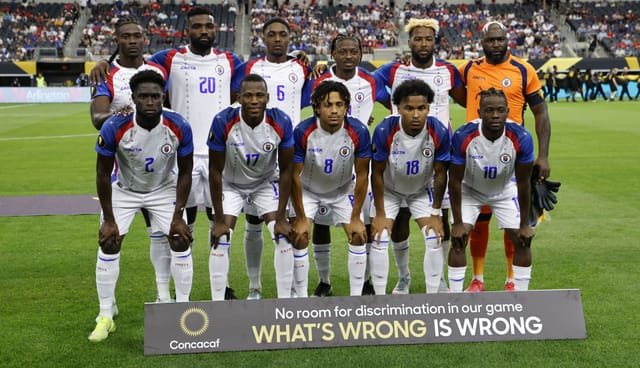
Just days before Haiti’s opening match of the 2026 FIFA World Cup, the Caribbean nation has found itself at the center of an unexpected controversy. FIFA has required Haiti to modify elements of its newly unveiled World Cup kit after determining that parts of the design could be interpreted as containing political imagery.
The decision comes at a particularly significant moment for Haitian football. After more than five decades away from the FIFA World Cup, Haiti is preparing for only its second appearance in the tournament’s history. Instead of focusing solely on preparations for a crucial group-stage encounter against Scotland, attention has temporarily shifted toward a debate involving football regulations, historical symbolism, and cultural representation.
While the jersey redesign has now been completed, the incident raises broader questions about how national teams celebrate their history while complying with FIFA’s strict equipment rules.
Why FIFA Objected to Haiti’s World Cup Kit
The controversy centers around artwork incorporated into Haiti’s official 2026 FIFA World Cup jersey.
Designed by Colombian sportswear manufacturer Saeta, the kit featured silhouettes inspired by figures associated with Haiti’s struggle for independence. The imagery referenced historic moments connected to the Haitian Revolution and the Battle of Vertières, events that played a crucial role in the nation’s fight against colonial rule.
Although many supporters viewed the design as a tribute to national history and resilience, FIFA determined that the imagery could potentially violate regulations prohibiting political, religious, or personal messages on team equipment.
Under FIFA guidelines, participating nations must ensure that all kit designs remain politically neutral throughout international competitions.
The governing body therefore requested modifications before the tournament begins.
Saeta Explains the Inspiration Behind the Design
Following FIFA’s decision, sportswear manufacturer Saeta released a statement clarifying the intention behind the original concept.
“The design was created as a tribute to the men and women who contribute to Haiti’s future and was never intended as a political statement.”
The company emphasized that the artwork celebrated national pride, perseverance, and cultural heritage rather than political ideology.
Nevertheless, Saeta confirmed it had implemented FIFA’s requested changes to ensure Haiti would face no obstacles in participating at the tournament.
The swift response allowed the issue to be resolved before Haiti’s opening match.
The Historical Significance Behind the Removed Imagery
To understand why the controversy attracted attention, it is important to appreciate the historical importance of the symbols involved.
The Haitian Revolution remains one of the most significant events in world history. It led to the establishment of Haiti as the first independent Black republic and remains a source of national pride for Haitians around the world.
The Battle of Vertières, fought in 1803, is widely regarded as one of the decisive moments that paved the way for Haitian independence.
For many supporters, incorporating references to these historical milestones was intended as a celebration of national identity rather than a political statement.
However, FIFA’s regulations focus not on intent alone but also on how imagery may be interpreted within a global sporting environment.
FIFA’s Rules on Political Messages Explained
The situation highlights one of FIFA’s most consistently enforced policies.
Football’s governing body seeks to keep international competitions free from political, religious, and ideological messaging. These rules apply not only to players but also to team apparel, stadium displays, official ceremonies, and promotional materials.
The objective is to maintain football as a neutral platform where sporting competition remains the primary focus.
| Permitted on FIFA Kits | Not Permitted on FIFA Kits |
|---|---|
| National colors | Political slogans |
| Federation badges | Religious messaging |
| Sponsor-approved branding | Campaign symbols |
| Cultural design elements | Potentially political imagery |
| Competition logos | Personal statements |
While these regulations aim to ensure consistency, they occasionally create difficult situations when historical or cultural symbols are involved.
A Recurring Issue for Haitian Sports Teams
The World Cup jersey controversy is not an isolated incident.
Earlier this year, Haiti encountered a similar challenge before the Winter Olympics. Designs associated with the country’s Olympic delegation reportedly required modifications after concerns were raised regarding imagery featured on the apparel.
The repeated incidents illustrate the complex relationship between cultural storytelling and international sporting regulations.
Many nations seek to showcase unique aspects of their history and heritage through uniforms, but global competitions often impose strict limitations regarding what can be displayed.
Why This Story Matters Beyond Football
At first glance, a jersey redesign may seem insignificant compared to events occurring on the pitch. However, sports uniforms often carry deep symbolic meaning.
National team jerseys represent more than athletic competition. They serve as expressions of identity, history, and collective pride.
For smaller football nations especially, World Cup appearances provide rare opportunities to introduce their culture to a global audience.
The debate surrounding Haiti’s kit reflects a broader challenge facing international sports organizations: balancing neutrality with cultural representation.
There is rarely a simple answer when historical symbols are involved.
Haiti’s Long Road Back to the FIFA World Cup
The timing of the controversy is particularly noteworthy because Haiti’s participation in the 2026 FIFA World Cup is itself a historic achievement.
The nation is returning to football’s biggest tournament for only the second time in its history.
Their previous appearance came in 1974, when Haiti faced a daunting group featuring several football powerhouses.
| Haiti World Cup History | Details |
|---|---|
| First Appearance | 1974 |
| Second Appearance | 2026 |
| Years Between Appearances | 52 Years |
| Current Confederation | CONCACAF |
| Only Caribbean Team at 2026 World Cup | Yes |
After decades of near misses and rebuilding efforts, qualification for the 2026 tournament represents a landmark moment for Haitian football.
Breaking Down Haiti’s Difficult Group
Haiti enters one of the tournament’s most challenging groups.
Group C Opponents
- Scotland
- Brazil
- Morocco
The opening match against Scotland could prove decisive.
A positive result would significantly improve Haiti’s chances of advancing, while defeat would place enormous pressure on subsequent matches against Brazil and Morocco.
Brazil’s status as five-time world champions makes them overwhelming favorites, while Morocco arrive with growing international credibility following several impressive performances in recent years.
The Unique Opportunity Facing Haiti
Despite the difficult group, Haiti arrives at the World Cup with relatively little external pressure.
Unlike traditional football powers expected to challenge for the trophy, Haiti can approach the tournament with freedom and ambition.
This underdog status could work to their advantage.
World Cup history is filled with examples of smaller nations exceeding expectations when organization, belief, and momentum come together.
For Haiti, simply reaching the knockout stage would rank among the greatest achievements in the country’s football history.
Could the Controversy Unite the Team?
One often-overlooked aspect of major tournaments is how adversity can strengthen team unity.
Unexpected challenges frequently create a stronger sense of collective purpose among players and staff.
While the jersey redesign was undoubtedly frustrating for those involved in its creation, the incident may ultimately become a rallying point.
Many athletes use external distractions as motivation, transforming controversy into additional determination on the field.
If Haiti performs well at the tournament, the kit story could quickly become a footnote to a much larger success narrative.
What Happens Next?
With the redesign completed and FIFA’s concerns addressed, attention can now return to football.
The revised jerseys have been approved for use, allowing Haiti to focus entirely on preparation for their opening fixture against Scotland.
Supporters will hope the discussion shifts from uniforms to performances as the tournament gets underway.
After waiting more than half a century for another World Cup appearance, Haiti’s players now have an opportunity to create history on the pitch.
Conclusion
Haiti’s forced World Cup kit redesign has highlighted the delicate balance between cultural expression and FIFA’s commitment to political neutrality. While the original jersey was intended to honor important moments in Haitian history, governing regulations ultimately required modifications before the tournament could begin.
Although the controversy generated headlines, it should not overshadow the remarkable achievement of Haiti’s return to the FIFA World Cup after 52 years.
For players, coaches, and supporters, the focus now turns to the challenge ahead. Facing Scotland, Brazil, and Morocco will test Haiti’s abilities, but the nation arrives with pride, determination, and an opportunity to write a new chapter in its football history.
If Haiti can translate that spirit into performances on the field, the story of their 2026 World Cup may be remembered for far more than a jersey redesign.
For breaking news and live news updates, like us on Facebook or follow us on Twitter and Instagram. Read more on Latest Sports on thefoxdaily.com.






COMMENTS 0