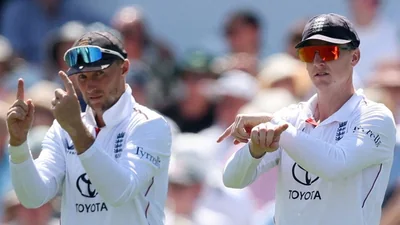
Harry Brook’s wait to become England’s Test captain is not being viewed as a rejection of his leadership credentials. Instead, Brendon McCullum believes the young batter’s opportunity will come later, with Joe Root selected to lead England as the Test side enters a new era following Ben Stokes’ retirement.
The England and Wales Cricket Board’s decision to hand the Test captaincy back to Root surprised many observers. Brook had already established himself as England’s Test vice-captain and had gained additional leadership experience while taking charge of the team in white-ball cricket.
That made Brook appear to be the natural candidate for the next stage of England’s red-ball leadership. However, England have opted for Root’s experience at a crucial transition point, while continuing to develop Brook as a future captain rather than immediately placing the full responsibility on his shoulders.
Why Joe Root was chosen ahead of Harry Brook
The decision to appoint Joe Root as England Test captain represents an unusual twist in his international career. Root previously held the role before Ben Stokes succeeded him, and his first spell as captain eventually came under significant scrutiny.
Yet the circumstances surrounding his return are very different.
Root is now England’s most experienced Test batter and one of the central figures of the red-ball team. With Stokes retiring and Brendon McCullum also leaving his Test coaching position, England faced the prospect of changing several major components of their leadership structure simultaneously.
Choosing Root therefore provides continuity at a time when the team is already preparing for a significant transition.
For the ECB, the calculation appears to be straightforward: rather than asking a relatively young leader to immediately carry the responsibility of rebuilding the Test side, England can use Root’s experience while giving Brook additional time to develop.
Brendon McCullum insists Harry Brook’s time will come
McCullum has made it clear that Brook has not been pushed aside in England’s long-term leadership plans.
Speaking to Sky Sports, McCullum praised Brook’s work as a white-ball leader and suggested that the batter remains on course for a major leadership role in Test cricket.
“He’s a wonderful player and he’s doing a fine job as white-ball leader. I think his time will come in the Test job.”
The message is significant because it suggests England see Brook as a future Test captain rather than simply a temporary vice-captain.
That distinction matters. Captaincy succession does not always have to happen immediately after a senior leader steps down. England can use Root’s return as a bridge, allowing Brook to continue learning the tactical, strategic and interpersonal aspects of international leadership.
Harry Brook already has valuable leadership experience
Brook’s strongest argument for the Test captaincy was his existing experience as a leader across England’s white-ball teams. He has already had opportunities to manage players, make tactical decisions and operate under the scrutiny that comes with leading an international side.
That experience should benefit him regardless of when the Test captaincy eventually arrives.
However, leading a Test team presents challenges that are different from those in limited-overs cricket. Test captains must manage five-day matches, changing pitch conditions, bowling workloads, fielding strategies and long periods of pressure.
There is also a greater emphasis on long-term tactical planning. A captain may need to construct a plan over several sessions rather than several overs.
Giving Brook additional time to develop in those areas could ultimately benefit England.
Why Root’s experience could help England during the transition
Root has already spent years dealing with the demands of Test captaincy. Although his previous tenure had difficult moments, that experience could now become an advantage.
He understands the pressures surrounding the role, the demands of managing bowlers across long spells and the importance of maintaining a dressing-room environment through difficult periods.
Most importantly, Root knows the England Test setup from the inside.
His return also means England do not have to completely rebuild their leadership structure overnight. Brook can continue contributing as vice-captain and white-ball leader while learning from a player who has already experienced the highs and lows of the job.
Root’s return is more than a simple captaincy comeback
The biggest story is not simply that Root has been given the captaincy again. It is what his appointment says about England’s priorities.
Following Stokes’ retirement and McCullum’s departure from the Test coaching role, England are entering a period where stability could be just as important as experimentation.
Root provides a familiar figure at the centre of the team.
At the same time, the appointment does not necessarily block the next generation. Brook can remain involved in leadership while continuing to develop his own identity as a senior England player.
This creates a potential succession pathway in which Root leads the immediate transition and Brook eventually inherits the role when the timing is considered right.
Brendon McCullum’s changing role adds another layer
McCullum is also moving into a different phase of his England career. After four years as Test coach, he has stepped away from the red-ball role while continuing his work with England’s white-ball teams.
His replacement in Test cricket will be Stephen Fleming, another former New Zealand international with extensive coaching experience.
McCullum’s comments about Fleming indicate that he believes England have made a strong appointment for the next phase.
“He’s a little bit like me, but better – that’s how I would sum him up. He’ll do a great job.”
That change means England are simultaneously entering a new coaching era and beginning another captaincy chapter with Root.
Stephen Fleming becomes a key figure in England’s new Test era
Fleming’s appointment could have a major influence on how England’s Test team develops under Root.
The former New Zealand captain brings his own understanding of leadership and international cricket, while his coaching career has given him experience working with players from different cricketing environments.
McCullum’s endorsement is notable because the outgoing Test coach understands the demands of the England setup better than almost anyone.
His belief that Fleming is capable of taking England forward should also reassure the team that the change is not necessarily a complete break from everything that came before.
Root and Brook could form England’s leadership bridge
One of the most interesting possibilities is that Root and Brook could work together as part of a longer succession plan.
Root can provide immediate leadership and experience, while Brook can continue developing as a future captain. Rather than viewing the two players as rivals for the same position, England can potentially use their different stages of development to strengthen the leadership group.
This could be particularly valuable for Brook. Becoming a Test captain is not only about being one of the team’s best players. It involves managing personalities, communicating with coaches, handling selection discussions and making difficult tactical calls.
Brook now has time to build those skills without the immediate expectation that he must transform into England’s Test captain.
What does this mean for Harry Brook’s future?
Brook remains firmly positioned as one of England’s most important future leaders. McCullum’s comments make that clear.
The delay could actually benefit him. If Root performs well as captain, Brook can learn from that experience while continuing to establish himself as a senior player.
He will also have the opportunity to demonstrate that his leadership qualities extend beyond limited-overs cricket.
The key will be how Brook responds to the decision. Rather than allowing the captaincy disappointment to become a distraction, he can use the coming period to strengthen his case for eventually taking charge of the Test side.
Joe Root vs Harry Brook: Why England’s decision makes sense
| Factor | Joe Root | Harry Brook |
|---|---|---|
| Test experience | Extensive experience at the highest level | Considerably less experience |
| Previous Test captaincy | Has already led England in the format | Has not yet led England in Tests |
| Current leadership role | Senior figure returning to captaincy | Test vice-captain and white-ball leader |
| Immediate value | Provides stability during transition | Represents England’s long-term leadership option |
| Long-term outlook | Experienced short-to-medium-term option | Potential future Test captain |
The biggest risk for England is not choosing Brook now
There may be criticism that England missed an opportunity to hand the captaincy to the next generation immediately. But the bigger risk would be rushing Brook into a role before the team is ready for another major leadership experiment.
England have already lost Stokes as captain and McCullum as Test coach. Replacing both with an entirely new captain and coach could have created an unnecessarily dramatic transition.
Root gives England a proven figure while Fleming establishes his own coaching structure.
Brook, meanwhile, can remain part of the leadership group and prepare for the future.
Prediction: Harry Brook could eventually inherit the Test captaincy
The most logical long-term outcome is for Harry Brook to eventually become England’s Test captain. McCullum’s comments strongly suggest that the ECB still views him as a future leader.
Root’s appointment therefore looks more like a bridge than a permanent decision about England’s leadership future.
If Brook continues to perform consistently and develops his leadership credentials, the experience gained alongside Root could make him better prepared when his opportunity arrives.
The crucial factor will be timing. England need to avoid creating pressure around a specific succession date and instead allow Brook’s development to determine when the handover makes sense.
What Stephen Fleming and Joe Root must get right
The new Test leadership team will have several priorities. Root will need to establish authority while maintaining the qualities that have made him such an important member of the England dressing room.
Fleming, meanwhile, must create a clear tactical identity for the Test side.
Brook’s development should also remain part of that process. If England genuinely see him as their future captain, giving him meaningful leadership responsibilities rather than simply attaching the vice-captain label will be important.
That could mean involving him more deeply in tactical discussions, team planning and communication with younger players.
Conclusion: England have chosen experience without abandoning the future
Harry Brook may have missed out on the England Test captaincy for now, but Brendon McCullum’s comments suggest his long-term leadership ambitions remain intact.
Joe Root’s return provides England with experience at a time of significant change following Ben Stokes’ retirement and McCullum’s departure from the Test coaching position. Stephen Fleming now takes charge of the red-ball team, creating another important chapter in England cricket.
For Brook, the situation could ultimately prove beneficial. He can continue leading England in white-ball cricket, learn from Root and develop the skills required to manage a Test side over five demanding days.
The immediate captain is Joe Root. But if McCullum’s prediction proves correct, Harry Brook’s Test captaincy story may simply have been delayed rather than cancelled.
For breaking news and live news updates, like us on Facebook or follow us on Twitter and Instagram. Read more on Latest Cricket on thefoxdaily.com.






COMMENTS 0