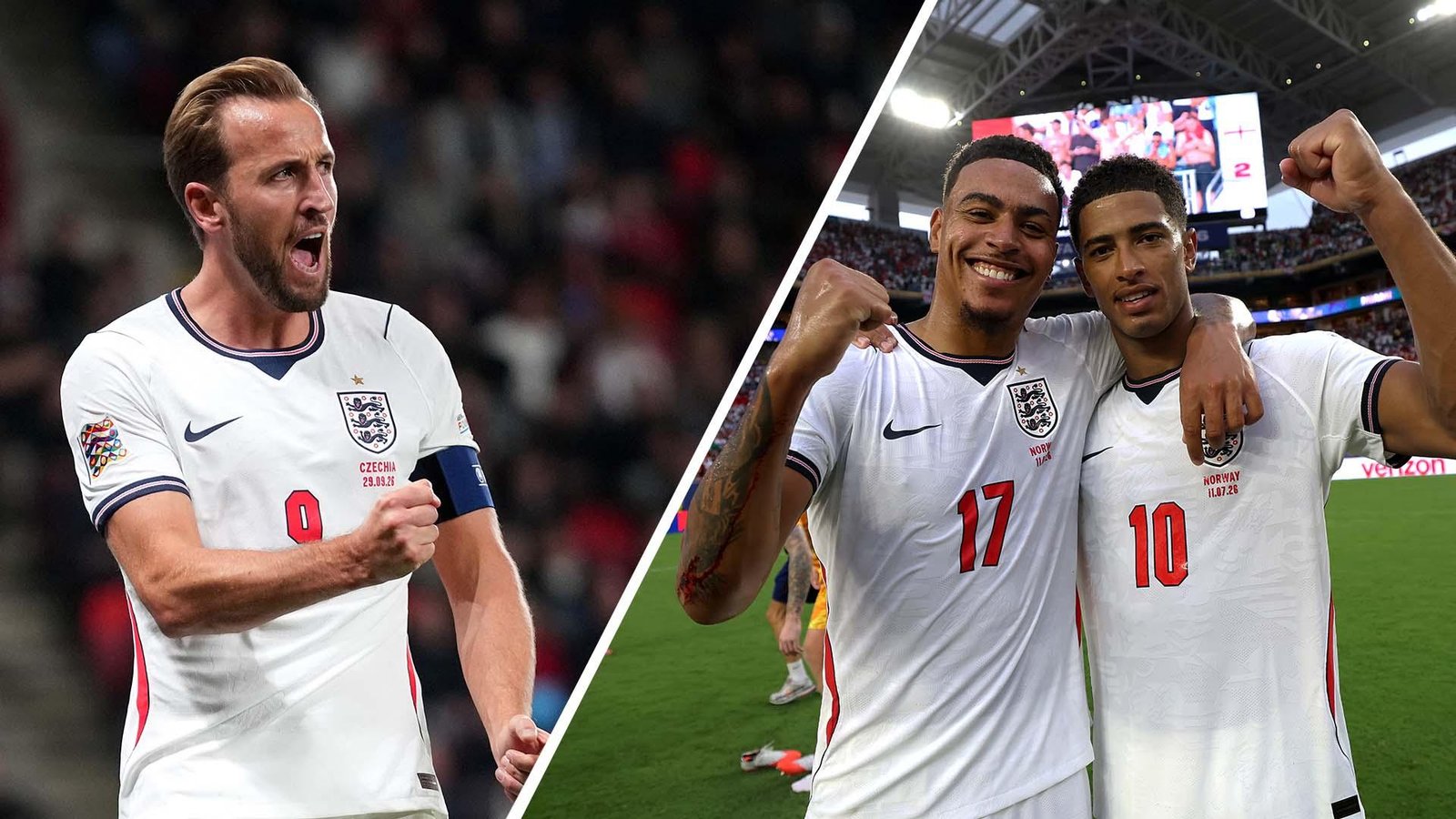
Harry Kane has built a compelling case for the Ballon d’Or through a goalscoring record that places him among the most productive forwards of his generation. Since moving from Tottenham Hotspur to Bayern Munich in 2023, the England captain has taken his game to another level, combining remarkable finishing with consistent performances across domestic and European competitions.
Kane’s numbers are particularly striking during the period being considered for this year’s award. Between August 3, 2025, and July 19, 2026, he scored 73 goals in 65 appearances, including his contributions for England. That extraordinary return puts him in a strong position in a debate often shaped by team success, individual brilliance and performances on the biggest stages.
The question is whether those numbers will be enough to make Kane the fifth Englishman to win the Ballon d’Or. His scoring record offers a powerful argument, but voters must also consider the strength of his competition, the quality of opposition and the influence players have beyond their goal totals.
Harry Kane’s best goalscoring season yet
Kane’s 2025-26 campaign represented a new high point in his club career. He scored 17 more goals than his previous best season, which he recorded during his first campaign in Germany. The improvement highlights how effectively he has adapted to Bayern Munich’s attacking system and continued to refine his game in his thirties.
His overall total becomes even more impressive when his England appearances are included. Kane finished the specified period with 73 goals in 65 matches, placing him among the most prolific players of the modern era.
Since 2000, only Lionel Messi has produced a higher scoring total across a comparable season in the figures provided. Messi scored 82 goals in 69 appearances for Barcelona and Argentina during the 2011-12 campaign, a record-breaking season that remains one of football’s most extraordinary individual achievements.
Kane’s total does not surpass Messi’s benchmark, but the comparison illustrates the scale of his accomplishment. Scoring 73 times across club and international football requires not only clinical finishing but also availability, consistency and the ability to maintain a high standard over a demanding schedule.
It is also important to distinguish between Kane’s club-only production and his combined total. His 73 goals include England appearances, while comparisons between different players can become misleading when competitions, match totals and counting periods do not align perfectly. Nevertheless, the figure demonstrates that Kane has delivered at an elite level across multiple settings.
Harry Kane’s goalscoring record at Bayern Munich
Kane’s impact in Germany has been immediate and sustained. He has scored 158 goals in 156 appearances for Bayern Munich since joining the club in 2023. That return means he has scored slightly more than one goal per appearance across all competitions, an outstanding rate for a forward operating against domestic and European opposition.
His Bundesliga record is equally notable. Kane averages 1.05 goals per game in Germany’s top division, a rate that compares favourably with two of the most celebrated strikers in Bayern’s history: Gerd Müller and Robert Lewandowski.
Müller scored 365 Bundesliga goals during his career, while Lewandowski finished with 312. Their totals remain substantially higher than Kane’s current tally, reflecting their much longer records in the competition. However, the scoring rates supplied for the three players show Kane ahead of both former Bayern stars.
| Player | Bundesliga goals | Average goals per game |
|---|---|---|
| Harry Kane | 158 | 1.05 |
| Gerd Müller | 365 | 0.86 |
| Robert Lewandowski | 312 | 0.81 |
Note: The totals and scoring rates reflect the figures supplied for this comparison and may cover different stages of each player’s career.
The distinction between a career total and a scoring rate matters. Müller and Lewandowski built their records over many seasons, while Kane’s Bundesliga career is still comparatively short. His current average does not guarantee that he will maintain the same rate over a longer period, but it shows how productive he has been since arriving in Germany.
There is also a wider debate about the relative difficulty of scoring in the Bundesliga compared with the Premier League. Kane previously played for Tottenham Hotspur in England, where he regularly faced some of Europe’s strongest defences. Critics may argue that his German numbers benefit from the different competitive environment at Bayern.
That argument deserves consideration, but it does not erase the significance of his achievements. Bayern must still navigate domestic title challenges, cup competitions and European fixtures. Kane’s production across those competitions suggests that his success is not simply a product of facing weaker Bundesliga opponents.
Kane’s domestic dominance in the Bundesliga
One of the clearest ways to assess Kane’s impact is to compare him with the other forwards competing in the same league. During the 2025-26 season, he finished well ahead of his domestic rivals in the race for the Torjägerkanone, the award given to the Bundesliga’s leading scorer.
Kane scored nearly twice as many league goals as Deniz Undav, who finished second in the scoring race. His total also exceeded the combined goals scored by Serhou Guirassy and Patrik Schick, who occupied third and fourth place respectively.
That gap is significant because it shows more than a narrow victory in a statistical contest. Kane created substantial distance between himself and other established Bundesliga forwards, making his scoring record one of the defining individual performances of the season.
A striker’s influence, however, should not be measured by goals alone. Kane registered eight assists during the period, demonstrating that he could also contribute to Bayern’s attacking play by creating opportunities for teammates.
Combining his goals and assists gives Kane an average of 1.32 goal contributions per appearance in 2025-26. That figure captures more of his overall attacking influence than his scoring total on its own.
Kane’s ability to contribute as both a finisher and a creator is particularly valuable against opponents who defend deep or focus their attention on stopping him. Rather than relying exclusively on runs behind the defence, he can participate in build-up play, link with teammates and help create space for other attackers.
This versatility strengthens his Ballon d’Or argument. While goals remain the most visible measure of a forward’s effectiveness, a player who consistently creates chances as well as finishing them can influence matches in several different ways.
Success beyond the Bundesliga
Kane’s case is not restricted to his domestic league performances. He also finished as the top scorer in the German Cup, adding another competition to a season defined by regular goalscoring. Cup football can present different challenges from league matches because a single poor performance can end a team’s campaign.
His Champions League record was similarly impressive. Kane finished second to Real Madrid’s Kylian Mbappé in the competition’s scoring chart, placing him among Europe’s leading forwards in the tournament that attracts intense attention from Ballon d’Or voters.
European performances can carry particular weight in individual award discussions because they provide opportunities to judge players against opponents from different leagues and tactical systems. A strong domestic scoring record demonstrates consistency, while Champions League production offers another measure of how effectively a player performs against elite competition.
Kane’s results across the Bundesliga, German Cup and Champions League therefore make his season more substantial than a league-only assessment would suggest. His output across competitions also reduces the risk of evaluating his campaign through a single competition or a small sample of matches.
International football adds another dimension. Kane’s England goals contributed to his total of 73 during the specified award period. International performances can influence public perception and the award debate, although their significance depends on the opposition, the stakes and the player’s contribution to the team’s results.
How Kane compares with Ballon d’Or rivals Kylian Mbappé and Lamine Yamal
Kane’s main competition for the Ballon d’Or includes Mbappé and Lamine Yamal, two players whose performances and reputations give them strong claims of their own. Each offers a different profile, making the comparison more complicated than simply ranking their goal totals.
Mbappé has long been one of the world’s most dangerous attacking players. His pace, movement and ability to create chances for himself make him a constant threat in transition and around the penalty area. He also outscored Kane at the World Cup, according to the supplied account, as France and England both reached the semifinal stage.
That international comparison is relevant because major tournaments can have an outsized influence on the Ballon d’Or conversation. Performances in a World Cup create memorable moments and allow players to demonstrate their quality in high-pressure matches. A tournament can therefore shape the narrative around an individual award even when the wider season’s numbers tell a more complicated story.
Yamal presents a different challenge. His technical ability, creativity and influence in attacking areas make him a serious contender, while Spain’s World Cup success strengthens his credentials. The supplied figures state that he scored for his country only once during the year, but international goals are just one part of his contribution and should not be treated as a complete measure of his value.
Comparing Kane with Yamal also requires some care because they occupy different attacking roles. Kane is an experienced centre-forward whose main responsibility is to convert chances and lead the line. Yamal operates in wider attacking areas and can influence games through dribbling, chance creation and progression of the ball.
Mbappé, meanwhile, combines the responsibilities of a goalscorer with the ability to attack space and create opportunities through individual acceleration. The three players can therefore be assessed using shared measures, such as goals and assists, while still recognising that their tactical roles are not identical.
On pure goalscoring volume, Kane’s 73-goal return gives him an outstanding argument. Yet the Ballon d’Or is not formally a prize awarded solely to the player with the most goals. Team achievements, performances in major competitions, individual influence and the overall quality of a player’s season can all affect how voters assess the leading candidates.
Could Harry Kane become the fifth English Ballon d’Or winner?
Kane’s season puts him in contention to become the fifth Englishman to win the Ballon d’Or. His goalscoring record offers a straightforward headline: 73 goals in 65 appearances over the specified period, alongside leading performances in Germany’s domestic competitions and a strong Champions League campaign.
His case is strengthened by the scale of the gap between him and his Bundesliga rivals. Finishing nearly twice as far ahead as the league’s second-highest scorer is a powerful indicator of individual dominance. His eight assists and average of 1.32 goal contributions per appearance also show that his influence extended beyond finishing moves.
Nevertheless, the award remains a judgement of an entire season rather than a statistical calculation. Kane’s opponents, Bayern’s achievements, England’s performances and the campaigns of Mbappé, Yamal and other contenders will all contribute to the final debate. A prolific scoring record can make a player a leading candidate without guaranteeing victory.
For Kane, the significance of this season goes beyond the prospect of individual recognition. His output reinforces his reputation as one of the world’s most reliable centre-forwards and demonstrates that his move to Bayern has helped him reach a new level of production.
Verdict: Do Kane’s numbers make him the Ballon d’Or favourite?
If goalscoring is the principal criterion, Kane has a formidable case. His 73 goals across 65 appearances, his record-breaking club season and his superiority over the Bundesliga’s other leading scorers make his campaign exceptional. His production in the German Cup and Champions League further strengthens the argument that he delivered across multiple competitions.
The comparisons with Müller and Lewandowski also provide useful context. Kane’s overall Bundesliga tally remains below those Bayern legends, but his current goals-per-game rate is higher than the figures supplied for either player. It is an indication of the extraordinary efficiency he has displayed since arriving in Germany.
Whether that translates into the Ballon d’Or will depend on how voters weigh individual statistics against team success, major-tournament performances and the contributions of rival candidates. Mbappé and Yamal have their own strengths, and neither can be dismissed simply because Kane has scored more goals.
Even with those caveats, Kane’s numbers make him one of the strongest candidates in the conversation. His season combines remarkable volume, consistency across competitions and meaningful contributions as both a scorer and a creator. If the award debate places heavy emphasis on decisive attacking output, the England captain’s claim will be difficult to ignore.
For breaking news and live news updates, like us on Facebook or follow us on Twitter and Instagram. Read more on Latest Football on thefoxdaily.com.






COMMENTS 0