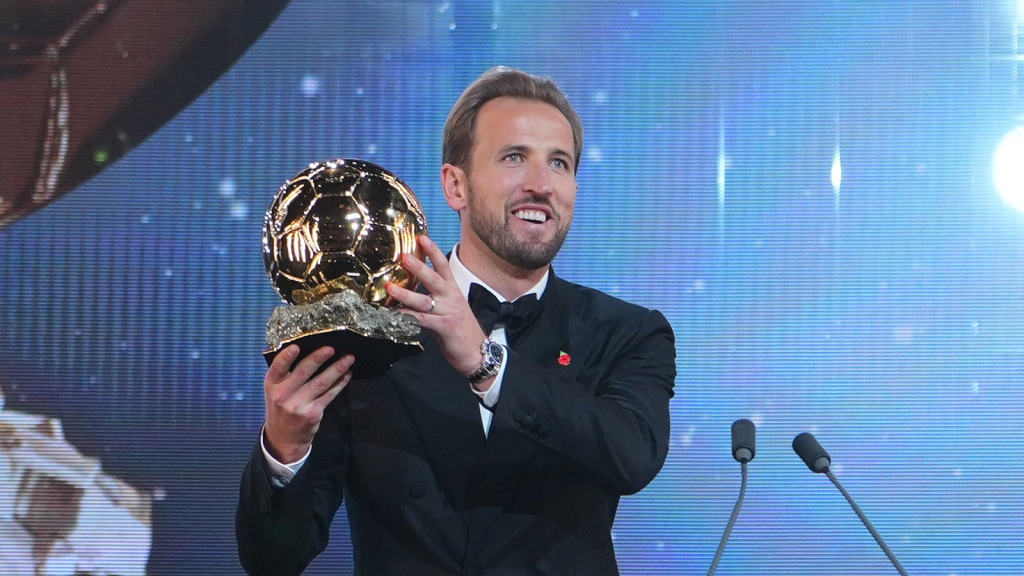
Harry Kane has reached the summit of individual Football recognition, winning the men’s Ballon dâOr ahead of France international Kylian Mbappé and Spanish sensation Lamine Yamal. The England captain and Bayern Munich striker secured the coveted award after a season defined by exceptional goalscoring, silverware and performances in some of football’s biggest competitions.
Kane’s reported achievement also carries historical significance for English football. He becomes the fifth Englishman to win the men’s Ballon d’Or and the first player from England to receive the honour in 25 years. His success places him among a select group of English footballers recognised as the outstanding individual performer in a particular season.
His campaign combined prolific scoring for club and country with success in German domestic competitions. Kane scored 73 goals across club and international football, led Bayern Munich to the Bundesliga and DFB-Pokal titles, and helped the German club reach the Champions League semi-finals. His performances for England further strengthened his case, adding to his growing legacy as one of the country’s most productive forwards.
Mbappé finished second in the men’s award race, while Barcelona forward Yamal placed third. Their positions underline the competitive nature of the contest, which brought together established international stars and one of European football’s most closely watched young talents.
For Kane, the recognition represents more than a celebration of goals. It also highlights a career built through persistence, adaptation and sustained improvement after a less direct route to the top of professional football.
Harry Kane’s 73-goal season explains why he won the Ballon d’Or
The strongest argument for Kane’s Ballon d’Or victory is the scale and consistency of his goalscoring. Across the 2025-26 season, he recorded 73 goals in 65 appearances for Bayern Munich and England, establishing himself as one of the most productive players in European football.
His total included 61 goals for Bayern and another 12 for England. These numbers demonstrate how effectively Kane translated his club form into international performances rather than relying on one competition to build his case for the award.
At Bayern, Kane became the focal point of an attack capable of producing goals across domestic and European competitions. His finishing helped the club secure the Bundesliga title and the DFB-Pokal, while his performances in the Champions League kept Bayern competing among Europe’s leading teams.
The importance of his season becomes clearer when goalscoring is considered alongside team success. Individual awards often involve players whose statistics are impressive but whose teams struggle to win major trophies. Kane combined exceptional personal production with silverware, giving voters a compelling combination of individual achievement and collective success.
Breaking down Kane’s goalscoring record
| Category | Achievement |
|---|---|
| Total appearances for club and country | 65 |
| Total goals for club and country | 73 |
| Goals for Bayern Munich | 61 |
| Goals for England | 12 |
| Major domestic trophies with Bayern | Bundesliga and DFB-Pokal |
| Champions League campaign | Semi-final appearance |
These figures help explain the scale of Kane’s achievement. His 73 goals across 65 appearances amount to more than one goal per match on average, an extraordinary return for a player operating at the highest level of club and international football.
The numbers also show why the award cannot be understood solely through league statistics. Kane contributed throughout the season, including in European competition and international fixtures, giving his candidacy a broad foundation.
Although goals are not the only measure of a footballer’s influence, they remain a central part of a striker’s responsibilities. Kane’s ability to deliver them consistently, while helping his teams win important matches, made his campaign particularly persuasive.
How Kane helped Bayern Munich win the Bundesliga and DFB-Pokal
Kane’s individual recognition is closely connected to Bayern Munich’s domestic success. The club won both the Bundesliga and the DFB-Pokal during the 2025-26 season, giving the England captain a domestic double to accompany his outstanding scoring record.
The Bundesliga title reinforced Bayern’s position among Germany’s dominant clubs. Winning the league requires consistency across a long schedule, where teams must manage injuries, changes in form and different tactical challenges. Kane’s sustained contribution gave Bayern a dependable source of goals throughout that campaign.
The DFB-Pokal added a different test. Unlike the league, where teams can recover from an occasional disappointing result, a domestic cup is decided through knockout matches. One poor performance can end a club’s hopes of winning the competition.
Kane delivered a memorable performance in the cup final, scoring a hat-trick as Bayern defeated Stuttgart. That display helped the Munich club end its five-year wait for another DFB-Pokal title and provided a defining moment in Kane’s season.
Why the domestic double strengthened his Ballon d’Or case
Winning two major domestic trophies gave Kane’s campaign a tangible outcome beyond personal statistics. Bayern benefited directly from his finishing, while the forward gained the opportunity to demonstrate his influence in matches where a trophy was at stake.
That distinction matters when assessing individual awards. A player can accumulate goals against a wide range of opponents, but performances in decisive matches often shape how a season is remembered. Kane’s cup-final hat-trick provided an especially clear example of his ability to influence a major occasion.
Bayern’s success also created a strong platform for his European campaign. The club reached the Champions League semi-finals, demonstrating that its season extended beyond domestic competition. Although Bayern did not complete a continental treble, its league and cup achievements gave Kane a substantial team-based accomplishment to accompany his individual numbers.
For the club, his Ballon d’Or victory is also a significant recognition of its attacking strength. Kane’s achievement reflects both his individual quality and the environment in which Bayern helped him produce consistently at the highest level.
Kane’s World Cup performances strengthened his international reputation
Kane’s performances for England added another important dimension to his Ballon d’Or campaign. The national team captain scored six goals at the 2026 FIFA World Cup, helping England secure a third-place finish.
The result represented England’s best World Cup finish since winning the tournament in 1966. It gave the national team a significant achievement on the international stage and placed Kane at the centre of a campaign that extended his influence beyond Bayern Munich.
His six goals also carried individual historical significance. Kane surpassed Gary Lineker to become England’s leading goalscorer in World Cup history, strengthening his position in the national team’s record books.
International tournaments present different demands from club football. Players have less time to prepare with their teammates, face opponents from different footballing traditions and operate under the pressure of elimination matches. Kane’s scoring record at the tournament demonstrated his ability to remain productive in that environment.
Why international performances matter in individual awards
Ballon d’Or voters assess players across a season rather than considering only one competition. Major international tournaments can therefore influence the conversation, particularly when a player combines a strong club campaign with meaningful contributions for their country.
Kane’s six World Cup goals gave his candidacy additional weight. His England performances were not simply an extension of his Bayern statistics; they represented a separate set of challenges in which he continued to produce at a high level.
His role as captain also made him one of the central figures in England’s tournament campaign. While leadership is difficult to quantify through statistics alone, his goals provided a measurable contribution to the team’s progress.
England’s third-place finish did not amount to a World Cup title, but it still represented a significant team achievement. Combined with Kane’s domestic double and Champions League semi-final appearance, it completed a season in which he delivered across several major competitions.
Harry Kane’s difficult journey makes the Ballon d’Or victory more meaningful
Beyond the statistics, Kane’s acceptance speech offered insight into how he views his career. The England captain spoke about hard work, resilience, determination and self-belief, describing a journey that did not take him directly to the top.
“My journey wasn’t straightforward. I wasn’t the kid who went straight to the top. I had to experience the downs,” Kane said.
His comments reflect a career in which sustained improvement has been central to his progress. Kane developed into one of England’s most productive forwards after working his way through professional football rather than immediately establishing himself among its biggest stars.
He spent years building his reputation in English football before moving to Bayern Munich in 2023. The transfer represented a major change, taking him from Tottenham Hotspur to one of Europe’s most successful clubs and placing him in a different domestic competition.
The move also created a new challenge. Kane had already established himself as a prolific scorer in England, but he needed to adapt to German football while meeting the expectations associated with joining Bayern. His subsequent goalscoring record and domestic success demonstrated how effectively he made that transition.
His Ballon d’Or victory therefore represents a culmination of several stages in his career. The award recognises the season’s achievements, but it also provides a broader perspective on a player who continued to develop after becoming an established international star.
From established Premier League striker to global award winner
Kane’s rise is particularly notable because his reputation was built over several seasons rather than through one sudden breakthrough. His goalscoring at Tottenham established him as a leading Premier League forward, while his England performances made him a central figure in the national team.
Moving to Bayern gave him a new competitive setting in which to pursue major trophies. The Bundesliga and DFB-Pokal victories addressed an important part of his career by adding significant club honours to his individual accomplishments.
Winning the Ballon d’Or now places him among football’s most distinguished individual award winners. It also demonstrates that his achievements in Germany have been recognised beyond the Bundesliga, reaching the wider international football community.
Alexia Putellas wins the Women’s Ballon d’Or
Kane was not the only major winner at the Ballon d’Or ceremony. Spain international and Barcelona forward Alexia Putellas claimed the Women’s Ballon d’Or, ending Aitana Bonmatí’s recent run of victories in the award.
Putellas prevailed over Barcelona teammate Ewa Pajor and Jamaica international Khadija Shaw, who plays for Manchester City. Her victory added another major individual honour to a career already associated with success at club and international level.
The result also highlighted Barcelona’s continuing presence in elite women’s football. Putellas and Pajor represented the same club in the award race, while Bonmatí’s previous success demonstrated the strength of the team’s recent generation of players.
Putellas had previously won the Women’s Ballon d’Or in 2021 and 2022. Her latest victory therefore represents a return to the top of the individual awards after Bonmatí’s successive wins in 2023 and 2024, with Bonmatí also winning in 2025.
Her achievement is significant in its own right rather than simply being a counterpart to Kane’s men’s award. The women’s game has developed a growing international audience, and the Ballon d’Or provides a prominent platform for recognising performances across its leading competitions.
The contrast between the two winners also illustrates how individual awards can reflect different forms of excellence. Kane’s campaign was defined by his remarkable goalscoring output and Bayern’s domestic double, while Putellas’s recognition adds another chapter to her record as one of the most successful players of her generation.
Harry Kane vs Kylian Mbappé and Lamine Yamal: What separated the contenders?
Kane’s victory came ahead of two high-profile rivals whose performances made them major contenders for the men’s award. Mbappé, the France international forward playing for Real Madrid, finished second, while Barcelona’s Spanish forward Yamal placed third.
The result reflects the different strengths represented in the race. Kane’s case was built around a remarkable goalscoring total, domestic trophies and his contribution to England’s World Cup campaign. Mbappé brought his own reputation as one of the world’s leading forwards, while Yamal represented a younger generation already competing at the highest level.
Comparing the three players solely through their positions in the final ranking would overlook the different roles they perform and the circumstances surrounding their seasons. The Ballon d’Or is an individual award, but the performances being assessed take place within teams, competitions and tactical systems that can differ substantially.
Kane’s 73 goals provide a particularly clear measure of his season’s output. His domestic double supplies additional evidence of success, while his six World Cup goals strengthen the international part of his record.
Mbappé’s second-place finish and Yamal’s third-place position nevertheless underline the strength of the competition. Both players remain significant figures in European football, and their presence among the leading contenders shows that Kane’s victory came in a field featuring established stars and emerging talent.
Why Kane’s victory stands out historically
Kane becomes the fifth Englishman to win the men’s Ballon d’Or, following Stanley Matthews in 1956, Bobby Charlton in 1966, Kevin Keegan in 1978 and 1979, and Michael Owen in 2001. His victory ends England’s 25-year wait for another winner.
The historical comparison is especially relevant because the award has frequently recognised players from countries and clubs with strong records in European football. Kane’s success restores an English name to the top of the list after a generation without an English men’s winner.
His victory also has significance for the Bundesliga. Bayern’s domestic success and Kane’s individual recognition have brought attention to the German league’s ability to produce a Ballon d’Or winner, an honour last achieved by a player from the German top flight in 1996, when Borussia Dortmund’s Matthias Sammer received the award.
For Bayern, the achievement reinforces the club’s standing as a destination for players competing for major honours. For English football, it provides a landmark moment for a captain whose career has combined domestic consistency, international goals and a late-career move that delivered major trophies.
What Harry Kane’s Ballon d’Or win means for his legacy
Kane’s award adds an important distinction to a career already defined by goalscoring records and international leadership. His achievements for England and Bayern have established him as one of the most influential forwards of his generation, and the Ballon d’Or now places him among the sport’s most recognised individual winners.
The award does not erase the challenges he has faced or automatically settle every debate about the greatest players of his era. Instead, it recognises the quality of a particular season in which his personal production and team success aligned exceptionally well.
His 73 goals, Bayern’s domestic double and England’s third-place World Cup finish form the central evidence behind that recognition. The Champions League semi-final appearance added another major competition to his campaign, even though Bayern did not win the European trophy.
Looking ahead, the challenge for Kane will be to maintain the standards that brought him this recognition. Individual awards can mark a peak, but a player’s longer-term standing is shaped by continued performance, major results and the ability to remain influential across different stages of a career.
For Bayern Munich, his success offers a powerful individual milestone to accompany its domestic achievements. For England, it ends a quarter-century wait for a men’s Ballon d’Or winner. And for Kane himself, it provides formal recognition of a season in which his goalscoring reached an extraordinary level.
Harry Kane’s Ballon d’Or victory is ultimately a story of sustained excellence rather than a single moment of brilliance. By combining 73 goals with major trophies and an influential World Cup campaign, the Bayern Munich striker built a compelling case for the award and secured his place among the select group of Englishmen to receive football’s most prestigious individual honour.
For breaking news and live news updates, like us on Facebook or follow us on Twitter and Instagram. Read more on Latest Football on thefoxdaily.com.






COMMENTS 0