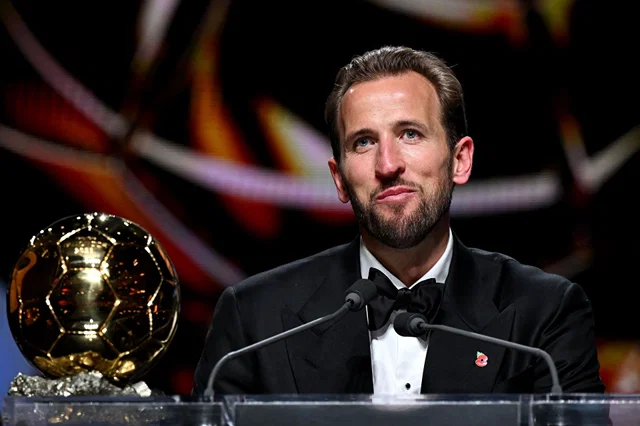
Samir Nasri has questioned Harry Kane’s 2026 Ballon dâOr victory, arguing that the Bayern Munich striker’s impressive statistics do not tell the full story of his season. Despite Kane’s remarkable goal-scoring record and success in domestic competitions, the former Arsenal midfielder believes the England captain has not consistently demonstrated the ability to lead his team to victory in the biggest matches.
Kane won the Ballon d’Or at a ceremony held at the London Palladium on Monday night, finishing ahead of Kylian Mbappé and Lamine Yamal. The result made him the first Englishman to claim football’s most prestigious individual award since Michael Owen won it in 2001.
The 70th edition of the ceremony paid tribute to Stanley Matthews, the inaugural winner of the award in 1956. Kane also received the Striker of the Year award, further recognising his outstanding performances in front of goal.
However, Kane’s historic achievement has not convinced everyone. Nasri has questioned whether individual statistics should carry so much weight when deciding the winner, suggesting that performances in crucial matches and the ability to make a decisive difference for a team should also be considered.
Samir Nasri Questions Harry Kane’s Ballon d’Or Victory
Nasri acknowledged Kane’s exceptional qualities but argued that the striker’s record does not necessarily demonstrate the kind of influence expected from a Ballon d’Or winner. Speaking on Canal+, the former France international suggested that Kane’s statistical achievements played the decisive role in the voting.
Nasri’s criticism centred on Kane’s perceived inability to carry his team through the most important moments of a season. Although he praised the Bayern Munich forward’s overall ability, he questioned whether Kane had consistently delivered when his team needed him most.
“Harry Kane, Ballon d’Or…okay, the statistics made the difference. He’s a fantastic player with so many qualities. But he’s never been the player who carried his team somewhere or made his team win in the very big matches.”
Nasri continued by suggesting that there was a recurring weakness in Kane’s performances, while making it clear that his criticism did not diminish his appreciation of the striker’s talent.
“There’s often a slight weakness. But he’s an extraordinary player.”
The comments highlight a familiar debate surrounding football’s biggest individual award: should the Ballon d’Or primarily reward statistics and consistency, or should decisive performances in high-pressure matches carry greater importance?
Kane’s supporters can point to his extraordinary goal tally and the trophies he won with Bayern Munich. Nasri, however, believes those achievements do not automatically establish that Kane was the player most deserving of the award.
Nasri Admits He Was Not Excited About the Winner
Nasri’s reaction suggested that his reservations extended beyond a technical disagreement about how the Ballon d’Or should be judged. When asked whether he was excited by this year’s winner, the former Arsenal and Manchester City midfielder responded bluntly.
“No, that’s an understatement.”
His response made his disappointment with the outcome clear. While Nasri recognised Kane as an extraordinary footballer, he was unconvinced that the England captain had done enough in the most significant matches to justify receiving the award ahead of his rivals.
The distinction is important because Nasri did not dismiss Kane’s ability or suggest that his goals were insignificant. Instead, his argument focused on the relationship between individual production and a player’s overall influence on team success.
For Kane, the award represents a major personal milestone after years of establishing himself as one of Europe’s most prolific forwards. For critics such as Nasri, however, the question remains whether his performances in decisive encounters were strong enough to place him above the other leading contenders.
Harry Kane’s Record-Breaking Season at Bayern Munich
Kane’s statistical achievements provide a powerful argument in favour of his Ballon d’Or success. The Bayern Munich striker scored 61 goals in 51 games for the German club, setting a new record for the most goals scored by a player in a single season in Bayern’s history.
His contribution was not limited to club football. Across club and international appearances, Kane recorded 73 goals in 65 appearances, underlining his consistency throughout the campaign.
Those numbers helped establish Kane as one of the most productive forwards in world football during the season under consideration. His finishing ability, movement in the penalty area and capacity to convert scoring opportunities made him a central figure in Bayern’s attacking performances.
Kane also helped Bayern Munich win the Bundesliga and the DFB-Pokal last season. Winning domestic silverware alongside producing such a substantial goal tally strengthened his case for football’s most prestigious individual honour.
His supporters can therefore argue that the Ballon d’Or recognition reflected more than statistics alone. Kane combined prolific scoring with team success, delivering performances that contributed to Bayern’s achievements across domestic competitions.
Nevertheless, Nasri’s comments demonstrate that even a record-breaking campaign can be interpreted differently depending on the criteria used to judge individual excellence. While Kane’s goal tally is difficult to overlook, the former France international believes his influence in the biggest games should have been examined more critically.
Vincent Garcia Reveals How Close the Ballon d’Or Race Was
The competition for the 2026 Ballon d’Or was reportedly extremely close, with Kane finishing ahead of Kylian Mbappé, who secured second place. The narrow margin added another layer of intrigue to the debate surrounding the final result.
Vincent Garcia, editor-in-chief of France Football, described the contest between Kane and Mbappé as exceptionally tight. According to Garcia, the difference between the two candidates was even smaller than the margin separating Rodri and Vinicius Junior in the 2024 Ballon d’Or race.
The closeness of the voting suggests that the final outcome was not necessarily an overwhelming endorsement of one candidate over the other. Instead, it reflects how closely matched the leading contenders were in the eyes of the voters.
When the competition is so tight, the criteria used to assess players become particularly important. Goal contributions, trophies, consistency and performances in decisive matches can all influence how voters compare candidates whose seasons may have been outstanding in different ways.
In Kane’s case, his extraordinary scoring record and domestic achievements provided a strong foundation for his candidacy. Mbappé’s second-place finish, meanwhile, indicates that he remained a serious contender for the award.
Garcia’s comments help explain why the result has attracted attention and criticism. A small difference in voting can separate two elite players, leaving room for disagreement over which achievements should carry the greatest weight.
Guti Also Questions Kane’s Ballon d’Or Win
Nasri was not the only former footballer to express dissatisfaction with Kane winning the 2026 Ballon d’Or. Real Madrid legend Guti also questioned the result, raising concerns about the ceremony being held in London and the award going to a London-born player.
Speaking on the Spanish television programme El Chiringuito, Guti suggested that the circumstances surrounding the ceremony were an extraordinary coincidence. He also argued that two of Kane’s rivals were more deserving of the honour.
“It’s quite a coincidence that they take the 70th anniversary Ballon d’Or ceremony to London and someone from London wins it. What a coincidence, right? An incredible coincidence. Lamine and Mbappé deserved it more.”
Guti’s remarks added another critical voice to the discussion surrounding the award. Unlike Nasri, whose argument focused on Kane’s impact in major matches, the former Real Madrid midfielder drew attention to the location of the ceremony and expressed a preference for Lamine Yamal and Mbappé.
His comments reflect the wider disagreement that often follows the announcement of a major individual football award. Even when a winner has impressive statistics and major trophies to his name, supporters of other candidates may believe that alternative performances or achievements deserved greater recognition.
However, Guti’s suggestion about the London ceremony was presented as a coincidence rather than evidence that the location influenced the voting. His central sporting argument was that Yamal and Mbappé were more deserving winners.
Harry Kane Joins an Exclusive List of English Ballon d’Or Winners
Kane’s victory carries considerable historical significance for both English football and Bayern Munich. He became the first Bayern player to win the Ballon d’Or since Karl-Heinz Rummenigge claimed the honour in 1981, ending a wait of several decades for the club.
He also became only the fifth Englishman to win the award, joining an exclusive group that includes Stanley Matthews, Bobby Charlton, Kevin Keegan and Michael Owen.
Matthews was the first-ever Ballon d’Or winner in 1956, establishing a historic connection between the award and English football. Charlton and Keegan later added their names to the list, while Owen became the most recent English winner before Kane when he received the award in 2001.
Kane’s achievement is particularly notable given the sustained scoring performances that have defined his career. His record-breaking season at Bayern Munich, combined with domestic trophy success, provided the platform for him to secure the honour.
For Bayern, the result also represents recognition of a player whose goal-scoring contribution helped the club achieve success in Germany. For England, Kane’s victory ends a 25-year wait for another player from the country to win football’s most prominent individual prize.
Can Statistics Alone Decide the Ballon d’Or?
The criticism from Nasri and Guti has reopened the debate about what the Ballon d’Or should reward. Kane’s numbers make a compelling case: 61 goals in 51 appearances for Bayern Munich, 73 goals across 65 club and country appearances, and victories in the Bundesliga and DFB-Pokal.
Those achievements demonstrate both individual productivity and team success. In a sport where goals often determine the outcome of matches, a striker who scores at Kane’s rate naturally becomes a strong candidate for individual recognition.
However, critics argue that goal totals do not always capture a player’s influence in the moments that matter most. A footballer can produce outstanding statistics over an entire season while still facing questions about performances in the biggest matches.
That is the distinction Nasri attempted to make in his assessment of Kane. He acknowledged the striker’s exceptional quality but questioned whether he had consistently carried his team or made the difference in crucial encounters.
Guti’s preference for Yamal and Mbappé adds another perspective to the discussion, demonstrating that different observers can evaluate the same award race according to different priorities.
Ultimately, the Ballon d’Or combines individual performances, team achievements and the judgment of voters. There is rarely a single statistic that can settle every debate, particularly when several candidates have produced outstanding seasons.
Kane’s historic victory confirms his place among the game’s most celebrated players. Yet the reactions from Nasri and Guti show that the award has not ended the argument over who truly deserved to finish first in 2026. While Kane’s record-breaking output and silverware make his case difficult to dismiss, his critics remain unconvinced that he delivered enough in the biggest matches to establish himself as the clear choice.
For breaking news and live news updates, like us on Facebook or follow us on Twitter and Instagram. Read more on Latest Football on thefoxdaily.com.






COMMENTS 0