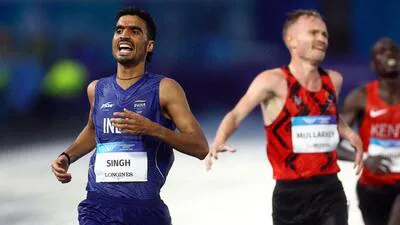
The Commonwealth Games 2026 in Glasgow presented one of the most unusual editions in the event’s history. A significantly reduced competition schedule, only 10 sports on the program, and the exclusion of several disciplines that traditionally produced India’s biggest medal hauls created a challenging environment for every participating nation. Yet, despite these limitations, India once again demonstrated its resilience by finishing fourth in the overall medal standings with 39 medals—13 gold, 17 silver, and 9 bronze.
For Indian sports, the achievement extends far beyond medal numbers. It reflects the country’s growing ability to compete across multiple disciplines instead of depending on only a handful of traditional strengths. More importantly, the Glasgow campaign offers valuable indicators of India’s progress before hosting the 2030 Commonwealth Games in Ahmedabad, where expectations will be considerably higher.
Why India’s Glasgow Performance Deserves Greater Recognition
Looking only at the medal table may not fully capture the significance of India’s campaign. Previous Commonwealth Games editions offered athletes far more opportunities because sports such as wrestling, badminton, table tennis, hockey, cricket and squash were included.
These sports have historically contributed a large share of India’s medals. Their removal drastically reduced the country’s chances of maintaining previous totals.
Under normal circumstances, analysts might have expected India’s medal count to fall sharply. Instead, the contingent adapted remarkably well by producing strong performances in sports that historically received less attention.
The result demonstrates a gradual transformation in India’s sporting ecosystem, where success is increasingly distributed across multiple disciplines rather than concentrated in a few dominant events.
How Glasgow 2026 Was Different From Previous Commonwealth Games
The Glasgow edition was unlike any Commonwealth Games in recent memory. Financial constraints led organizers to significantly reduce the size of the event, leaving only ten sports on the official program.
This meant athletes from several popular disciplines never received an opportunity to compete, directly affecting medal-heavy countries such as India.
| Factor | Previous Commonwealth Games | Glasgow 2026 |
|---|---|---|
| Number of Sports | Much Larger Program | Only 10 Sports |
| Indian Medal Opportunities | Very High | Significantly Reduced |
| Traditional Strengths Included | Most Sports Present | Several Major Sports Removed |
| Competition Format | Standard Multi-Sport Event | Condensed Schedule |
Because of these structural changes, direct comparisons with earlier editions should be made carefully. India’s ability to remain among the leading nations despite fewer opportunities arguably carries greater value than raw medal totals alone.
Sports Missing That Usually Drive India’s Medal Count
Several disciplines that have consistently delivered medals for India were absent from Glasgow.
- Wrestling
- Table Tennis
- Badminton
- Squash
- Hockey
- Cricket
Together, these sports represented a substantial portion of India’s previous Commonwealth Games success.
The absence of these events forced India’s athletes competing in athletics, boxing, weightlifting, judo and para sports to shoulder much greater responsibility.
Boxing Emerged as India’s Biggest Gold Medal Factory
One of the defining stories of Glasgow was the extraordinary performance of Indian boxing.
The boxers contributed seven gold medals, accounting for more than half of India’s total gold medals during the Games. The achievement underlined years of investment in coaching, grassroots development and international exposure.
Women’s boxing proved particularly impressive, with Indian female boxers dominating multiple weight categories. Their consistency highlighted how women’s sport continues to become one of India’s strongest international assets.
While Commonwealth competition varies in overall depth compared to Olympic events, the Glasgow performance nevertheless provides confidence ahead of upcoming Asian and Olympic qualification cycles.
Athletics Continues Its Upward Journey
Perhaps the clearest indication of India’s sporting evolution came from athletics.
Indian athletes secured sixteen medals across athletics events, doubling the previous edition’s tally. Although para athletics contributed significantly after being integrated into the overall medal count, the performances from able-bodied athletes also showcased encouraging progress.
Track and field has historically been one of the toughest global sporting disciplines for Indian athletes due to fierce international competition.
Every medal earned in athletics therefore represents years of systematic improvement in sports science, coaching, infrastructure and athlete preparation.
Gulveer Singh Opens a New Chapter for Indian Distance Running
Among India’s standout performers, Gulveer Singh produced one of the most memorable campaigns.
Distance running has traditionally been dominated by East African nations at major international competitions. Indian runners have often struggled to consistently challenge for podium finishes.
By winning medals in both the 5,000 metres and 10,000 metres, Gulveer demonstrated that Indian endurance running is gradually reaching higher competitive standards.
His achievements may inspire a new generation of middle and long-distance runners who now have proof that medals are achievable at major international championships.
Tejaswin Shankar’s Versatility Shows New Standards of Indian Athletics
Modern athletics increasingly rewards versatility, and Tejaswin Shankar illustrated exactly that.
Competing across multiple disciplines demands exceptional physical conditioning, technical expertise and mental resilience.
Winning another Commonwealth medal despite injury reflects not only individual determination but also the improved support systems now available to elite Indian athletes.
Such performances help redefine expectations for Indian athletes competing beyond their traditional comfort zones.
Indian Javelin’s Continued Rise
Indian javelin throwing has transformed dramatically over the past decade.
At Glasgow, having two Indian throwers standing on the podium emphasized that the country is developing genuine depth rather than relying on a single superstar.
This is particularly encouraging because sustained international success depends on multiple athletes consistently challenging for medals.
Healthy competition within the national setup usually leads to higher performance standards across future championships.
Judo Delivered the Biggest Surprise of the Games
Every major sporting event produces an unexpected storyline, and for India, Glasgow belonged to judo.
Gold medal-winning performances from Indian judokas surprised many observers because the sport has faced administrative instability and developmental challenges domestically.
The breakthrough demonstrates how emerging sports can rapidly improve when athletes receive quality coaching, international competition and institutional support.
If momentum continues, judo could become an important medal source in future multi-sport events.
Weightlifting Remained Reliable Despite Lower Gold Count
Weightlifting has long been among India’s strongest Commonwealth disciplines.
Although the gold medal tally declined compared to previous editions, Indian lifters still contributed valuable medals.
This consistency reflects the sport’s established training systems and talent pipeline.
Maintaining competitiveness even during transitional phases is often a hallmark of mature sporting programs.
Para Athletes Continue Transforming India’s Sporting Landscape
The integration of para sports into the overall medal picture further highlighted India’s growing inclusivity in elite sport.
Indian para athletes have steadily improved over recent years through increased funding, better coaching and greater public recognition.
Their performances in Glasgow reinforced the idea that India’s sporting ambitions now extend well beyond traditional Olympic pathways.
Greater visibility for para sport also encourages broader participation across the country.
India’s Sporting Model Is Becoming More Balanced
One important lesson from Glasgow is that India is becoming less dependent on a handful of sports.
Successful sporting nations usually develop wide medal potential across diverse disciplines.
Countries that rely too heavily on one or two sports often experience dramatic fluctuations whenever event programs change.
India’s ability to remain competitive despite the removal of several favourite disciplines suggests a healthier long-term sporting structure.
What Glasgow Means for the 2030 Commonwealth Games in Ahmedabad
Perhaps the biggest takeaway from Glasgow lies in what comes next.
Hosting the Commonwealth Games offers advantages that extend beyond home crowd support. Athletes benefit from familiar conditions, reduced travel demands and increased public attention.
Governments also tend to accelerate investments in infrastructure, sports science and athlete preparation before hosting major international competitions.
If a broader range of sports returns in 2030, India could realistically challenge for one of its strongest Commonwealth Games performances since New Delhi 2010.
Key Areas India Can Improve Before 2030
- Expand grassroots talent identification.
- Increase investment in sports science.
- Strengthen injury prevention programs.
- Provide greater international competition exposure.
- Improve coaching development across emerging sports.
- Enhance athlete transition pathways from junior to senior competition.
Comparison: Why Glasgow Success May Be More Valuable Than Higher Medal Totals
Winning over 100 medals at home remains one of India’s greatest Commonwealth achievements.
However, Glasgow presented a fundamentally different challenge.
Instead of relying on medal-rich traditional events, athletes had to maximize opportunities in a much smaller sporting program.
That required adaptability, depth and resilience.
Viewed from this perspective, remaining fourth despite significantly fewer medal opportunities may represent one of India’s most strategically important Commonwealth campaigns.
Key Insight: Glasgow 2026 proved that India’s sporting progress is no longer measured only by medal totals. The country’s expanding competitiveness across athletics, boxing, judo and para sports suggests a broader foundation capable of supporting sustained international success.
Future Outlook
The years leading to the 2030 Commonwealth Games will be crucial for Indian sport. Athletes emerging from Glasgow are likely to form the core of future squads, while younger talents will have opportunities to challenge established names.
With continued investment, better domestic competition and stronger high-performance systems, India appears well positioned to strengthen its standing not only in the Commonwealth Games but also across Asian and Olympic competition.
The Glasgow edition should therefore be remembered not as a tournament defined by what was missing, but as one that revealed how much broader India’s sporting potential has become.
Conclusion
India’s fourth-place finish at the Commonwealth Games 2026 represents far more than a respectable medal tally. It showcases the nation’s ability to adapt, compete and succeed even when traditional strengths are unavailable. Breakthrough performances in athletics, boxing, judo and para sports demonstrated the growing depth of Indian sport, while experienced athletes continued to deliver under pressure.
Most importantly, Glasgow has established a strong foundation for the 2030 Commonwealth Games in Ahmedabad. If current progress continues and more sports return to the competition schedule, India will enter the home Games with realistic ambitions of producing one of its greatest Commonwealth performances in history.
For breaking news and live news updates, like us on Facebook or follow us on Twitter and Instagram. Read more on Latest Sports on thefoxdaily.com.






COMMENTS 0