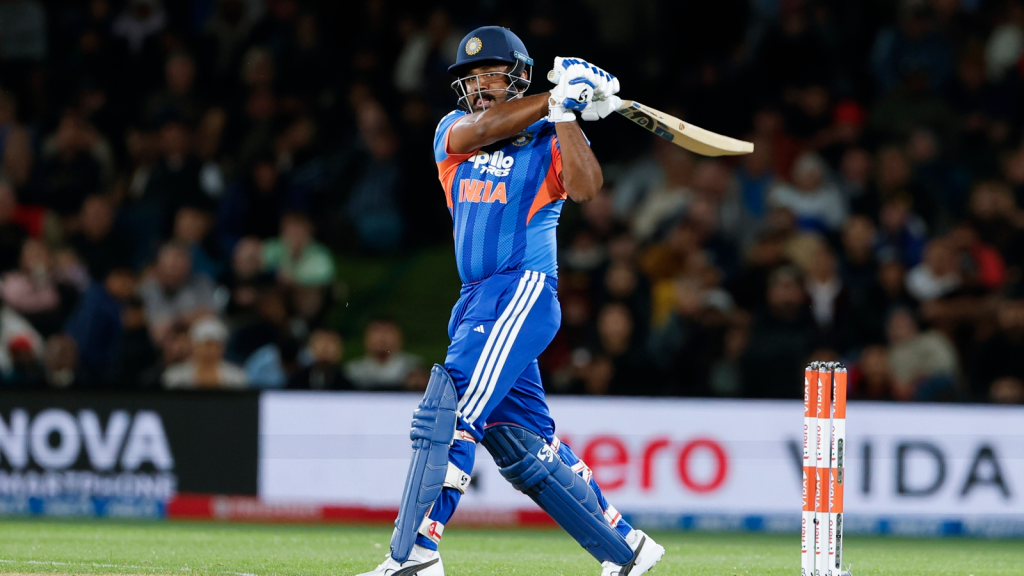
India Beat New Zealand by Four Wickets in First T20I
India Chase Down 226 to Beat New Zealand by Four Wickets in First T20I
India began their five-match T20I series against New Zealand with an impressive four-wicket victory in Christchurch on Thursday, successfully chasing a target of 226 with two balls to spare. Sanju Samson’s half-century provided the foundation for the pursuit, while Naman Dhir delivered a decisive finishing performance to help the visitors take a 1-0 lead in the series.
New Zealand had posted a formidable 225/4 after batting first, powered by an unbeaten 82 off 40 deliveries from Glenn Phillips. A substantial fourth-wicket partnership between Phillips and Bevon Jacobs helped the hosts build a challenging total, but India’s batters responded with an aggressive start and a composed finish to secure the win.
The opening contest featured contrasting performances from both sides. New Zealand demonstrated their ability to accelerate during the latter stages of an innings, while India showed the value of batting depth and partnerships when chasing a demanding target. The result gives the visitors early momentum as the teams prepare for the remaining matches of the series.
New Zealand Post 225/4 After Glenn Phillips’ Unbeaten 82
Batting first, New Zealand finished their innings on 225/4, establishing a target that required India to maintain a strong scoring rate throughout the chase. Glenn Phillips was the standout performer for the hosts, remaining unbeaten on 82 from just 40 balls.
Phillips’ innings gave New Zealand the acceleration they needed to produce a competitive total. His ability to score quickly during the latter stages helped the hosts put pressure on India’s bowling attack and ensured that the home side finished with a score capable of testing the visitors.
A significant portion of New Zealand’s late scoring came through Phillips’ 73-run partnership with Bevon Jacobs for the fourth wicket. The stand helped the hosts maintain their momentum and add valuable runs after losing earlier wickets.
Partnerships are particularly important in T20 cricket because they allow teams to recover from setbacks and build towards a strong finish. Phillips and Jacobs provided that stability for New Zealand, with their fourth-wicket stand helping shape the innings and push the total to 225/4.
Although New Zealand reached a substantial score, India’s successful chase ultimately meant that the hosts could not turn their batting performance into a victory. The result underlined how even a total above 220 can be vulnerable when the chasing team combines an attacking start with effective contributions in the middle and lower order.
Bhuvneshwar Kumar Returns to International Cricket
One of the notable talking points from New Zealand’s innings was Bhuvneshwar Kumar’s return to international cricket after nearly four years away from the international game. However, the outing proved challenging for the experienced bowler, who conceded 49 runs without taking a wicket.
Returning to international cricket after an extended absence can be demanding, particularly in the fast-paced T20 format. Bowlers must quickly adapt to the intensity of the contest, manage their lengths and variations, and respond to batters looking to score at a high rate.
Against a New Zealand batting lineup that produced 225 runs, Bhuvneshwar was unable to make a breakthrough. His figures reflected the pressure created by the hosts, especially during the productive partnership between Phillips and Jacobs.
Despite the difficult outing, a single performance does not determine what a bowler can contribute over the course of a series. India’s bowling unit will look to assess the lessons from the opening match and find ways to limit New Zealand’s scoring opportunities in the next encounter.
Arshdeep Singh, Mayank Yadav and Axar Patel Take One Wicket Each
India’s bowling attack had a mixed outing as New Zealand crossed the 220-run mark. Arshdeep Singh, Mayank Yadav and Axar Patel each claimed a wicket, but the visitors were unable to prevent the hosts from building a substantial total.
Taking wickets is crucial in T20 cricket because it interrupts partnerships and can slow a batting side’s scoring momentum. However, wicket-taking must be balanced with controlling the run rate, particularly when the opposition has batters capable of accelerating during the final overs.
New Zealand’s total suggested that the Indian bowlers faced difficulties containing the hosts across the innings. Phillips’ unbeaten knock and the fourth-wicket stand with Jacobs were particularly influential in helping New Zealand reach 225/4.
India ultimately overcame the challenge with the bat, turning a demanding target into a successful chase. Nevertheless, the bowling performance will offer areas for the team to examine as the series continues, especially when preparing to face a New Zealand batting lineup that can generate rapid scoring through partnerships.
Sanju Samson’s Half-Century Gives India a Strong Foundation
Chasing 226, India needed an assertive start to avoid allowing the required run rate to climb beyond reach. Sanju Samson delivered an important contribution with a half-century, helping the visitors establish a platform for the chase.
Samson’s innings was central to India’s pursuit because chasing a total of 226 demands consistent scoring from the beginning. A strong contribution at the top of the order can ease pressure on the middle order, giving incoming batters more flexibility to balance risk and run-scoring.
His half-century helped India stay in contention as they pursued New Zealand’s total. Rather than relying entirely on a late surge, the visitors were able to build their chase through contributions at different stages of the innings.
In high-scoring T20 matches, a half-century can be valuable not only for the runs it adds but also for the stability it provides. Samson’s performance helped keep India’s target within reach and created an opportunity for the batters who followed to finish the job.
Abhishek Sharma Helps India Attack Early
Abhishek Sharma joined Samson in providing India with an attacking start. The opening approach was important because India were chasing a target that required them to maintain a healthy scoring rate across the innings.
When a team is pursuing more than 220 runs, a cautious start can make the closing overs considerably more difficult. An aggressive opening phase helps establish the tempo and gives the middle order a clearer idea of the scoring rate required to remain on course.
Samson and Abhishek helped India set that tone. Their early intent put the visitors in a position to continue the pursuit, although the challenge remained to maintain momentum and navigate the pressure as the innings progressed.
Their contribution also demonstrated the importance of a clear batting plan in T20 cricket. Chasing a large target requires a team to identify opportunities to score quickly while avoiding a collapse that can undo the work of the opening batters.
Shreyas Iyer and Naman Dhir Finish the Chase
India’s pursuit required a strong finish after the opening batters had helped establish the platform. Shreyas Iyer and Naman Dhir played important roles in the closing stages, with Dhir producing the finishing effort that helped India seal victory.
Closing out a high-scoring chase requires composure as well as attacking intent. Batters must manage the remaining deliveries, keep track of the required rate and avoid giving the opposition an opportunity to regain control through quick wickets.
Dhir’s contribution proved decisive as India reached the target with two balls remaining. His finishing effort ensured that the visitors did not need to take the chase into the final delivery, completing a four-wicket win and securing an early advantage in the series.
The result reflected the combined impact of India’s batting lineup. Samson supplied the half-century, Abhishek helped create an aggressive start, and Iyer and Dhir contributed to the final push. This balance between the opening and closing stages proved crucial against a New Zealand side that had scored 225/4.
What India’s Victory Means for the Five-Match Series
India’s four-wicket win gives them a 1-0 lead in the five-match T20I series and provides a positive start to the contest. An opening victory can help build confidence, particularly when it comes from successfully chasing a challenging target.
The manner of the win will be encouraging for India’s batting group. Chasing 226 required the team to remain committed to its approach, respond to pressure and ensure that the required run rate stayed manageable. Contributions from several batters helped the visitors complete the task.
New Zealand, meanwhile, will have to assess how they can defend a substantial total more effectively. Phillips’ unbeaten 82 and the partnership with Jacobs gave the hosts a strong platform, but India’s batting response meant that their effort was not enough to secure the opening match.
With four matches remaining, the series is still open. New Zealand have an opportunity to respond in the next game, while India will look to build on their early advantage and carry the momentum of their successful chase forward.
India vs New Zealand 1st T20I: Match Summary
| Match Detail | Information |
|---|---|
| Match | India vs New Zealand, 1st T20I |
| Venue | Christchurch, New Zealand |
| New Zealand’s Score | 225/4 |
| Glenn Phillips | 82 not out off 40 balls |
| Phillips-Jacobs Partnership | 73 runs for the fourth wicket |
| Bhuvneshwar Kumar | 49 runs conceded, no wickets |
| Indian Wicket-Takers | Arshdeep Singh, Mayank Yadav and Axar Patel |
| India’s Result | Won by four wickets |
| Chase | Target of 226 reached with two balls remaining |
| Series Score | India lead 1-0 |
Frequently Asked Questions
Who won the first T20I between India and New Zealand?
India beat New Zealand by four wickets in Christchurch, taking a 1-0 lead in the five-match T20I series.
What score did New Zealand post in the first T20I?
New Zealand scored 225/4 after batting first, setting India a target of 226 runs.
How many runs did Glenn Phillips score?
Glenn Phillips remained unbeaten on 82 off 40 balls, helping New Zealand post a competitive total.
Who were India’s wicket-takers?
Arshdeep Singh, Mayank Yadav and Axar Patel each took one wicket during New Zealand’s innings.
How did Sanju Samson contribute to India’s win?
Samson scored a half-century that helped establish the foundation for India’s successful chase of 226.
Who helped India finish the chase?
Shreyas Iyer and Naman Dhir played important roles in the closing stages, with Dhir delivering the finishing contribution as India reached the target with two balls remaining.
Conclusion
India opened their five-match T20I series against New Zealand with a four-wicket victory after chasing down 226 in Christchurch. New Zealand’s 225/4, built around Glenn Phillips’ unbeaten 82 and his 73-run partnership with Bevon Jacobs, presented a formidable challenge.
India answered through Sanju Samson’s half-century, Abhishek Sharma’s aggressive start and the finishing contributions of Shreyas Iyer and Naman Dhir. Completing the chase with two balls to spare gave India an early 1-0 series lead and set up an intriguing contest for the remaining matches.
For breaking news and live news updates, like us on Facebook or follow us on Twitter and Instagram. Read more on Latest Cricket on thefoxdaily.com.






COMMENTS 0