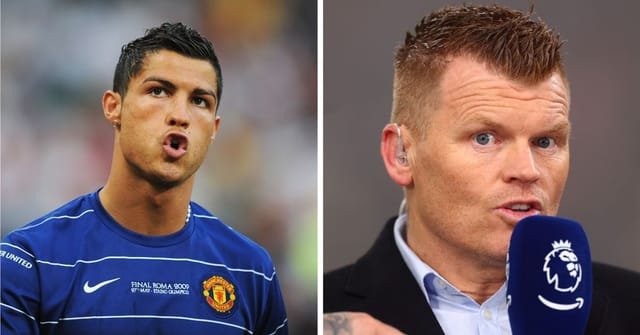
Ask most defenders who played in the Premier League during the mid-2000s which opponent they dreaded facing the most, and Cristiano Ronaldo will be the first name out of most mouths. By the time he had completed his transformation from teenage prodigy to the most devastating attacker in English Football, Ronaldo had become a problem that no full-back had a reliable answer to: pace, power, skill, and a capacity for improvisation that made every defensive setup feel insufficient before he had even touched the ball.
And yet John Arne Riise, the Norwegian left-back who spent seven years at Liverpool and faced Ronaldo multiple times across some of the most competitive Liverpool versus Manchester United fixtures of that era, does not name the Portugal star as the hardest winger he ever faced. That distinction belongs to Arjen Robben. And his explanation for why reveals something genuinely insightful about what makes a winger not just technically excellent, but truly impossible to defend.
The Riise Verdict: Ronaldo Was Brilliant, Robben Was Relentless
Speaking in an exclusive interview with Sporf via World Cup Betting, Riise drew a distinction between the two wingers that goes beyond simple comparison and into the specific psychology of defending against different types of attacking threats:
“When it comes to Cristiano Ronaldo when he was at Manchester United, he was more a winger then, he was obviously difficult to play against because of his pace, but he’d stop the ball still and do tricks. But with Robben, he’d just get the ball and have a go at you. For me, I hated playing against very quick wingers, because it’s hard to stop the pace. Skill-wise, Ronaldo was up there with the best of the best. But as a left-back, it was harder when Robben came at me with the ball. He never stops, inside, outside, shooting, crossing. It was much harder to know what to do when he came at me like that.”
The key phrase is buried in the middle of that quote and deserves to be extracted and examined: “it was much harder to know what to do.” Riise is not saying Robben was more talented than Ronaldo. He is saying that Robben created more defensive uncertainty. And in football, uncertainty is the thing that beats defenders far more often than raw ability.
The Tactical Difference: Why Uncertainty Beats Skill Every Time
To understand why Riise’s assessment is so analytically compelling, it helps to think about what a defender is actually doing when they face a winger one-on-one. The defender’s fundamental goal in that moment is to reduce the attacker’s options to one. Force them onto their weaker foot. Force them inside where covering defenders can help. Force them toward the byline where the angle for a dangerous pass or shot becomes limited. Any defender who can successfully constrain an attacker to a single predictable option has won that individual battle, even if the attacker is technically superior.
The problem with Robben, as Riise describes it, was that he genuinely could not be constrained to a single option. Robben’s ability to cut inside onto his left foot from the right flank was so well-known, so widely anticipated, and so completely unstoppable that it constituted its own tactical problem: even when a defender knew exactly what Robben was going to do, they often could not prevent it. And Robben knew they knew. And he did it anyway. And it still worked.
But Riise’s specific point is that Robben was not only a threat cutting inside. He could go outside too. He could cross. He could shoot from the outside of the box. He could stop and start, change direction, and switch his decision mid-run in a way that made reading him almost impossible. Every time a defender committed to one option, Robben had already identified another.
Ronaldo, during his United years, was a different kind of problem. His stepover sequences and skill moves were extraordinary to watch, but they also created brief moments of predictability within an individual duel. A defender who could delay long enough, maintain their shape, and not dive into a challenge had a chance of containing Ronaldo, or at least forcing him wide. Those moments of trick execution gave defenders something to react to, even if reacting correctly was extremely difficult.
With Robben, there were no such pauses. He got the ball and immediately tried to beat you. No ceremony, no showcase, just the relentless forward momentum of a player who had already decided what he was going to do and was executing it before the defender had time to set their feet.
| Attribute | Cristiano Ronaldo (United era) | Arjen Robben |
|---|---|---|
| Primary threat | Pace, skill moves, unpredictable creativity | Direct running, cut inside or go outside, immediate commitment |
| Defensive read | Brief moments of predictability in trick sequences | Almost no pause, decisions made before defender could respond |
| Technical quality | Exceptional, among the best ever | Elite, particularly left foot and cutting inside |
| Riise’s assessment | Brilliant but containable within moments | Harder because you never knew what was coming next |
| What made them dangerous | Skill and physical attributes | Relentlessness and decision-making speed |
Who Was John Arne Riise and Why His View Carries Weight
Context matters when evaluating this kind of retrospective player comparison, and Riise’s credentials as a witness to both players are worth establishing clearly.
The Norwegian left-back played for Liverpool from 2001 to 2008, making over 230 Premier League appearances for the club during a period when Liverpool were regularly competing against Manchester United, Chelsea, and Arsenal at the top of English football. He was part of the Liverpool side that won the Champions League in 2005 in Istanbul, one of the most famous nights in European football history. He faced Ronaldo multiple times in the fiercely contested Liverpool versus Manchester United fixtures across the mid-2000s, when Ronaldo was developing into the most dangerous winger in England.
His experience facing Robben came through Champions League and international competition, playing against Chelsea and later Bayern Munich across a career that took him through Roma, Fulham, and various other clubs after leaving Anfield. He retired from professional football in 2023, meaning his playing career covered a sufficient span to give him genuine firsthand experience of both wingers at their most difficult.
This is not a journalist’s opinion or a pundit’s speculation. It is the assessment of a defender who was on the receiving end of both players’ best work, repeatedly, and who has had the years since retirement to reflect clearly on what those experiences actually felt like.
Ronaldo’s Legacy Beyond United: A World Cup Final Chapter
While Riise’s interview focuses on the Ronaldo of the United years, the Portuguese forward has continued his career far beyond Old Trafford. He joined Al-Nassr in Saudi Arabia in 2023 following his departure from United, and at 41 years old, he is now preparing for what is widely expected to be his final FIFA World Cup with Portugal in the United States this summer.
Portugal secured a 2-1 win over Chile in their first pre-tournament friendly and face Nigeria before the competition begins. By widespread agreement, this is the strongest Portugal squad Ronaldo has ever been part of at a World Cup, with a deep and talented group of players around him that previous tournament squads lacked. The question of whether Ronaldo can add a World Cup winners’ medal to a career that already contains almost every individual honor the sport offers has become one of the defining storylines of the 2026 tournament.
Ronaldo himself has previously acknowledged that not winning the World Cup does not undermine his standing as one of the greatest players in football history. But wanting it, and wanting it badly, is not something he has tried to conceal. At 41, with this likely being his last opportunity, the Portugal captain will be playing with the kind of accumulated hunger that the best athletes carry into their final major competitions.
The Broader Lesson: What Makes a Winger Truly Unplayable
Riise’s assessment of Robben versus Ronaldo offers something useful for understanding how defenders experience attacking players, as opposed to how fans and analysts experience them.
From the stands or a television broadcast, skill moves are the most visually spectacular element of a winger’s game. Stepovers, elasticos, and ball control sequences draw the crowd’s attention and fill highlight reels. They represent the visible expression of a player’s technical mastery, and Ronaldo was among the greatest practitioners of those techniques the game has ever produced.
But from a defensive position, the thing that actually creates the most difficulty is not spectacle. It is uncertainty. The attacker who forces a defender to make a decision they are not confident in is more dangerous, in a practical sense, than the attacker whose extraordinary technique gives the defender a momentary frame of reference, however difficult that reference is to act on.
Robben’s directness, his refusal to slow down, his genuine threat in multiple directions from any position on the right flank, created the kind of sustained uncertainty that Riise describes as harder to manage than Ronaldo’s brilliance. Not because Ronaldo was less talented. Because Robben’s approach left the defender with fewer cognitive anchors to hold onto.
In football, as in most competitive domains, the player who removes your certainty is often more dangerous than the player who simply outperforms you. Riise spent seven years at Liverpool facing some of the best attackers in the world. His verdict that Robben created more defensive uncertainty than anyone else, including the man who became the most decorated individual player in football history, is worth taking seriously.
Conclusion: A Former Left-Back’s Honest Take on Two Generations of Greatness
John Arne Riise’s naming of Arjen Robben as the toughest winger he ever faced is not a slight against Cristiano Ronaldo. He was emphatic about Ronaldo’s technical brilliance and acknowledged his difficulty as an opponent without reservation. The distinction he draws is positional and practical: as a left-back, the player who gave him fewer clues, less time to react, and fewer moments of relative predictability within a duel was the harder opponent.
Robben’s relentless directness, his genuine two-way threat going inside and outside, and the speed at which he committed to decisions made him, in Riise’s professional experience, the most difficult winger he faced across a career spanning more than two decades at the highest level of the game.
That is a verdict from someone who was there, on the pitch, with nowhere to hide. And in the ongoing conversation about which players were truly the hardest to face, the word of a man who spent his career doing the facing is about as authoritative a source as the debate can offer.
For breaking news and live news updates, like us on Facebook or follow us on Twitter and Instagram. Read more on Latest Sports on thefoxdaily.com.






COMMENTS 0