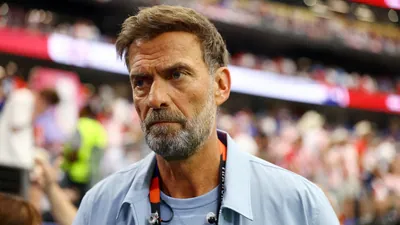
German football may be standing at one of the most important crossroads in its modern history. Following another disappointing FIFA World Cup campaign, the German Football Association (DFB) has turned its attention toward one of the country’s most respected football minds: Jurgen Klopp.
The former Liverpool and Borussia Dortmund manager has confirmed that discussions regarding the Germany national team job are expected to take place following Julian Nagelsmann‘s departure. While no agreement has been finalized, the possibility of Klopp taking charge has already sparked excitement among supporters and analysts who believe German football needs far more than a simple coaching change.
The situation raises several important questions: Why has Germany struggled since winning the World Cup in 2014? What makes Klopp the leading candidate? Can one manager truly rebuild a football giant? And what would a Klopp-led Germany look like heading toward the next major international tournaments?
This potential appointment is about far more than replacing a coach. It could represent the beginning of a complete cultural and tactical reset for one of football’s most successful nations.
Germany’s World Cup Struggles Have Become a Long-Term Problem
For decades, Germany was considered the benchmark for consistency in international football. Whether playing brilliantly or grinding out results, the four-time world champions almost always found a way to compete for trophies.
That reputation has gradually faded over the last decade.
After lifting the FIFA World Cup trophy in 2014, Germany’s performances at major tournaments have fallen well below expectations. Early exits, tactical uncertainty, inconsistent player development, and an inability to adapt to changing football trends have contributed to a prolonged decline.
| Tournament | Germany’s Performance |
|---|---|
| FIFA World Cup 2014 | Champions |
| FIFA World Cup 2018 | Group Stage Exit |
| UEFA Euro 2020 | Round of 16 |
| FIFA World Cup 2022 | Group Stage Exit |
| UEFA Euro 2024 | Quarterfinals |
| FIFA World Cup 2026 | Round of 32 Exit |
Such results would be disappointing for any major football nation, but for Germany they represent a dramatic fall from the standards established over generations.
The latest World Cup elimination intensified calls for structural reform rather than another short-term managerial solution.
Why Jurgen Klopp Has Become Germany’s Preferred Choice
Few coaches possess a resume as impressive as Klopp’s.
Throughout his managerial career, he has consistently transformed teams by creating strong identities, developing players, and building winning cultures.
His achievements include:
- Reviving Borussia Dortmund and challenging Bayern Munich’s dominance.
- Winning multiple Bundesliga titles.
- Leading Dortmund to a UEFA Champions League final.
- Transforming Liverpool into Premier League and Champions League winners.
- Developing young talent while maintaining elite competitiveness.
- Creating some of the most recognizable tactical systems in modern football.
Unlike many coaches who rely heavily on expensive transfers, Klopp has built a reputation for maximizing existing talent and creating cohesive team structures.
This ability could prove particularly valuable for Germany, which possesses considerable talent but has struggled to translate individual quality into collective success.
The Klopp Philosophy: More Than Just High Pressing Football
Many football fans associate Klopp primarily with aggressive pressing and high-energy football.
While that reputation is deserved, his success goes much deeper.
Klopp’s teams are built around several core principles:
- Collective responsibility
- Fast transitions
- Strong team culture
- Mental resilience
- Player development
- Tactical adaptability
His greatest strength may not be tactical innovation alone but his ability to create belief within a squad.
At both Borussia Dortmund and Liverpool, Klopp inherited teams that were not considered the strongest in Europe. Yet through leadership, motivation, and tactical clarity, he turned them into genuine contenders.
Germany’s national team currently appears to need exactly that type of transformation.
The Bigger Issue: Germany’s Problems Extend Beyond Coaching
One of Klopp’s most revealing comments was his suggestion that Germany’s challenges are not solely connected to Julian Nagelsmann.
That observation highlights a reality many experts have discussed for years.
Germany’s recent struggles stem from several interconnected issues:
1. Talent Development Challenges
German academies continue producing technically gifted players, but critics argue that creativity and individual flair have sometimes been sacrificed in favor of structured systems.
2. Tactical Evolution Across Europe
International football has evolved rapidly. Nations once considered underdogs now possess advanced coaching structures and sophisticated tactical approaches.
Germany can no longer rely on historical prestige alone.
3. Leadership Transition
The generation that won the 2014 World Cup featured influential figures such as experienced defenders, midfield controllers, and elite leaders.
Replacing such personalities has proven difficult.
4. Identity Crisis
Perhaps most importantly, Germany has struggled to define its football identity in the post-2014 era.
Klopp’s appointment could help restore a clear direction.
How Klopp Could Reshape the German National Team
If Klopp ultimately accepts the role, several immediate changes could follow.
A Clear Tactical Identity
One criticism of recent Germany teams has been inconsistency in style and approach.
Klopp typically establishes a recognizable identity quickly, giving players clear responsibilities and expectations.
Greater Intensity
German football has traditionally been associated with energy, discipline, and relentless work rate.
Klopp’s philosophy naturally aligns with those values.
Stronger Team Chemistry
National teams spend limited time together compared to club sides.
Klopp’s communication skills and motivational abilities could help create unity faster than many coaches.
Youth Integration
Throughout his career, Klopp has shown a willingness to trust young players.
Germany’s next generation could benefit significantly from that approach.
What Happens With Red Bull?
One of the biggest obstacles remains Klopp’s current position as Red Bull’s global head of soccer.
The role gives him significant influence across the company’s football operations and represents a major professional commitment.
Any agreement with Germany would likely require extensive negotiations involving both parties.
The situation creates an unusual dynamic because Klopp is not currently unemployed, meaning the DFB must convince all stakeholders that the move benefits everyone involved.
This factor could determine how quickly discussions progress.
Comparing Klopp to Germany’s Recent Coaches
Germany’s recent managers have all brought different strengths, but Klopp offers a distinctive profile.
| Coach | Key Strength | Primary Challenge |
|---|---|---|
| Joachim Low | Long-term continuity | Difficulty refreshing the squad |
| Hansi Flick | Tactical experience | Inconsistent tournament results |
| Julian Nagelsmann | Innovation and modern tactics | Limited success at major tournaments |
| Jurgen Klopp | Culture building and transformation | Would need structural support |
Unlike his predecessors, Klopp’s biggest asset may be his ability to lead organizational change rather than simply coach matches.
Why German Football Fans Are Excited
Klopp remains one of the most admired figures in German football.
His charisma, authenticity, and proven success make him uniquely capable of reconnecting supporters with the national team.
At a time when fan frustration has increased due to repeated tournament disappointments, his arrival could generate renewed optimism.
Beyond results, supporters want a team that reflects passion, ambition, and a clear identity.
Those qualities have defined Klopp’s career.
The Financial and Sporting Stakes Are Enormous
Success in international football extends beyond trophies.
Strong national team performances influence:
- Commercial partnerships
- Youth participation rates
- League popularity
- Global football reputation
- Player market value
- Fan engagement
Germany remains one of football’s most influential nations, but prolonged underperformance risks weakening that position.
The DFB’s pursuit of Klopp demonstrates recognition that restoring competitiveness requires bold decisions.
A Potential Blueprint for the Future
If Klopp takes charge, his impact may extend beyond the senior national team.
Many observers expect discussions to include broader topics such as coaching education, youth development pathways, talent identification, and long-term football planning.
This could ultimately become the most important aspect of his tenure.
Rather than focusing solely on qualifying campaigns and tournament preparation, Germany may seek a complete football strategy designed to compete with emerging powers over the next decade.
That broader vision aligns closely with Klopp’s comments regarding the need for fundamental change.
Prediction: Why This Could Become One of Football’s Most Important Appointments
Managerial appointments often generate excitement, but few carry the significance of this potential partnership.
Germany is not simply searching for a coach. The country is searching for a renewed football identity.
Klopp’s track record suggests he thrives in precisely these situations.
If negotiations succeed and structural support follows, Germany could become one of the most dangerous teams in international football again by the next major tournament cycle.
However, success will depend on whether the federation embraces the deeper reforms Klopp appears to believe are necessary.
Conclusion
The possibility of Jurgen Klopp becoming Germany’s next national team manager represents far more than a high-profile coaching appointment. It symbolizes an opportunity for one of football’s greatest nations to confront years of underachievement and begin a genuine rebuilding process.
Germany’s struggles since winning the 2014 World Cup have exposed issues that extend beyond tactics and personnel. The challenge now is restoring confidence, identity, and long-term competitiveness.
Klopp’s leadership, experience, and proven ability to transform organizations make him a logical candidate for such a task. Whether negotiations ultimately lead to an agreement remains uncertain, but one thing is clear: German football has reached a decisive moment.
If Klopp accepts the challenge and receives the support required to implement meaningful change, the next chapter of German football could become one of the sport’s most fascinating comeback stories.
For breaking news and live news updates, like us on Facebook or follow us on Twitter and Instagram. Read more on Latest Sports on thefoxdaily.com.





COMMENTS 0