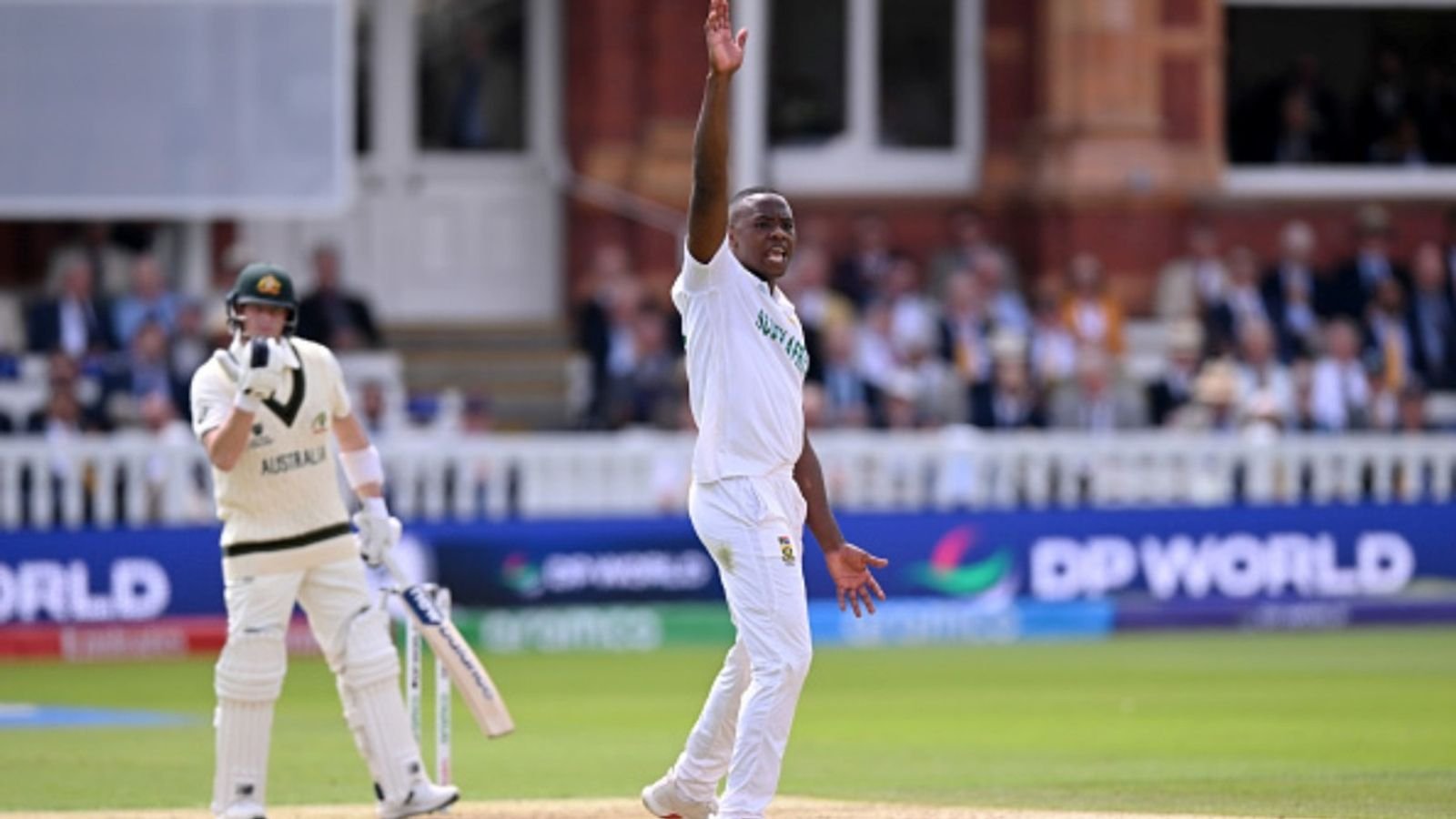
Kagiso Rabada injury concerns have become a major talking point for South Africa ahead of their three-Test home series against Australia, scheduled to begin on October 9 in Durban. The fast bowler is reportedly facing a lengthy recovery after suffering a grade-three tear to his right hamstring during training earlier this month.
According to a report by Rapport, former South Africa fast bowler and current Lions fast-bowling coach Allan Donald indicated that Rabada could be sidelined for nine or ten weeks. Cricket South Africa has not yet officially confirmed the full extent of the injury, with a detailed medical assessment expected to determine the final timeline.
The potential absence comes at an especially difficult time for the Proteas. South Africa are the reigning World Test Championship winners and currently sit second in the WTC standings, while Australia occupy top spot. The upcoming series is therefore not merely a prestigious home contest; it could have significant consequences for the next phase of the WTC cycle.
Why Kagiso Rabada’s injury is such a major problem for South Africa
South Africa have several quality fast bowlers available, but replacing Rabada is not simply a matter of selecting another player with a similar pace profile.
Rabada provides experience, wicket-taking ability, control and the capacity to deliver breakthroughs against established batters. His importance becomes even greater against Australia, a team packed with experienced Test batters and accustomed to dealing with high-quality pace.
The numbers underline the scale of the potential loss. Rabada has taken 164 wickets in 36 World Test Championship matches at an average of 22.31, including seven five-wicket hauls. That makes him South Africa’s leading wicket-taker in WTC history.
His record against Australia is even more striking. Rabada has claimed 58 wickets in 11 Tests against Australia at an average of 21.39, with four five-wicket hauls. Only Dale Steyn and Hugh Tayfield have taken more Test wickets for South Africa against Australia.
Rabada’s record against Australia makes the timing worse
The potential absence is particularly damaging because Rabada has repeatedly been effective against Australia.
| Rabada’s Test Record | Figures |
|---|---|
| WTC wickets | 164 |
| WTC Tests | 36 |
| WTC bowling average | 22.31 |
| WTC five-wicket hauls | 7 |
| Wickets vs Australia | 58 |
| Tests vs Australia | 11 |
| Average vs Australia | 21.39 |
| Five-wicket hauls vs Australia | 4 |
These figures explain why this injury could alter South Africa’s plans significantly. Against an Australian batting lineup, South Africa need bowlers capable of creating wickets without requiring perfect conditions. Rabada has repeatedly demonstrated that ability.
His absence would therefore affect more than the bowling department. It could change how captain Temba Bavuma manages his attack, how aggressively South Africa use their new-ball bowlers and how much workload falls on their other frontline pacers.
What exactly is the injury situation?
Rabada sustained a right hamstring injury during training earlier this month. The reported diagnosis is a grade-three tear, which would normally represent a serious muscle injury requiring an extended rehabilitation period.
Allan Donald reportedly indicated that Rabada could be unavailable for nine or ten weeks. With the Australia series beginning on October 9, that timeline places his participation under considerable pressure.
However, it is important to distinguish between a reported recovery estimate and an officially confirmed return date. Cricket South Africa had not publicly confirmed Rabada’s final availability at the time of the report, and rehabilitation timelines can change depending on medical assessments and the player’s progress.
For South Africa, the sensible approach will be to avoid rushing their premier fast bowler back simply because the opposition is Australia. A hamstring problem can become more complicated if a player returns before being fully prepared for the demands of Test Cricket.
South Africa already have several replacement options
The Proteas are fortunate in one respect: their fast-bowling resources are deeper than they were in previous generations.
If Rabada is unavailable, Lungi Ngidi is likely to carry a major share of the responsibility. Marco Jansen offers another important pace option while also contributing as a batting all-rounder.
Corbin Bosch gives South Africa another pace-bowling all-rounder, while Dane Paterson provides experience and control. Wiaan Mulder and Kwena Maphaka are additional options who could enter the selection discussion depending on conditions, workload and team balance.
The potential return of Anrich Nortje adds another intriguing possibility. Nortje has recently returned to competitive cricket in the European T20 Premier League and has the pace to create problems for Australia. However, he has not played Test cricket since 2023, so his readiness for the longest format would need to be assessed carefully.
Who could lead South Africa’s attack without Rabada?
The most logical approach could be to distribute Rabada’s responsibilities rather than expecting one bowler to replace everything he provides.
Lungi Ngidi
Ngidi could become one of the leaders of the attack. His experience in international cricket makes him an obvious candidate to take greater responsibility with the new ball and in crucial phases of an innings.
Marco Jansen
Jansen could become even more important because he provides value in both departments. His height and left-arm angle give South Africa variety, while his batting can strengthen the lower middle order.
Corbin Bosch
Bosch offers balance as a pace-bowling all-rounder. If South Africa want additional batting depth, his presence could become particularly useful in a three-Test series.
Anrich Nortje
Nortje is the wildcard. If he is considered ready for Test cricket, his pace could provide South Africa with a different dimension. However, returning to Test cricket after a long absence is very different from playing shorter-format matches.
South Africa’s biggest selection dilemma may be balance
Rabada’s absence could force South Africa to rethink their ideal combination.
When a team loses its premier fast bowler, selectors can respond by simply adding another seamer. But that can create problems elsewhere, especially if the replacement does not provide Rabada’s workload or control.
South Africa could instead choose a combination involving three specialist quicks plus an all-rounder, allowing the captain to spread the workload. Another possibility would be to strengthen the batting and rely on a smaller group of frontline bowlers.
The right answer will depend heavily on pitch conditions in Durban and the venues that follow. A green surface could encourage South Africa to select extra pace, while flatter conditions may increase the importance of bowling depth.
Why the Australia series matters in the World Test Championship
The timing of the series gives Rabada’s injury an importance beyond a single bilateral contest.
South Africa currently sit second in the WTC standings with three wins from four Tests. They drew their Test series in Pakistan 1-1 before recording a historic series victory over India.
Australia are currently at the top with eight wins from 10 Tests. Their campaign also included a setback in Darwin against Bangladesh, but they recovered strongly.
| Team | WTC Position | Recent Record Mentioned |
|---|---|---|
| Australia | 1st | 8 wins from 10 Tests |
| South Africa | 2nd | 3 wins from 4 Tests |
A strong home series could therefore help South Africa consolidate their position near the top of the championship table. Conversely, losing a key player before facing the current table leaders could make an already demanding assignment even harder.
South Africa cannot afford to become overly dependent on Rabada
There is an important lesson hidden inside this injury setback: championship teams need depth.
Rabada is arguably the centrepiece of South Africa’s Test bowling attack, but the Proteas have invested heavily in developing a group of fast bowlers capable of operating at international level.
The Australia series will provide a genuine test of that depth. If Ngidi, Jansen, Bosch, Paterson or another replacement can take responsibility, South Africa could discover that their attack is more flexible than expected.
That does not make Rabada’s absence insignificant. Instead, it creates an opportunity for the next generation of South African bowlers to prove that the team can compete at the highest level without relying on one superstar.
The workload question could become decisive
Test cricket places enormous demands on fast bowlers. A bowler may need to deliver long spells, recover quickly and repeat high-intensity actions across several days.
That makes South Africa’s management of their bowling resources particularly important if Rabada is unavailable.
The team could rotate workloads more aggressively, use all-rounders for short spells and avoid overusing one bowler simply because the match situation demands wickets. The objective should be to maintain intensity throughout five days rather than producing one spectacular spell and exhausting the attack.
This could also influence fielding strategy. A captain may prefer more attacking fields when a fresh bowler is operating but become more conservative when protecting a tiring seamer.
Could Rabada’s absence change the series itself?
It is too early to predict the outcome of the Australia series, but Rabada’s availability could influence the tactical shape of the contest.
Australia would know that South Africa have lost their leading WTC wicket-taker if Rabada is ruled out. That could encourage Australian batters to adopt a different approach during the early stages of innings, particularly if South Africa lack an equivalent threat from the opposite end.
South Africa, on the other hand, may attempt to compensate through collective pressure. Instead of searching for one bowler to produce Rabada-like spells, they could attack in partnerships and use different angles to prevent Australian batters from settling.
That is potentially the most important tactical adjustment: replacing a superstar with a system rather than with a single individual.
Timeline: From injury concern to the Australia series
- Earlier in August 2026: Kagiso Rabada suffered a right hamstring injury during training.
- August 30: Reports emerged suggesting a grade-three tear could keep him sidelined for nine or ten weeks.
- September 10: Rabada is expected to miss the Lions’ first game of the domestic season because of his injury.
- October 9: South Africa are scheduled to begin their three-Test home series against Australia in Durban.
The timeline explains why South Africa face a race against time. Even if Rabada progresses well through rehabilitation, returning directly into a Test series without sufficient match preparation would carry its own risks.
What should South Africa prioritise?
The first priority should be Rabada’s complete recovery rather than forcing an early comeback.
The second should be establishing a clear alternative bowling combination before the Australia series begins. South Africa cannot afford to wait until the first Test to decide who will take responsibility for the attack.
Finally, the Proteas need to maximise the value of their all-rounders. Players such as Jansen, Bosch and Mulder could become especially important because they allow the team to maintain bowling depth without weakening the batting lineup.
The bigger picture for South Africa
South Africa have entered a strong period in Test cricket, highlighted by their WTC title and their position near the top of the current standings. The Australia series represents another opportunity to establish themselves as a consistent force in the format.
Rabada’s injury threatens to complicate that progress, but it does not eliminate South Africa’s chances. Their bowling resources give them several possible combinations, and home conditions could provide an additional advantage.
The biggest uncertainty is whether those alternatives can reproduce the pressure Rabada normally creates. Numbers suggest that replacing his wicket-taking record will be extremely difficult. The solution will therefore have to come from collective performance.
Conclusion: Rabada’s fitness could be one of the series’ biggest storylines
Kagiso Rabada’s injury has created a serious concern for South Africa ahead of their three-Test home series against Australia. A reported grade-three right hamstring tear and a possible nine-to-ten-week recovery period could leave the Proteas without their most successful WTC bowler.
The timing could hardly be more significant. South Africa are second in the WTC standings, Australia are first, and the series begins on October 9 in Durban. Rabada also owns an outstanding record against Australia, making his potential absence especially costly.
Yet South Africa do have options. Ngidi, Jansen, Bosch, Paterson, Maphaka and potentially Nortje give the selectors several routes to rebuild the attack.
The key will be resisting the temptation to search for a direct replacement for Rabada. No single bowler is likely to replicate everything he provides. Instead, South Africa may need a collective solution built around pace, variety, workload management and disciplined partnerships.
If Rabada returns in time and is fully fit, South Africa will regain one of the most dangerous fast bowlers in Test cricket. If he misses the series, the Australia Tests could become the ultimate examination of whether the reigning WTC champions have enough bowling depth to remain among the world’s leading Test teams.
For breaking news and live news updates, like us on Facebook or follow us on Twitter and Instagram. Read more on Latest Cricket on thefoxdaily.com.






COMMENTS 0