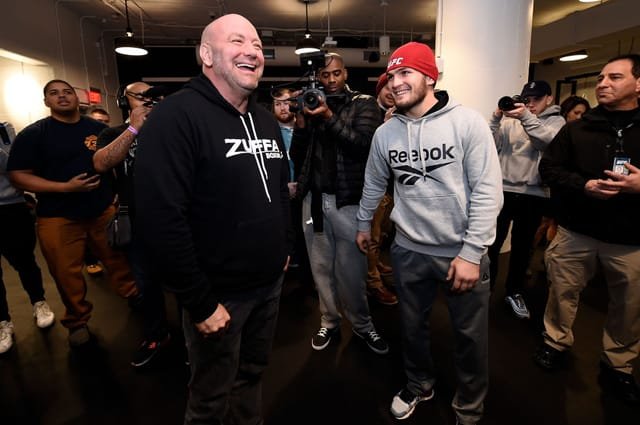
Khabib Nurmagomedov has offered a fascinating explanation for the UFC’s extraordinary rise, crediting Dana White’s business mentality and uncompromising decision-making for helping transform the promotion into the biggest organization in mixed martial arts.
The former UFC lightweight champion discussed White’s leadership while appearing on the Lex Fridman Podcast. Reflecting on his own experience of running Eagle FC, Nurmagomedov explained that managing a combat-sports promotion is considerably more complicated than simply putting together fights.
His comments focused on one central idea: White has been able to separate personal relationships from business decisions. According to Nurmagomedov, that distinction allowed the UFC president to make difficult choices even when those decisions were unpopular.
The discussion is particularly interesting because Nurmagomedov has experienced the UFC from both sides. He spent years competing inside the organization before eventually becoming involved in promoting MMA himself. That perspective gives his assessment of White’s leadership unusual weight.
Khabib identifies Dana White’s biggest business strength
According to Nurmagomedov, one of White’s most important qualities is his ability to separate business from personal relationships.
“He’s very good at separating business from personal relationships.”
That approach can be especially important in combat sports, where promoters frequently work with athletes, coaches, managers, broadcasters and other personalities who develop strong personal relationships with the organization.
Nurmagomedov believes White maintained a clear distinction between those relationships and the decisions required to grow the UFC.
From a business perspective, that can allow a promoter to make decisions based on the long-term interests of the company rather than short-term emotions. In a sport where fighters can become extremely popular with fans, maintaining that separation can be difficult.
Nurmagomedov specifically highlighted White’s willingness to make major decisions regardless of whether everyone involved agreed with them.
Why Nurmagomedov called White “cold-blooded” in business
Nurmagomedov used particularly strong language when describing White’s approach to business. He said the UFC executive could be extremely cold-blooded when making decisions.
The point was not necessarily that White lacks personal relationships. Instead, Nurmagomedov was describing the ability to put the interests of the promotion ahead of individual preferences when important decisions have to be made.
That mentality can be valuable in professional sports because growth often requires decisions that will not satisfy everyone.
For a promotion such as the UFC, those decisions can involve matchmaking, contracts, event locations, media strategy, broadcasting arrangements and the broader commercial direction of the company.
Nurmagomedov’s argument is that White consistently prioritized the UFC’s long-term interests when those difficult choices arose.
“The UFC always came first”
One of the strongest points made by Nurmagomedov was his description of White’s priorities.
He compared White’s mentality to the familiar idea from mafia movies that family always comes first, before jokingly applying the concept to the UFC instead.
For White, according to Nurmagomedov, the UFC itself always came first.
That philosophy is significant because the promotion has undergone enormous changes over several decades. The UFC evolved from a controversial combat-sports product into a globally recognized sports organization with a massive international audience.
Such growth requires a consistent focus on the brand. Individual fighters may come and go, champions change and rival promotions emerge, but the promotion itself has to remain the central product.
The UFC’s success was not built by Dana White alone
Although Nurmagomedov placed major emphasis on White, he was careful not to suggest that one person built the UFC without assistance.
He specifically acknowledged the contributions of people such as Bruce Buffer and Joe Rogan, as well as commentators and other figures who helped create the distinctive UFC presentation.
This is an important distinction. The success of a major sports organization is rarely the result of one executive alone.
Fighters create the sporting product. Coaches and teams help develop athletes. Commentators help explain the action. Production teams create the television experience. Broadcasters distribute the product, while marketing teams turn individual personalities and fights into major events.
Nurmagomedov’s argument is that White was the person who ultimately made many of the major strategic decisions that brought those elements together.
Why UFC became more than just another MMA promotion
The UFC’s biggest achievement has been its ability to turn MMA into a recognizable global sports product.
MMA existed long before the UFC became dominant, with fighters and promotions competing in different markets around the world. The UFC’s growth helped create a centralized brand that casual sports fans could recognize.
That brand-building process required more than simply booking good fights.
The UFC developed recognizable championships, rankings, event branding, broadcast personalities, promotional campaigns and fighter-driven storylines. Over time, major UFC events became entertainment properties as well as sporting competitions.
This combination helped the organization expand beyond its original niche.
Khabib’s Eagle FC experience gives his comments added context
Nurmagomedov’s comments are particularly noteworthy because he has experience on the promotional side himself.
His involvement with Eagle FC gave him a different perspective on what happens behind the scenes. Running a promotion requires dealing with fighters, venues, broadcasting, matchmaking, finances and audience expectations simultaneously.
That experience likely influenced his appreciation of the difficulty involved in building a major MMA organization.
It is one thing to understand the UFC as a fighter. It is another to attempt to operate a promotion and discover how many moving parts are involved in producing successful events.
Nurmagomedov’s perspective therefore comes from someone who understands both the athlete’s side and some of the promoter’s responsibilities.
What makes UFC’s business model different?
The UFC’s modern success can be understood through several interconnected areas rather than one single factor.
| Area | Why it matters |
|---|---|
| Fighter development | Creates a steady pipeline of athletes who can eventually become contenders and champions. |
| Event promotion | Turns individual fights into major sporting occasions that attract global attention. |
| Broadcasting | Allows UFC events and personalities to reach audiences across multiple markets. |
| Brand identity | Creates consistency across championships, events, production and promotional material. |
| Star power | Popular fighters give casual audiences reasons to follow individual events. |
The strength of this model is that these elements reinforce each other. Successful fighters increase interest in events, major events increase exposure, and increased exposure can create new stars.
Why the UFC’s global expansion is significant
Nurmagomedov pointed to the speed of the UFC’s growth when comparing its development with the history of traditional sports.
His broader point was that MMA reached a remarkable level of international recognition within a comparatively short period.
Traditional sports such as football, cricket and baseball have developed through long histories, established competitions and generations of fan culture. MMA, by comparison, has had to overcome questions about regulation, safety, sporting legitimacy and public perception.
The UFC played a major role in changing that perception by operating under standardized rules and positioning MMA as a professional sport rather than simply a spectacle.
From controversial beginnings to global sports brand
The UFC’s early years were significantly different from the modern organization. MMA faced resistance in several markets, including concerns about safety and the lack of regulation.
As regulatory structures developed and the sport adopted more standardized rules, MMA became easier to present as a legitimate competitive discipline.
The UFC benefited from that evolution and increasingly positioned itself alongside mainstream professional sports.
That transition is part of the larger story behind Nurmagomedov’s praise for White. The UFC’s commercial growth was not simply about making more fights. It required changing how audiences, broadcasters and sporting institutions viewed MMA.
Khabib’s own UFC legacy makes the discussion even more interesting
Nurmagomedov’s relationship with the UFC is complicated by the fact that he was one of the organization’s biggest stars.
He retired with a perfect professional record of 29-0 after successfully defending his UFC lightweight championship. His final fight came against Justin Gaethje at UFC 254.
Nurmagomedov’s decision to retire immediately after defeating Gaethje shocked the MMA world. He left the sport without suffering a professional defeat and became one of the most influential fighters of his generation.
His comments about White therefore come from someone who experienced the organization’s championship environment at the highest possible level.
Why Dana White does not consider Khabib the MMA GOAT
There is an interesting contrast between Nurmagomedov’s praise of White and White’s previous assessment of Nurmagomedov’s own legacy.
During an earlier appearance on the Lex Fridman Podcast, White explained why he did not place Nurmagomedov at the very top of his personal MMA GOAT list.
White acknowledged that Nurmagomedov had the ability to be part of the GOAT conversation but argued that his career did not last long enough at the highest level.
That argument highlights one of the most common debates in MMA: should greatness be measured by peak dominance or by longevity?
Peak dominance versus longevity in the MMA GOAT debate
Nurmagomedov’s career is an excellent example of the difficulty involved in comparing fighters from different eras.
His unbeaten 29-0 record and dominant lightweight championship run provide a compelling case based on peak performance.
However, GOAT discussions often consider additional factors, including the number of elite opponents defeated, championship defenses, length of time at the top and performance across different stages of a career.
That is where Nurmagomedov’s relatively short championship reign compared with some other legendary fighters becomes part of the discussion.
White’s position does not diminish Nurmagomedov’s accomplishments. Instead, it demonstrates how difficult it is to establish one universal standard for MMA greatness.
The bigger lesson from Khabib’s assessment of Dana White
The most interesting part of Nurmagomedov’s comments is that he did not reduce the UFC’s success to one promotional trick.
Instead, he focused on leadership philosophy.
His description suggests that White’s willingness to make unpopular decisions was just as important as his ability to promote major fights. In an industry driven by personalities, emotions and competition, separating personal relationships from business decisions can help an organization maintain a consistent direction.
That does not mean every decision made by White has been universally accepted. The history of the UFC contains plenty of controversies and disagreements involving fighters and fans.
Nurmagomedov’s point is more fundamental: a major sports organization cannot grow if its leadership is afraid to make difficult decisions.
What the UFC’s future could look like
The UFC has already established itself as the leading global MMA promotion, but maintaining that position presents a different challenge from achieving it in the first place.
The organization must continue developing new stars while keeping established champions relevant. It must also balance sporting merit with entertainment value, manage the expectations of fighters and maintain its appeal to international audiences.
The next generation of UFC stars will therefore play a major role in determining whether the organization can continue its extraordinary growth.
Nurmagomedov’s comments suggest that the leadership philosophy he attributes to White could remain important as the promotion enters its next stage.
Conclusion: Khabib credits Dana White for UFC’s transformation
Khabib Nurmagomedov’s assessment of Dana White provides an unusual look at the qualities he believes helped transform the UFC into the world’s leading MMA promotion.
According to Nurmagomedov, White’s ability to separate business from personal relationships, make difficult decisions and consistently prioritize the UFC helped create the foundation for its long-term success.
Nurmagomedov also acknowledged that the UFC’s rise was a collective effort involving fighters, commentators, broadcasters and many other contributors. However, he viewed White as the person responsible for making the biggest strategic decisions.
The comments are particularly notable because Nurmagomedov understands the UFC from both sides of the business. He was once one of its biggest champions and later gained experience running his own MMA promotion.
At the same time, the discussion about White’s assessment of Nurmagomedov’s GOAT credentials highlights the complexity of MMA legacy debates. An undefeated record and extraordinary dominance can create an elite legacy, while longevity provides another important measure of greatness.
Ultimately, Nurmagomedov’s message about White is simple: building a global sports organization requires difficult decisions, long-term vision and a willingness to put the health of the promotion above personal relationships.
For breaking news and live news updates, like us on Facebook or follow us on Twitter and Instagram. Read more on Latest MMA on thefoxdaily.com.






COMMENTS 0